
One Of Italy's Largest Artificial Lakes Is A Scenic Wetland Escape With Fishing, Wildlife, And Countryside Views
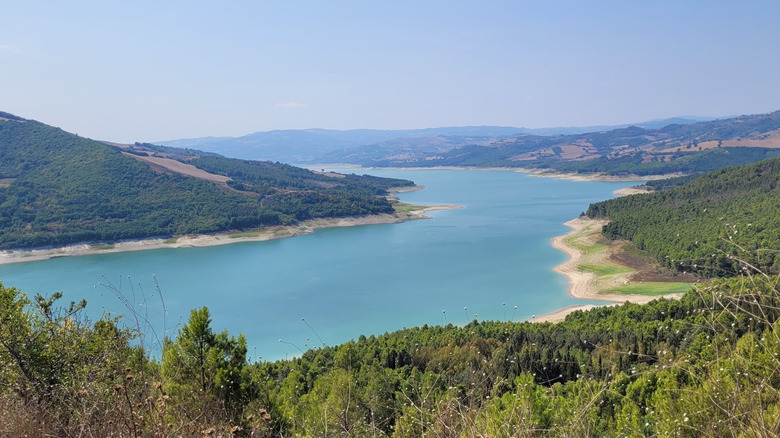
Italy's northern waterside escapes are well-trodden territory — the glamorous shores of Lake Como or the Alps-ringed Lake Garda might come to mind. But one of the country's largest artificial lakes lies in the southern half of Italy, between rolling farmland and wooded hills topped by medieval towns. Spanning the border between the Puglia and Molise regions, Lago di Occhito ("Occhito Lake") is about 7.5 miles long and holds 250 million cubic meters of water. Sardinia's Lake Omodeo may be larger, but Occhito is the largest reservoir by volume you'll find on the Italian mainland. Its backdrop is the Fortore Valley, a rural swath dotted with vineyards and green hills, and traced by the Fortore River — which was dammed to create the lake.
Anglers come to Occhito for freshwater fishing, while walkers, birdwatchers, and photographers can explore the wetland habitat and quiet countryside around the reservoir. For travelers heading to southern Italy, Occhito's location puts it in proximity to the better-known landmarks of Puglia, a region compared to Santorini but with fewer crowds. Meanwhile, it's also within reach of the castle-sprinkled hill towns of neighboring Molise.
Occhito is designated a Natura 2000 site (a conserved nature area) by the European Union's Habitats Directive, serving as a home for several protected species. Its habitats include a mix of wetland, grassland, and forest, which are particularly valuable for birds. Kingfishers, herons, ospreys, and spoonbills are some of the species recorded at the site. At the Occhito Dam, hemming the lake's north side, you might also spot otters along the banks.
Explore Lago di Occhito's shores and hill towns
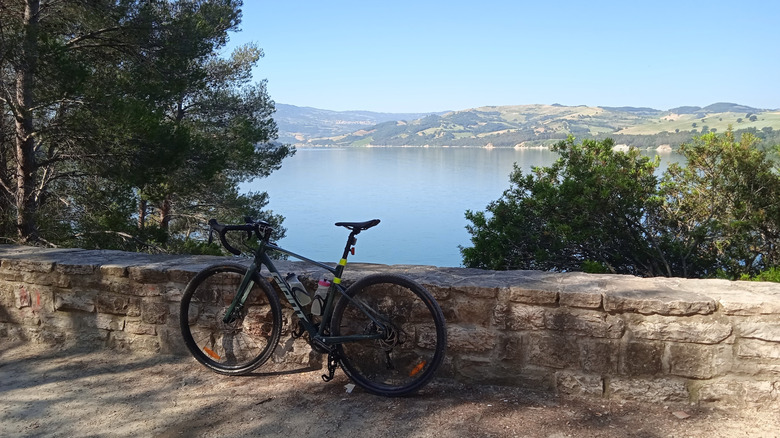
Under Lago di Occhito's surface is a fair share of wildlife, too. Anglers can cast for carp, perch, trout, tench, eel, and catfish, with accessible spots on both the Molise and Puglia sides of the reservoir. Roads and tracks provide access to much of the shoreline, and, on the Puglian side, you can walk or bike along paths around the dam. There's one important catch, however: fishing is permitted only on a no-kill basis. You'll also need a fishing license — the Regione Puglia offers a license for foreigners that's valid for three months.
For travelers who'd rather explore than cast a line, the same shoreline provides paths for walking and cycling. On the Puglian side, the Alcedo Visitor Center at the dam has an interpretive nature trail and picnic area. There's also a longer loop route that begins at the visitor center, following the lakeshore and surrounding countryside with views across the reservoir. "The forest around [Lago di Occhito] is fabulous," wrote one visitor. "Lovely views of the neighbouring towns and orchards."
For some travelers, it might make sense to make Lago di Occhito part of a tour of the tiny hill towns scattered around the Fortore Valley. Some lie within Molise, an unspoiled region known for its food and villages. Macchia Valfortore, for example, sits on Occhito's western slopes amid olive groves and historic buildings like the Gambacorta Baronial Palace — the lakeshore is about a 10-minute drive from the town. Just south of the lake, Gambatesa makes for another historic stop, with the Renaissance-era, richly frescoed Capua Castle. In terms of larger hubs, Occhito is about a 1.5-hour drive from Foggia, an authentic Italian city with agricultural importance.