
This Popular Souvenir Can Be Confiscated By US Customs
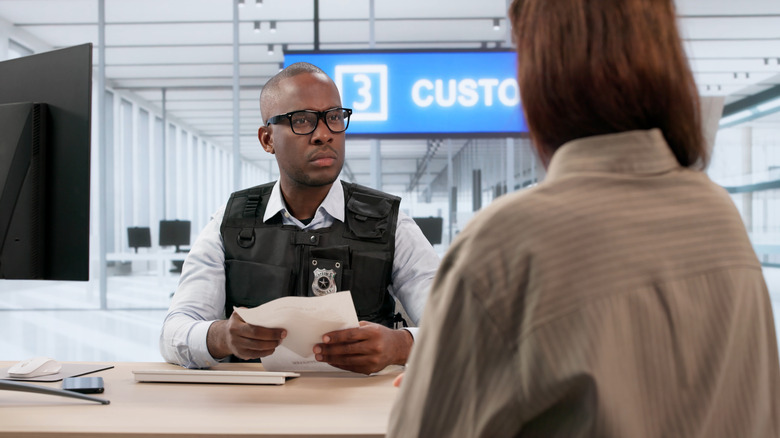
For most globetrotters, bringing home mementos is part of the journey. Whether they're mass-produced magnets or locally crafted art, souvenirs anchor the tourism economy. One popular collectible is food or beverage sourced from one's travel destination, as returning home with flavors from afar can be one of the most meaningful ways to share travel experiences. However, there are rules for bringing consumables into the U.S., and, according to New Hampshire-based travel risk management company Global Rescue, food and alcohol are some of the often-confiscated items along North American borders. One bottled beverage in particular keeps the U.S. Customs and Border Protection (CBP) on high alert: absinthe.
This spirit is a high-proof, bitter-tasting, typically green-colored liquor with fennel, anise, and wormwood making up its core ingredients. While wormwood's medicinal properties were documented early on by the ancient Egyptians (and it was also later used by the ancient Greeks for pain relief), absinthe itself only started being commercially manufactured in 18th-century Switzerland. It later evolved as a recreational drink among Europe's literary set, as "the Green Fairy" was thought to evoke hallucinations that could expand creativity. Its ritualistic drinking process — involving fountains, slotted spoons, and sugar cubes — added to its allure. But beyond hallucinations, overconsumption of the beverage has been blamed for more alarming consequences: psychosis, brain damage, and murderous violence among them. Even van Gogh's infamous mental decline may be at least partially attributed to his absinthe addiction.
In 1908, Switzerland banned absinthe's production, with several other European countries doing so in the same era. The United States followed suit in 1912 and only lifted the ban in 2007. Today, the spirit remains heavily regulated in the U.S. According to CBP, absinthe entering the United States must contain less than 10 parts per million of thujone, the active compound found naturally in wormwood. CBP guidance states that "the term 'absinthe' cannot be the brand name; the term 'absinthe' cannot stand alone on the label; and the artwork and/or graphics cannot project images of hallucinogenic, psychotropic or mind-altering effects," otherwise the bottles are subject to seizure.
Why absinthe was so controversial and how to bring it home
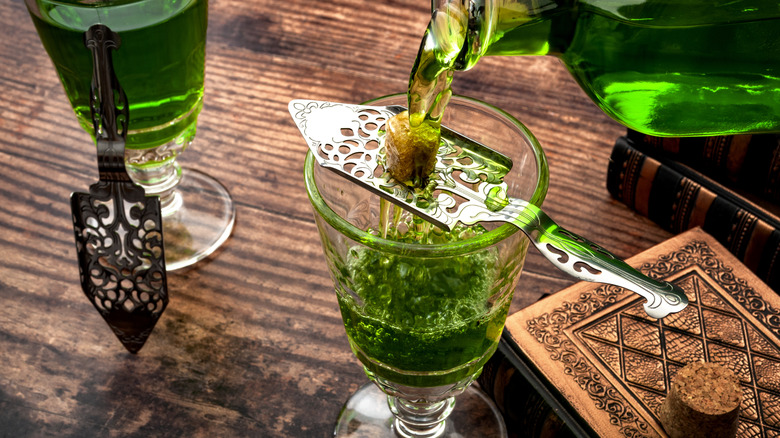
Experts once blamed absinthe's delirium-inducing qualities on wormwood, an ingredient that contains thujone, which is a naturally occurring, potent chemical compound. However, modern science has questioned and debunked archaic studies that claimed wormwood was the sole root of absinthe's toxicity. Rather, toxic additives from shady manufacturers, along with the alcoholism of some of its consumers, likely played a large role in the drink's dangerous reputation.
If anything, the ban on absinthe only added to its mystique. As the Los Angeles Times put it, "The whiff of illegality made absinthe all the more desirable." For nearly a century, smugglers trafficked absinthe into the U.S. and restaurateurs sneaked bottles in through the back door, as The New York Times reported. Bootleggers even altered the distilling process to mask the giveaway green tint. And to this day, although no longer prohibited, bottles of absinthe are still often confiscated by customs officials.
That being said, it is possible to bring home a bottle of the Green Fairy, provided it complies with U.S. legal limits and labeling mandates. Enthusiasts of the spirit have suggested in online discussions that U.S.-approved absinthe tastes just as good as that containing higher amounts of thujone — as long as you choose a quality bottle. But both CBP and the Transportation Security Administration (TSA) are constantly refining their traveler guidelines. For example, in April 2026, TSA quietly updated its marijuana policy after some substances were reclassified. Additionally, restrictions on what can be brought in and out of a destination don't just apply to alcohol and drugs: Beach sand, for instance, is one of the souvenirs that will be confiscated from travelers leaving Hawaii. So whether you're planning to bring home absinthe, consumables, or other souvenirs, know the rules in advance to avoid making a major customs mistake at the airport.