
6 Japanese Hot Springs Rules American Tourists Break Within The First 10 Minutes
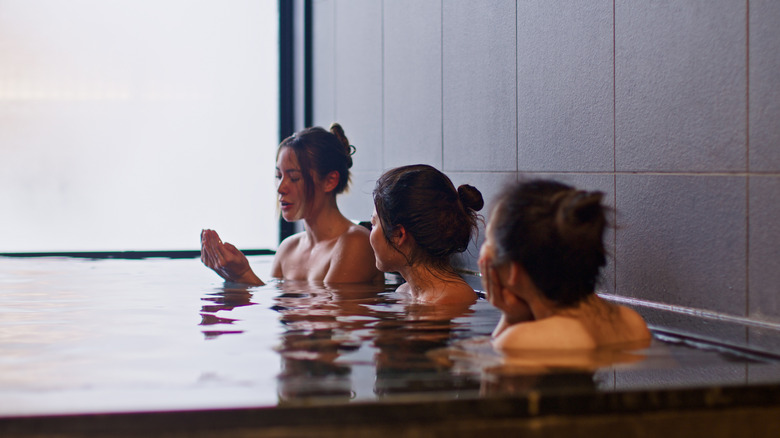
The first time I visited a Japanese hot spring was at a resort near Mount Fuji. Because I was only 15 years old and this trip to Japan marked my first time leaving the U.S., my knowledge of Japanese hot spring etiquette was negligible, to say the least. I wore flip flops in the changing room, struggled not to stare at the people disrobing around me, and wanted to hide when my host mother informed me that I wouldn't be allowed to wear my swimsuit inside the bathing area. When I later lived in Japan as an adult, I knew more about what to expect, but was still surprised to learn that the etiquette rules can vary between hot springs, known as onsen in Japanese.
Japan has about 27,000 natural hot spring sources. But for a hot spring to be considered an onsen, it must meet strict legal requirements, including specific criteria related to water temperature and mineral content. Japan has several types of onsens, including indoor baths, outdoor baths, mixed-gender baths, foot baths, and private baths where you can reserve a room for yourself, your family, or a group of friends. This article will primarily focus on the etiquette rules that surround visiting communal indoor or outdoor onsens, as these are the most common.
Whether you're planning a trip to a Japanese hot spring resort and want to make sure you understand all the rules before you go, or are simply curious about the occasionally embarrassing mistakes Americans can make in rule-centric Japan, below are six common spoken and unspoken rules Americans break when visiting Japan's famous thermal springs, often within minutes of arrival.
Failing to remove your shoes at the entrance
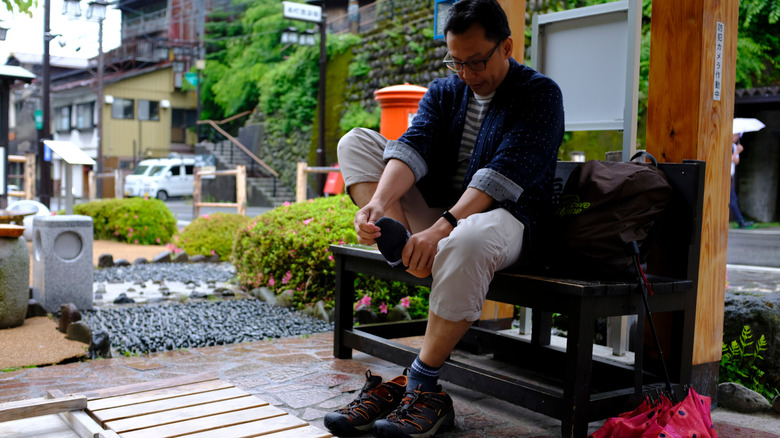
At the entrance of an onsen and outside of the changing rooms, you'll find a shoe cubby or designated area where you'll want to place your shoes. As an American, I was often wary of this. What if someone stole my shoes? But unlike the U.S., Japan is generally safe. In fact, Japan has been crowned as the world's safest for public transportation and an ultimate destination for solo travelers due in part to the low crime rate.
While you may be tempted to carry your loafers or sneakers into the changing room and store them in a locker with your other belongings, don't. Removing your shoes before you enter a home or an area that needs to be kept especially clean, like an onsen, is a rule everyone in Japan is expected to follow, regardless of their own cultural practices or preferences. Outdoor shoes generally aren't allowed in areas where guests walk barefoot or with facility-provided footwear.
Not fully disrobing
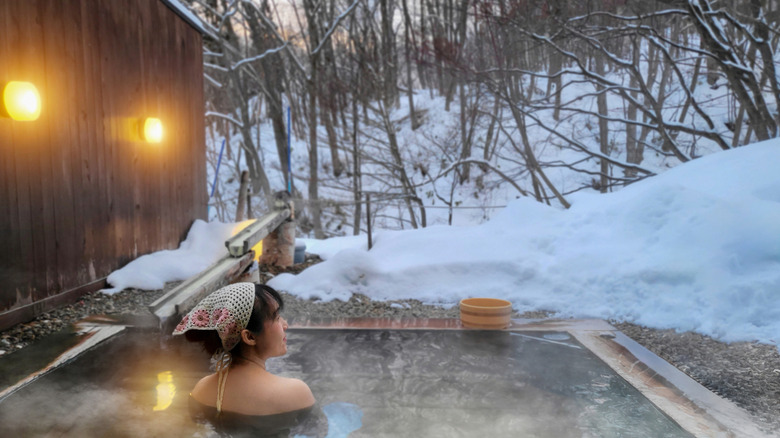
The first time I visited an onsen, I was a 15-year-old exchange student. Unfamiliar with hot spring etiquette, I was shocked to learn that I couldn't wear the bathing suit I'd packed. Self-conscious and insecure, the experience of wandering from bath to bath unclad and in full view of total strangers was deeply embarrassing. Although genders are separated in the changing rooms and generally in the baths themselves, appearing naked around strangers can still be disconcerting for anyone who is shy or unaccustomed to it.
Americans may make the mistake of not fully disrobing and may enter the bathing area still wearing shorts or various undergarments. While you'll likely be able to take in a small towel with you, all articles of clothing will need to be kept in the changing room. While some mixed-gender facilities may have different rules, at most gender-separated communal onsens, you are typically not allowed to wear bathing suits, towels, or clothing into the baths. This is because the fabric can trap detergent residue and micro-debris, causing the water to become unsanitary and forcing the onsen to close the facility, drain, and clean the baths.
Not washing completely
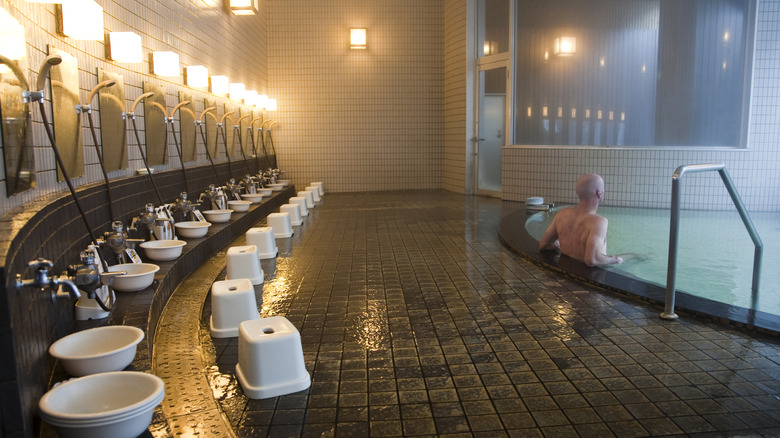
In the U.S., it's common to see posted signs in the locker rooms of spas or public pools requesting that guests please shower prior to entering the water. But this is often more of a polite guideline than a strictly enforced rule. In Japan, failing to wash prior to entering the baths is a major error — and a quick rinse in the shower won't count, either. When visiting an onsen, you'll need to thoroughly wash with soap and water. The first time I visited an onsen as a teenager, I watched in amazement as my host mother completely lathered up in soap and then set to work vigorously scrubbing at every inch of her body with a wash cloth for 10 minutes. I attempted to do the same, feeling awkward as I crouched next to her on the small stool.
An onsen will frequently provide soap, shampoo, and a shower area where you can sit and take your time cleaning. Make sure you thoroughly rinse away all soap, wash off any makeup, and tie long hair back into a ponytail or bun. Also, washing your face or dunking your head in the communal bath water is not allowed.
Not covering up tattoos
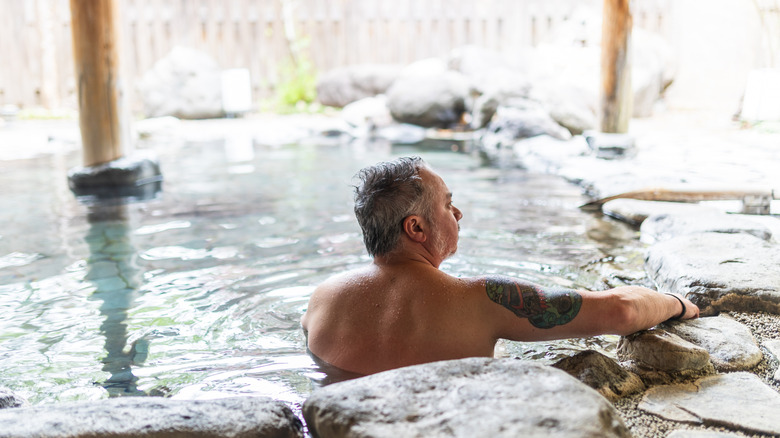
While attitudes have been changing recently, traditionally tourists with tattoos have been banned from entering hot springs in Japan. This is because tattoos have long been associated with the yakuza, Japan's infamous organized crime element. I have a small flower tattoo and once had a parent file a complaint with the head of the school I was teaching at in Japan, questioning whether it was appropriate for a person with a tattoo to be working with children. Although I didn't get in trouble because the school understood the relatively benign nature of tattoos in the U.S., this was a wake-up call. Attitudes toward tattoos may have softened over the decades in Japan, but some still take tattoos and their potential implications seriously.
If you have a tattoo, you'll want to do some research and preparation in advance. Before heading to a hot spring, find out what the onsen's policies are on tattoos in order to save yourself the embarrassment of being turned away at the entrance. Some onsens may prohibit tattoos entirely, while others will allow tattoos so long as they are covered with a waterproof patch. Still others may allow those with tattoos to visit without covering up with patches, but only in private baths. Some facilities may even welcome those with tattoos and not require any special considerations at all. It's helpful to ask ahead of time.
Using the modesty towel incorrectly
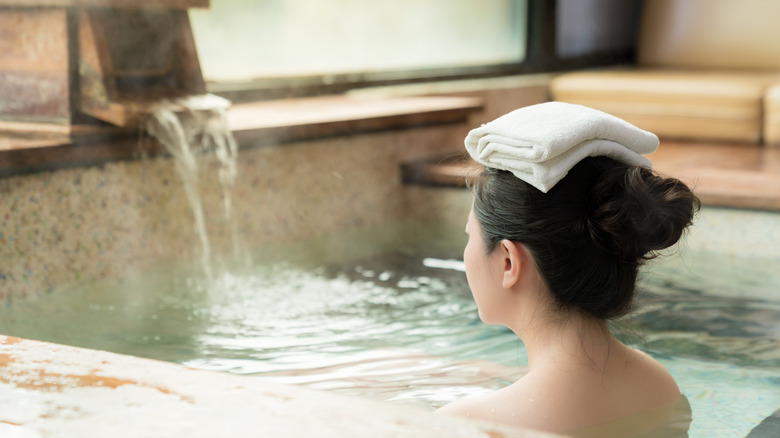
While you can't bring your clothes into the communal bathing areas, the onsens will often provide a small towel, often referred to as a modesty towel, that you can bring in with you. You can hold this towel in front of you to cover yourself while you move around the bathing area, but because this towel is often no bigger than a face towel, this might prove challenging.
It's common to see Japanese bathers wearing the small towel folded neatly on top of their heads while they soak or using it to dab at the sweat on their foreheads. Americans and other foreigners can take this to mean that it's okay to dip the towel in the water. This should not be done, however, as the towel needs to stay out of the water for sanitary reasons. If you don't wish to place the towel on your head, store it neatly on the side of the bath or else forgo the modesty towel altogether.
These are just general guidelines, however. Onsen etiquette regarding modesty towels may vary depending on the type of facility. Pay attention to posted signs and what other guests are doing, as this will clue you in to the appropriate etiquette for that particular onsen. The first time I visited a mixed-gender onsen with a friend, for example, I made the mistake of wandering between several outdoor pools unclad without a towel, only to discover that all of the women in the onsen had covered their bodies with special modesty wraps or bathing garments, even inside the baths. These are called yuami-gi, and some mixed-gender onsens permit this type of coverage or even require it.
Being too loud
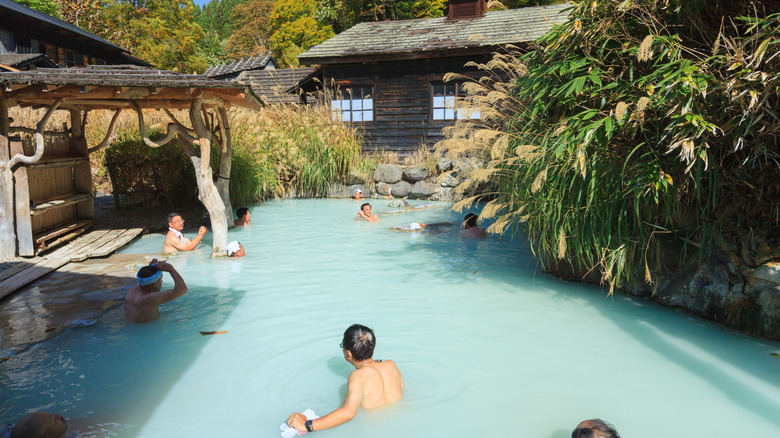
An onsen is a shared space, and like many public spaces in Japan, including trains, the expectation is that you'll keep your voice down and avoid disruptive behavior. An onsen isn't a pool party or an opportunity to stage a social gathering. Unlike in a hot tub at a resort in the United States, where boisterous conversations and even drinking are tolerated, disruptive behaviors in an onsen, such as loud conversations or splashing, are considered rude. You should also refrain from bringing your phone inside the bathing area, as taking pictures or filming inside an onsen when bathers are present is forbidden.
In the end, there's no way to guarantee you won't accidentally embarrass yourself while navigating unfamiliar social norms in a foreign country. But if you're worried about committing a mistake in a Japanese hot spring, simply stay quiet, observe others, and pay attention to posted signs. And if you're still unsure? Find a friendly employee and ask for help.