
7 Japanese Train Etiquette Mistakes Americans Frequently Make
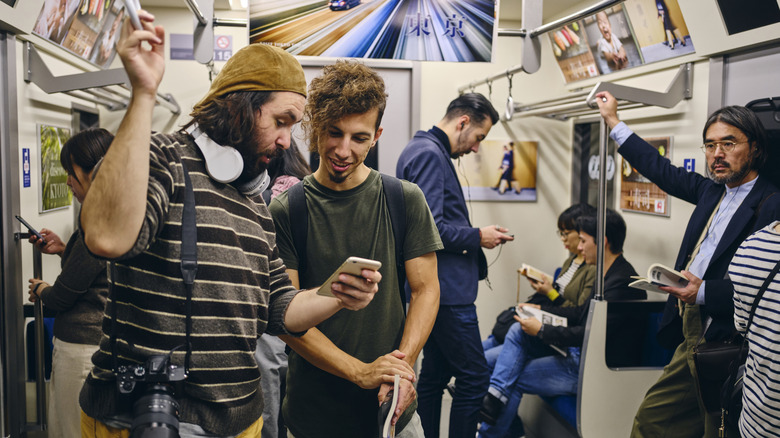
When I first moved to Japan in high school and later again after college, I broke many etiquette rules. This was partly out of ignorance, but also — I'm embarrassed to admit — partly because I thought some of these rules were overly restrictive. Who cared if I put on my makeup while riding the subway? And who would notice if I ate an apple while walking through a crowded Tokyo station? Besides, I was an American. Didn't my status as a foreigner afford me some slack?
But as my Japanese friends were quick to inform me, these etiquette guidelines were far from mere suggestions — they were important rules. And failing to follow them could risk insulting those around me. The last thing I wanted to do was offend anyone, so I squashed my "I'll do what I want!" American mentality and did my best to conform — especially when riding the subway or train, which I did every day for my commute to work.
Japan's train system is internationally known for its cleanliness, efficiency, and punctuality. But what is perhaps less well-known, particularly among Americans, are the social norms that passengers are expected to follow. Some of these are clear thanks to the posted signs. But other expectations may go unspoken, as they are so intrinsically part of Japanese culture that the native-born may not even be aware of them. To the Japanese, lining up single-file on the subway platform or turning phones to silent upon entering a train are just common sense. But for those of us who grew up in a more individualistic society like the United States, these norms may not seem so obvious. Below are seven train etiquette mistakes I made when I first moved to Japan that many other Americans frequently make — and that you can avoid.
Entering and exiting the train incorrectly
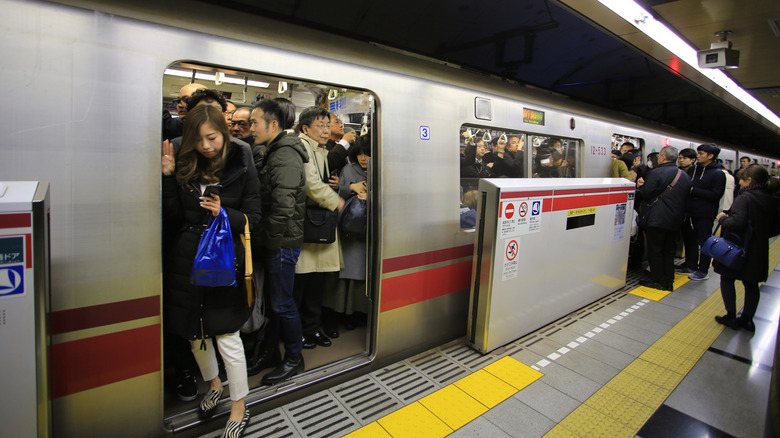
As a former New Yorker, I felt I had a solid grasp on the skills needed to ride a subway during peak times, but I soon found out that Tokyo rush hour is on another level entirely. Japan is home to eight of the 10 busiest train stations on the planet (via World Atlas), and in order to ensure everyone gets where they need to go, commuters are expected to plan ahead, stay aware of those around them, and follow a set of spoken and unspoken guidelines.
While you're waiting to board a subway or train, line up behind the markings on the platform in either a single-file line or two by two. When the train pulls in, allow all the passengers to exit before you board. Once inside, don't stop in the middle or in front of the entrance — keep moving to make way for others behind you. If you must stand near the doors, you'll need to step off the train whenever it pulls up to the station to give passengers the chance to exit and enter the train without having to go around you. Make sure to gather up your belongings before you reach your stop and then move toward the doors so that you'll be ready to exit as soon as they open.
Blocking the flow of traffic
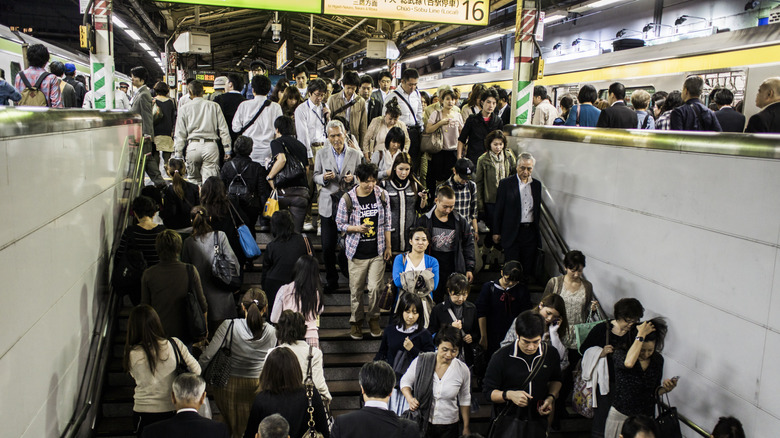
Japanese train stations are massive, and when I first moved to Tokyo, I'd often stop in the middle of a busy walkway or stairwell to study a sign or double-check a train schedule. I'd only pause for a moment, but blocking the path in a station walkway or staircase is a no-no in Japan. Doing so inconveniences others, as they'll have to step around you, and it impedes the flow of traffic.
Plus, Japanese city stations can get very crowded, making stopping dangerous. I lived near Shinjuku Station in Tokyo, which holds the Guinness World Record for the busiest railway station. It receives more than 2.7 million people per day (as measured in 2022), and I stumbled on more than one occasion while navigating through the hordes of travelers. If you're in a Japanese train station and you're unsure about where to go, step aside or find a spot out of the way until you figure it out.
Mishandling luggage
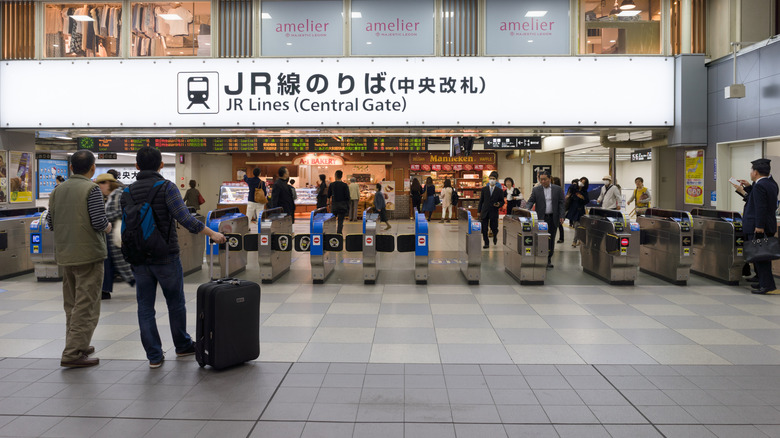
In 2025, the Japan Private Railway Association published the results of its most recent annual survey, whereby participants ranked annoying behaviors on trains and in stations. On the question of disruptive foreign tourist etiquette, they chose mishandling bags and luggage as the second-most irritating behavior (cited by 41.9% of respondents). Just like in the U.S., it's considered rude to put your bags on the seat next to you, as you're taking up a seat that might otherwise be occupied by a passenger. If you're traveling with luggage, hold it on your lap, place it on an overhead rack, or keep it on the floor in front of you, taking care to occupy as little space as possible.
You'll also want to ensure that you do your best to condense your luggage. If you're traveling in a group and everyone has suitcases, think about separating into different areas of the train. This way, all of your luggage doesn't get shoved together into a giant blockade, making it difficult for other passengers to maneuver around or find seats.
Taking up too much space
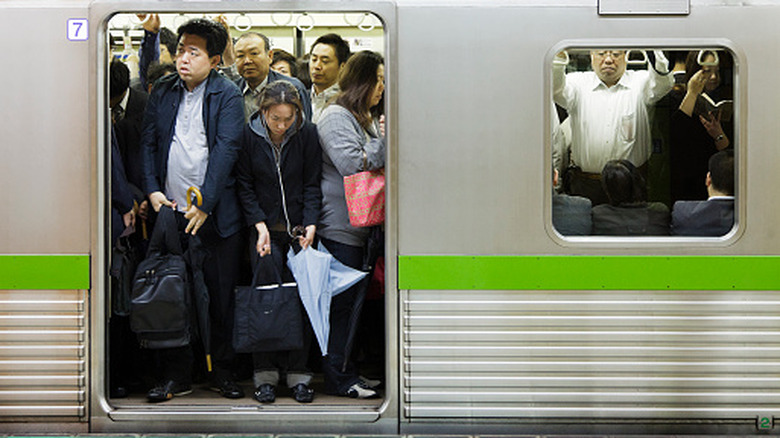
Americans generally require more personal space than those raised in collectivist societies, which can lead to some cultural misunderstandings. In the U.S., maintaining distance from one another is considered polite behavior, but depending on how you're sitting or standing, someone in Japan may interpret that as occupying more room than is needed.
Whether you're sitting or standing on a train, it's important to try to take up as little space as possible. Avoid sitting with your legs crossed or splayed, or spreading your limbs or belongings over more than one seat. On long-distance trains, sit with your legs in front of you and do not stretch them into the aisle. I once saw a Japanese man on a crowded Tokyo subway take these guidelines to an extreme, pretzel-folding himself so that he was bent over a train railing so that the folks next to him would have enough room.
You'll also want to treat your belongings as though they are extensions of your body. Remove backpacks and purses before boarding crowded train cars and wear them on your front. Place any shopping bags in the overhead racks or hold them in front of you. This makes it easier for people to squish into the spaces around you.
Talking too loudly
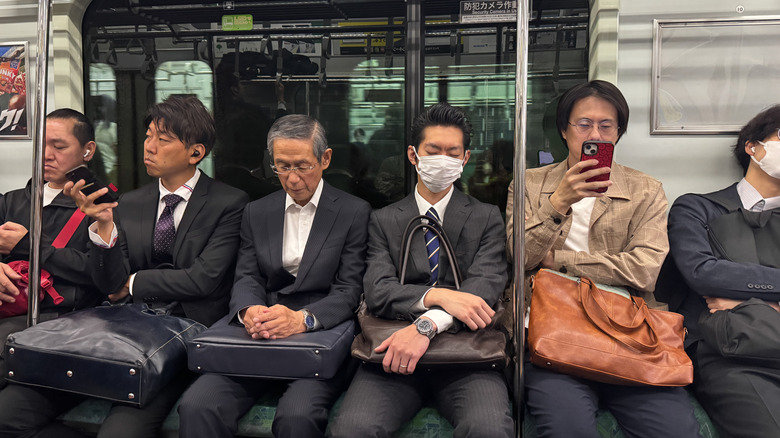
Being quiet on public transit is another one of the 15 rules tourists should know. In the aforementioned 2025 survey, the Japan Private Railway Association asked 5,202 people to identify up to three of the tourist behaviors they found most bothersome. 69.1% of respondents decided that, out of all the etiquette faux pas foreigners commonly commit, loud and unruly behavior annoyed them the most. Americans may not think they're being noisy on the train — but even behavior that has the potential to become distracting, like taking group selfies or public displays of affection, is frowned upon (and you should also be aware of this unspoken rule about PDA before visiting Japan).
Japanese people generally speak quietly or remain silent in public spaces so as not to disturb those around them. This is particularly true during rush hour, when people are sandwiched so closely together that one person's mouth may be mere inches from a stranger's ear. You'll also want to set your phone to silent before boarding the train, use headphones when listening to music or watching videos, and avoid talking on the phone on local trains or subways. It's also expected that people standing near the train car's priority seating — which is reserved for the elderly, pregnant women, or those with disabilities — turn off their phones, so as to prevent interference with any medical devices.
Applying makeup on the train
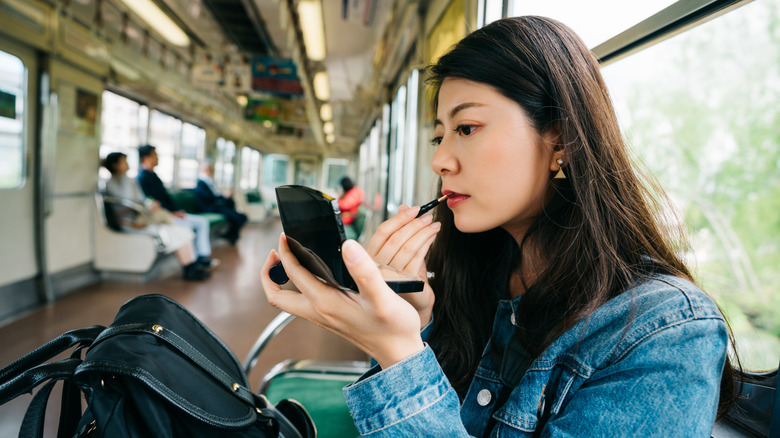
It took me a long time to break the habit of putting on makeup on the train, mostly because I was usually running late. I relied on this downtime on the train to apply a final coat of mascara or retouch my lipstick on my way to work or a night out with friends. But this practice definitely earned me some disapproving looks from my fellow passengers.
While applying makeup en route might be more common these days than it once was, for some Japanese people, particularly those from older generations, this is viewed as impolite. Traditionally, grooming is what you do at home or in the privacy of a restroom. Like flossing or brushing your hair, it's simply not something that should be done publicly on a crowded train. Moreover, those concerned with etiquette claim that some makeup smells can be unpleasant and have the potential to be messy.
Eating on the train
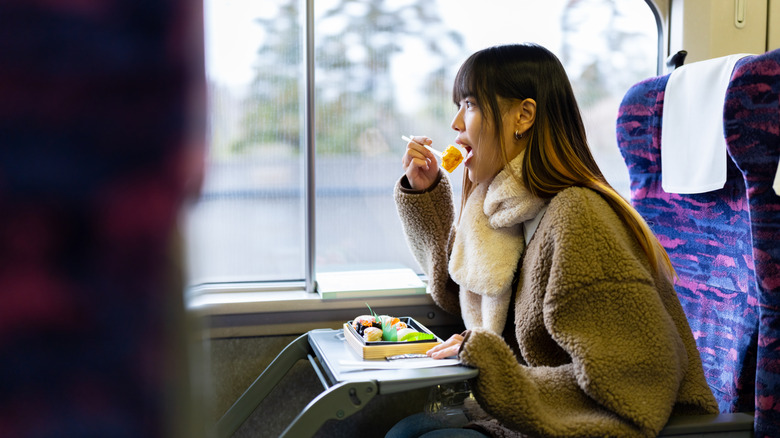
For many Americans, scarfing down a muffin on the commute to work is seen as smart multitasking. However, in Japan, eating and drinking while walking down the street will get you the side-eye from locals. Similarly, eating on the subway or on local commuter trains goes against social norms. Admittedly, I struggled with this etiquette rule, as I couldn't understand how eating something that wasn't messy or smelly in any way — say, a handful of trail mix — could be a problem. But, while not technically banned, it is an unwelcome behavior.
The one exception to this rule is on long-distance trains like the Shinkansen. Here, eating is not only acceptable but expected, as food is sold on board. In fact, enjoying an ekiben (station bento box) is a Shinkansen tradition. If you get a chance, I recommend trying one, as the ekiben are made with a colorful assortment of high-quality veggies, seafood, or meat, and they are incredibly tasty and nutritious.
If you break any of these seven train etiquette rules in Japan, fret not. An apologetic smile and an "excuse me" ("sumimasen" in Japanese) can go a long way to smoothing over an unintentional faux pas.