
6 Once-Thriving Oklahoma Towns That Transformed Into Eerie, Abandoned Beauties
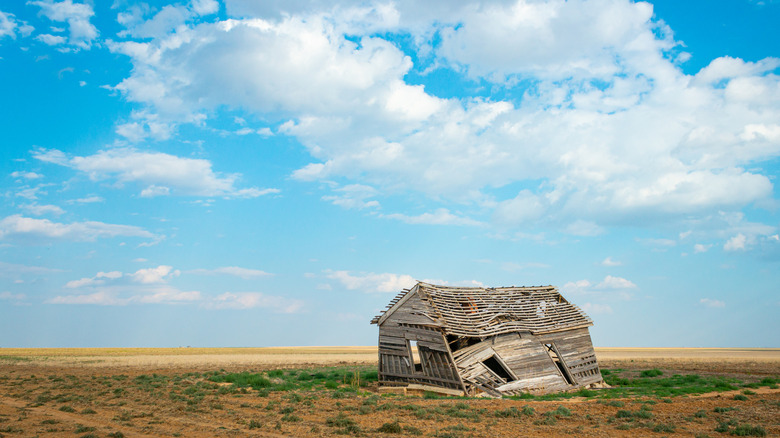
Not so long ago, Oklahoma was a booming territory thanks to the oil and mining industries, with a near-constant flow of small, transient towns popping up across the state. Sadly, due to economic decline (as well as other political and environmental factors), these places started to disappear — seemingly almost as quickly as they popped up, as the Oklahoma Historical Society explains. At the time of this writing, there are more than 2,000 known ghost towns in Oklahoma. Many of them are legitimately lost to history while others still exist in some way or another, with their structures lingering in limbo. Some of the towns that are technically still in existence are actually considered "living" ghost towns, populated with only a few citizens who refuse to leave home.
The Sooner State is rich with eerily beautiful places that were once vibrant and alive. Some of these prairie ghost towns can be visited by simply driving down Route 66, while others are flung across the entire state. No matter where you find them, one thing is for certain: They all have their own tales to tell. Let's take a visual tour of six ghost towns in Oklahoma that are still picturesque in their own right.
Fallis
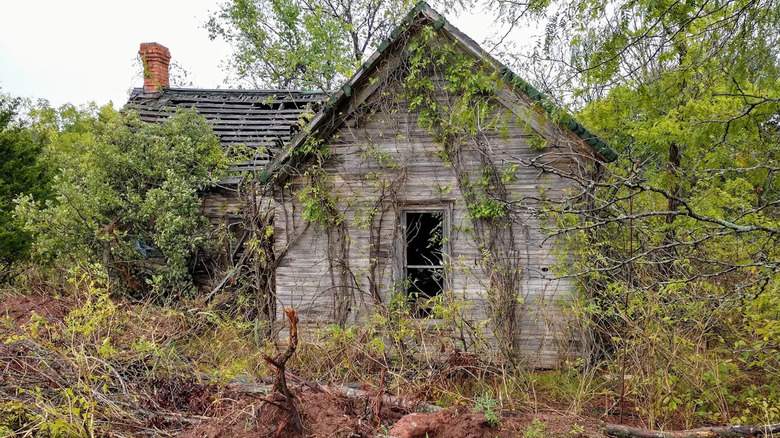
Fallis, Oklahoma, was established in the 1890s (via Oklahoma Historical Society). The small town was producing impressive amounts of cotton, and thanks to its placement near the railways, it thrived. Fallis had a sizeable Black community, among them a Black editor who worked for one of the local newspapers back in 1904. It also produced several notable Black authors, poets, and educators. Due to several factors, including railroads shutting down, the Dust Bowl, and a fire that ravaged the town in 1960, Fallis was eventually doomed to failure, per Lincoln County News. Today, it's a ghost town, with only some of its dilapidated structures still lingering.
Texola
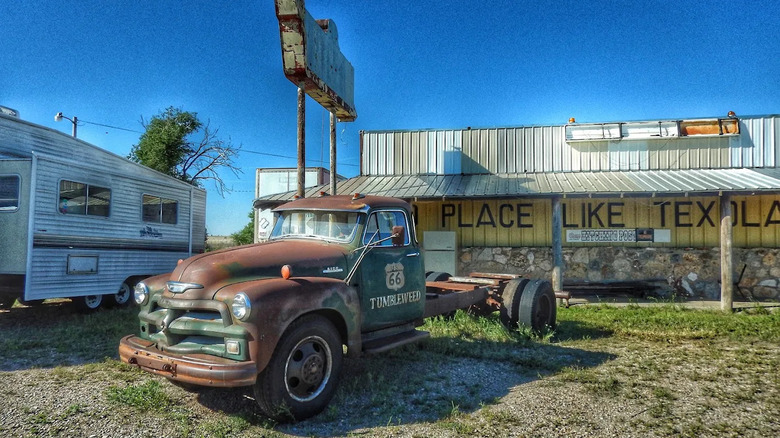
On the Oklahoma/Texas state line along Route 66 is Texola. The Oklahoma Historical Society explains that it was called "Texokla" and "Texoma" before "Texola" was formally decided upon. With a gristmill and two cotton gins, it did well for itself in the early- to mid-1900s. After the Dust Bowl and the Great Depression had taken their toll, though, the population declined. That said, it still has residents, making it a living ghost town. One building is even on the National Register of Historic Places: Magnolia Service Station. Now, this once-thriving Route 66 town is an almost abandoned outpost with curious historical sites.
Picher
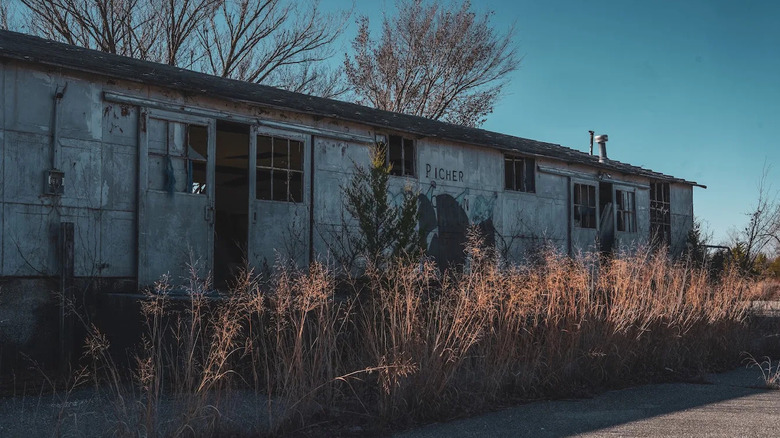
America's "most toxic ghost town" is a mining town on the border of Kansas and Oklahoma. From 1917 until 1947, Picher was one of the world's leaders in zinc and lead, per Koco News. The town thrived, but at a price: Piles of toxic mining byproduct started rising all over its borders. Soon, the groundwater supply was tainted, and the ground the town was built on became unstable. Most of the residents were gone by 2008, when a monstrous EF4 tornado hit Picher and sadly killed some locals while taking out homes and buildings. Little remains but memories.
Skedee
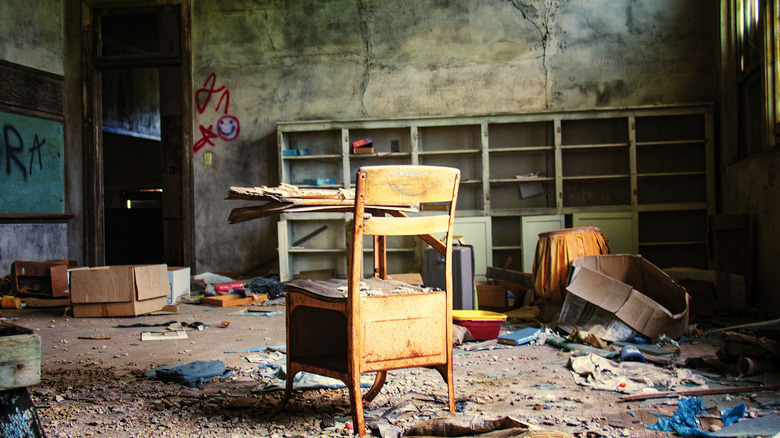
Skedee had its boom period in the early 20th century thanks to cotton and the introduction of a railroad through the area, per Oklahoma Historical Society. Its population hardly wavered until 1940, when it began to decline. In 1957, a flood tore through town, destroying the vital train tracks and marking the beginning of the end (via U.S. Geological Survey). The population decreased until the early 1960s, when the post office closed. There is a tiny subset of residents in Skedee, but most of them work and attend school in Pawnee.
Centralia
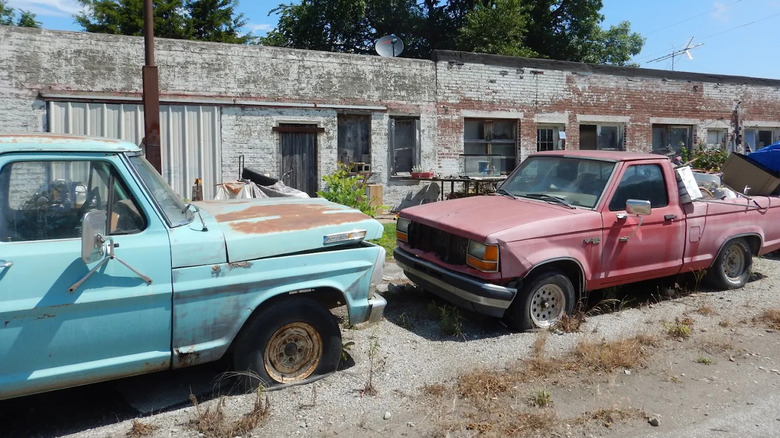
Centralia, Oklahoma, suffered two fires: one in January 1907, and another in July 1917, per Abandoned Oklahoma. Despite this, the town managed to thrive in the early 20th century. At its peak, it had a school, multiple churches, grocery stores, a library, hotels, a newspaper, a booming business district, and banks. But the Great Depression blew in and changed the town for the worse, until Centralia was in its death throes. Families left, the school closed, and a railroad spur that had been planned through Centralia was abandoned. All that's left is a couple of decaying buildings.
Ingalls
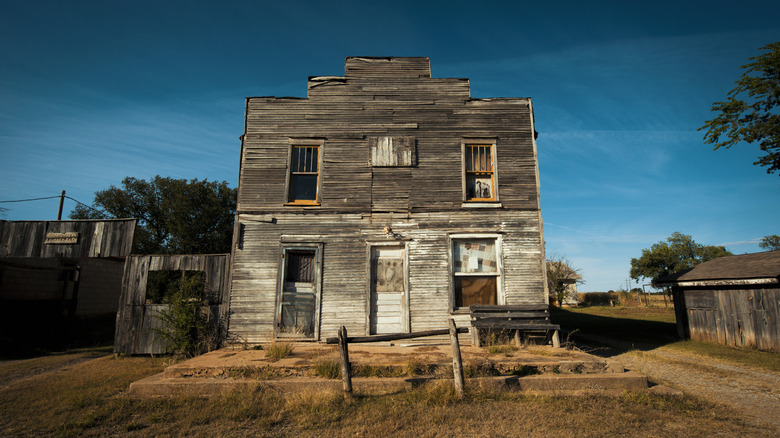
Ingalls, Oklahoma, was established in 1889, without mines or a railroad in the area (via Legends of America). But it did have a thriving town which catered to several local outlaws. In September 1893, a shootout occurred between the Doolin-Dalton Gang and the U.S. Marshals. Nine died that day; it had really become the Wild West. This reputation did Ingalls no favors, and people began to fear for their safety. Finally, a new railroad skipped the town, sealing its fate. Oklahoma's abandoned ghost town was a hotspot for outlaws; today, a tiny handful of folks still live here, but the town is, for the most part, silent.