
This Popular National Park Removed 30 Signs And People Aren't Happy About It
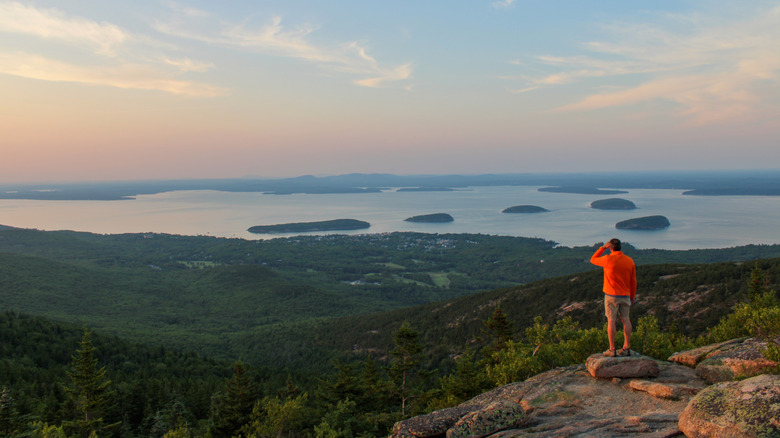
For many Americans, national parks are considered precious places where the country's past, present, and future exist harmoniously. Where nature, people, and history create a sacred environment protected for everyone. But that may no longer be the case, as visitors to Acadia National Park in Maine are realizing. According to The Associated Press, this national park has removed 30 signs after President Donald Trump released a signed executive order titled Restoring Truth and Sanity to American History in March 2025. Many of these signs relate to the native Wabanaki people, while others highlighted the effects of climate change on the national park.
President Trump's executive order stated that national parks shouldn't have "descriptions, depictions, or other content that inappropriately disparage Americans past or living." However, people are angry about the removal of these signs, seeing this as more of a narrative-building exercise by the POTUS than anything beneficial to the country and its national parks. "Our national parks are not billboards for propaganda," Congresswoman Chellie Pingree was quoted saying in a letter to Interior Secretary Doug Burgum by The Associated Press. "They are places where millions of people come each year to learn, reflect, and confront both the beauty and the difficult truths of our shared history."
In Acadia National Park, one sign removal in particular has sparked a lot of anger. Atop Cadillac Mountain, a marker relating the peak's importance to Wabanaki Nation people no longer exists. The drive to the peak via Cadillac Summit Road is still one of Acadia's best scenic drives, but the experience now lacks important cultural and historical insights. Penobscot Nation citizen Jennifer Neptune described the removal as "a real gut punch [...] not just for Indigenous people [...] for the people whose stories don't get shared" to The Associated Press.
Acadia National Park's signs are gone, but maybe not for long
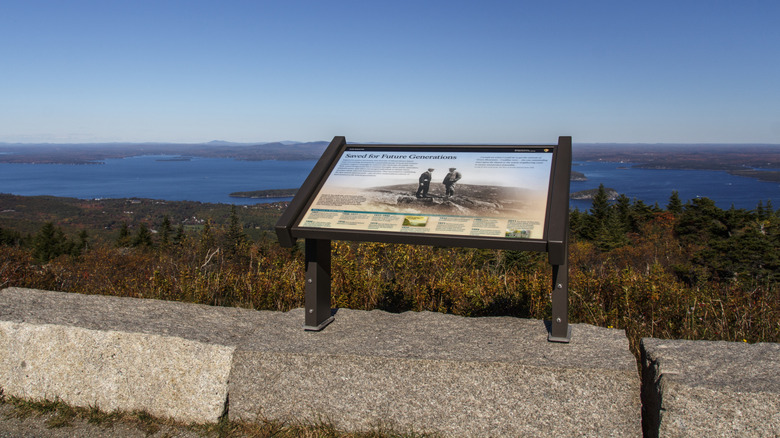
The backlash from this decision to remove historical, cultural, and environmental signage from national parks prompted a lawsuit in February 2026. This led a federal judge to order the restoration of these markers. "History cannot be faithfully told while excluding the experiences of communities whose contributions, struggles, and achievements form an important part of our Nation's story," U.S. District Judge Angel Kelley was quoted by PBS. Although the judge also ordered the Trump administration to provide updates on these restorations, efforts to do so have been minimal.
A small group of archivists called Save Our Signs (SOS) is trying to document all the signs from over 400 national parks and other historic sites before they're lost. Crowdfunding and volunteer contributions have helped the group amass over 17,000 photos for their archives. You can use the group's interactive SOS Censorship Tracker to see the exact signage that's been removed from Acadia National Park and others around the country. There are currently only 20 signs from Acadia documented, but photographs from anyone who's able to contribute are welcome.
The support they have received from outsiders only further reinforces how upset people are about this decision. Many don't feel these signs are disparaging and are important for American people to retain. "I'm a U.S. Army veteran who has visited a lot of Native American-centric parks/monuments [...] I never once felt disparaged or denigrated because those signs told the truth about the actions of the Army. I felt educated, empowered, and emboldened," one person wrote on the r/NationalPark subreddit. National parks have been through some changes in 2026, but you can still visit ones like Acadia. If you do, it might be worthwhile taking photos of any signs you see. Start with the Acadia National Park Loop Road, one of America's most scenic, before choosing your hiking spots.