
What Does A Red And Green Striped Buoy Mean On The Water?
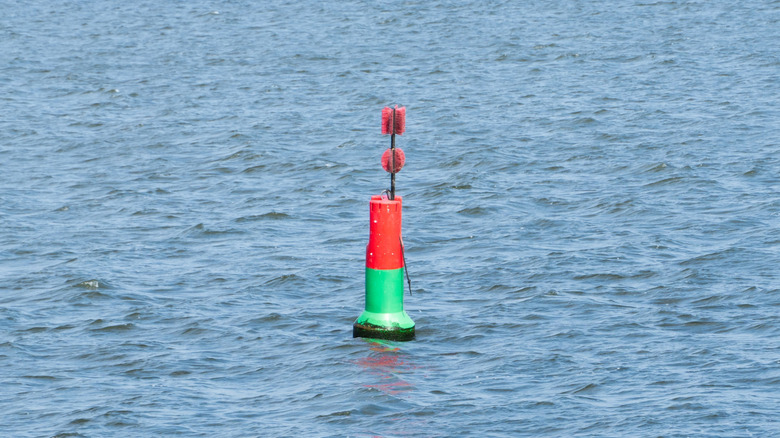
All boaters are expected to adhere to the maritime Rules of the Road and heed the information provided by various aids to navigation, such as buoys and markers. Most often, these critical messages are not conveyed by written words, but by colors and shapes. To that end, it is important that all boaters understand what the assorted colors, shapes, and combinations thereof are expressing. For example, in the US green can-shaped buoys mark the left side of a channel returning to port, while red cone-shaped buoys mark the right. These are the most common buoys, so most boaters are familiar with them. However, what does it mean when you spot a buoy that has both colors? Turns out, the meaning of a red and green striped buoy depends on the placement of the colors, as well as the portion of the world in which you are boating.
Like green can and red cone, or nun, buoys, red and green striped buoys are channel markers. However, unlike the solid-colored variety, they are not indicating the edge of the channel. Rather, red and green striped buoys denote where the channel splits. Therefore, they are sometimes called bifurcation or junction buoys. When such a buoy is spotted, the important thing to pay attention to is which color is on top. That's because the uppermost color band indicates the main or preferred channel. For this reason, these buoys are also sometimes referred to as preferred-channel buoys.
How to pass a preferred channel buoy
When it comes to how you should pass a red and green striped preferred channel buoy, that depends on the portion of the globe in which you are boating. The International Organization for Marine Aids to Navigation (IALA) developed and maintains the guidelines for maritime aids throughout the world. However, although the colors and shapes are the same globally, the manner in which buoys are passed is different based on region.
Region B includes North and South America, Japan, South Korea, and the Philippines. In this region, green buoys should be left on the port, or left, side when passed returning to port or moving upstream. Red buoys, on the other hand, should be left on the right, or starboard, side. A preferred channel buoy should be passed based on the color of the top band — green should be left to port (left) and red to the starboard (right) side of your boat. This applies to anywhere in Region B. So, whether you are on a bucket list-worthy boating adventure on the Great Lakes or in the boating capital of the Bahamas, you react the same to these buoys.
Should you happen to be boating in Region A, which includes Africa, Asia, Australia, and Europe, you would do the exact opposite. So, if you are on an exhilarating yachting vacation in Croatia, Greece, or anywhere else outside of Region B, you should leave the green-topped preferred channel buoy on your right. A buoy with red as the uppermost color should be passed on the right, leaving the buoy to your left.