
Between Valencia And Castello Is A Seaside Town With A Sandy Beach, Festivals, And A Medieval Castle
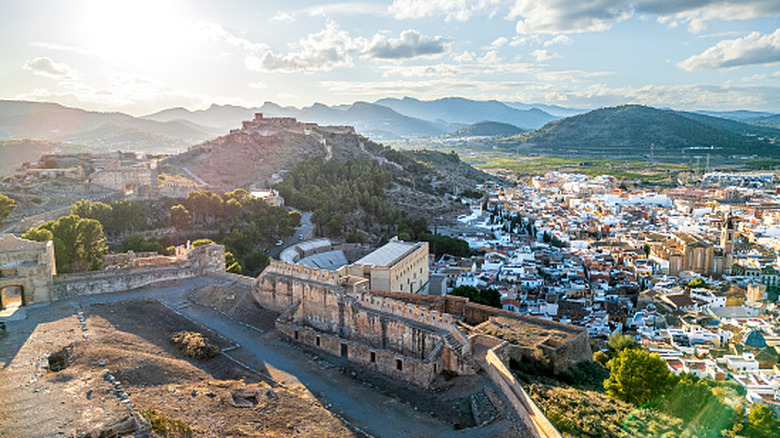
Just a short day trip from Valencia lies one of the most important towns in Spanish history. Yet, it is often overlooked by travelers, who see it as a passing backdrop on the train journey from Valencia to Castelló or Barcelona. However, for those who take the time to visit, the tiny seaside town of Sagunto offers an instant trip to the past.
Sagunto, which was originally an Iberian town, rose to prominence just before the Second Punic War, in which the Carthaginians and Romans fought for control over the Mediterranean and much of southern Europe. The town of Saguntum, as it was known then, was where the famed Carthaginian general Hannibal led a siege against an ally of Rome in 219 B.C. that helped trigger the entire war. The Romans and Carthaginians would continue to fight bitterly until the Second Punic War concluded in the Romans' favor in 201 B.C., giving them almost complete control of the western Mediterranean.
Modern-day Sagunto retains many remnants harking back to its ancient past. Nestled beside the newer constructions and modern amenities are narrow cobbled streets, a 2,000-year-old Roman Theatre, and a medieval castle perched at the top of a hill. This ancient castle sits on the site once under siege by Hannibal, and existed even before Roman influence. However, since the rise and fall of the Roman Empire, it has undergone many changes and renovations, turning into a unique tapestry of competing influences on Spanish history. This castle and the rest of Sagunto's old town are just over a 30-minute drive from Valencia, or 20-30 minutes by train. The historic district of Castelló is just a 45-minute drive away.
Step into the past in Sagunto
Taking a trip to Sagunto today is like stepping off a modern-day train platform and landing sometime between 2,000 and 500 years ago. While Valencia is home to one of Spain's largest historic centers, Sagunto offers an equally historic vibe, with a castle and theater dating back thousands of years.
The Castillo de Sagunto, or Sagunto Castle, showcases its heritage in layers, boasting a medley of Islamic motifs, a Moorish structure, Christian paintings, and Iberian and Roman flourishes. The outer walls and the albacar section were built under Islamic rule, while later Christian rule fortified them. The castle's Iberian and Roman influence is visible in the rest of the property, although much of the construction dates back to the later Moorish period. Sagunto Castle sits atop a flat hill 564 feet above sea level, stretching approximately 0.6 miles lengthwise and providing a panoramic view of the city below.
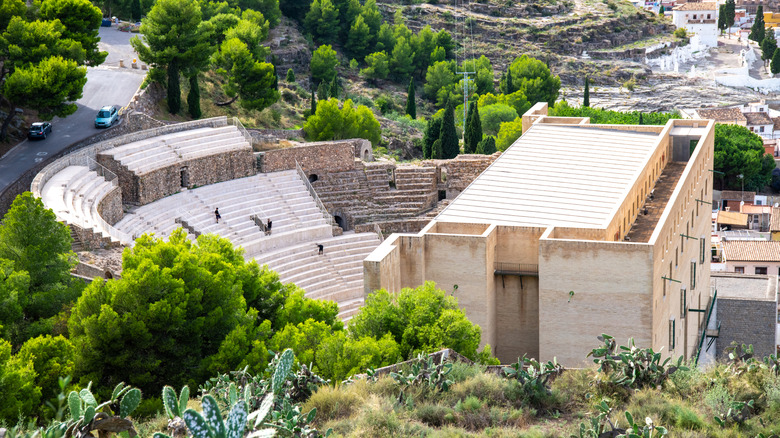
At the foot of the castle hill lies another of Sagunto's historic treasures — a 2,000-year-old Roman Theatre, restored and still used for performances to this day. The original construction was built into the hillside for the best acoustics and sat as a fairly intact set of ruins for centuries. In 1896, it became the first site to be declared a Spanish National Monument. However, in the early 1990s, the Spanish Government decided to restore the theatre, covering much of the ruins with new stone. While it retains its original shape — the traditional semicircular seating of a Roman theater — the move to cover up most of the ruins was an extremely controversial topic at the time, with an archived 1993 New York Times article even calling for the architects to be "thrown to the lions."
Beaches and festivals — the playful side of Sagunto
More than 30 years after its restoration, the Roman Theatre is now entertaining visitors once again. Every year, Sagunto celebrates the Sagunt a Escena, a performing arts festival that brings plays, circus shows, musical acts, and dance performances to the Roman Theatre's stage. The theatre holds 8,000 people, but if you can't make it inside, the festival often spills out onto the streets in its Off Romà program. During this time, music and festivities take over Sagunto's streets, and the audience joins in on the celebrations. Sagunt a Escena takes place every year in August and is a great small-town alternative to the festivals of Barcelona, one of Europe's most "overtouristed" places.
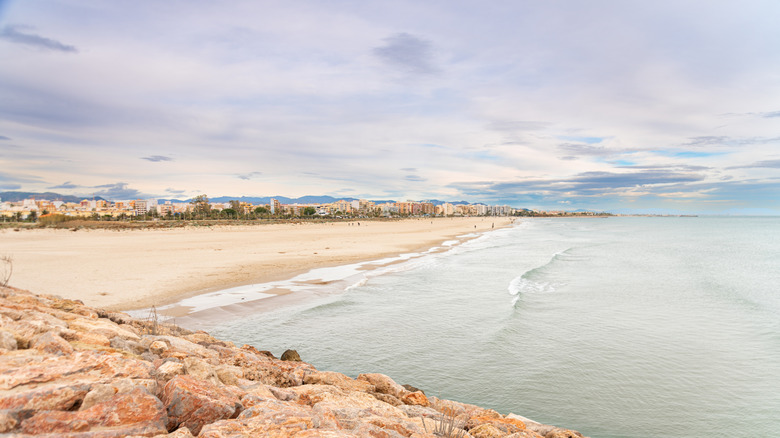
For that specific flavor of Spanish relaxation, head to Sagunto's beaches. The town's scenic Mediterranean coastline stretches approximately 8 miles, split into four beaches — Puerto de Sagunto, Almardá, Corinto, and Malvarrosa. The busiest of the lot is Puerto de Sagunto, the main town beach. It has fine golden sand, dedicated water sports sections, shallow swimming near the shore, and a range of beachfront restaurants to choose from. It's the most lively of Sagunto's four beaches, and features a 0.75 mile-long stretch of soft sand.
The northern adjoining beaches of Almardá, Corinto, and Malvarrosa provide a quieter escape away from the main town center, and the northern corner of Malvarrosa even has a dedicated nudist area. These beaches are less developed and more natural than the "picture-perfect" image of a tourist beach. The sand here is intertwined with rough gravel, and sand dunes and beach vegetation have been left as is to preserve the area's natural state. In keeping with Spain's reputation for having the most Blue Flag beaches, all four of Sagunto's beaches are Blue Flag certified.