
What Does A Black And White Checkered Flag Mean At The Beach?
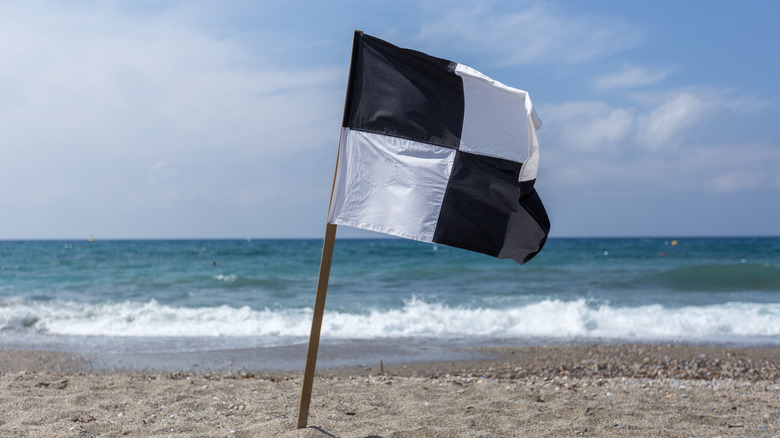
If you happen to see a black and white checkered flag flying as you're strolling down the beach, you may assume some sort of race has just ended. After all, such a banner has long been associated with the culmination of a competition. On the beach, the look of a black and white checkered flag varies slightly from those used on racetracks, and its meaning is quite different, too.
Black and white checkered flags included in the beach flag systems of the International Life Saving Federation and the United States Lifesaving Association are better described as quartered. Unlike the racetrack version, which has several rows of white and black squares, the lifeguard version has two of each: Black squares are in the upper left and lower right quadrants, and the white squares are in the upper right and lower left. The presence of this banner on a section of beach is to designate that area for surfing or the use of non-powered watercraft, such as boogie boards, paddleboards, and kayaks. Typically, these flags are used in pairs, with the area between the flags being designated as a surf zone.
So, what does this mean for swimmers? Whether you are in Haleiwa, Hawaii, the world's "surfing capital," or an obscure beach destination, if you see a black and white flag flying, you shouldn't attempt to swim in that area. Mixing fast-moving surfboards and stationary or slow-moving swimmers in a close-quarters situation can be quite dangerous. So, swimmers should treat a black and white flag the same way they would treat a red flag flying on the beach and stay out of the water — at least in that immediate area.
Why surfers and swimmers shouldn't share space

While it may seem a bit exclusionary for a zone to prohibit swimmers, which are often the largest group of beachgoers in many destinations, there is a practical reason for these restrictions. Simply put, surf zones are created to improve safety for both swimmers and surfers. Surfboards are hard objects moving quickly through the water. While surfers have some control over their movements, they are not always able to avoid unexpected objects, including swimmers, especially once they've gained a lot of momentum. Additionally, swimmers can be difficult to spot amidst the rolling waves, meaning surfers have very little time to react.
Swimmers can take solace in the fact that some beaches have designated swim zones in which surfers are not allowed for the very same reasons. In other cases, there may be no practical reason to separate sections with flags. That's because the best surfing conditions typically aren't ideal for swimming and vice versa. The large waves sought out by surfers, as well as the dangerous rip currents that often accompany them, can make swimming quite hazardous, even if surfers aren't around. Similarly, calm conditions perfect for swimming may not attract many board riders.
To that end, even if no flags are flying, if you see a stretch of beach being utilized by surfers, it's best to swim elsewhere to avoid potentially dangerous conditions and to reduce the risk of collision. Conversely, if you are a surfer, it's best not to attempt riding waves through a crowded swim area — even if it's not designated as a protected swim zone. The best bet is to look for signal flags and observe the water before entering, regardless of whether you are there to surf or swim.