
The Real Meaning Behind The Colorful Lifeguard Stands On Miami Beach
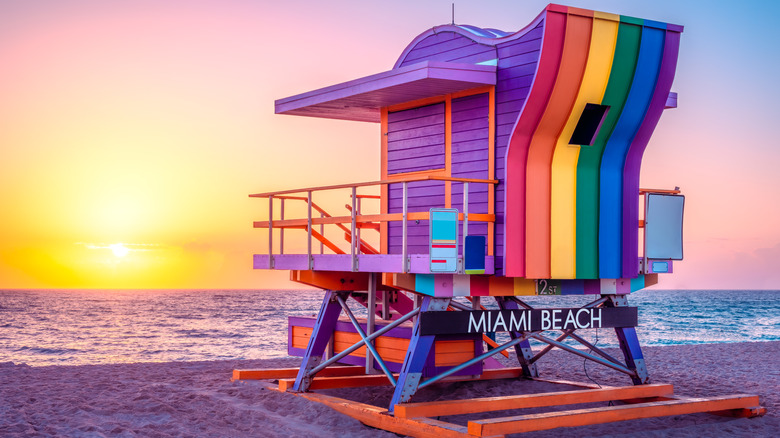
While other coastal towns along the Atlantic may settle for nondescript wooden shacks, the colorful lifeguard stands on Miami Beach are a collection of candy-colored towers in shades of bubblegum pink, sunny yellow, seafoam green, and tangerine orange. Scattered along the shoreline from South Pointe Park to 86th Street, the structures look more like oversized beach toys than practical places for lifeguards to keep watch. But there's more to their technicolor charm than meets the eye.
On August 24, 1992, before the sun came up over South Beach, Hurricane Andrew tore across Miami-Dade County, leaving catastrophic damage in its wake. Despite widespread power outages, uprooted palm trees, and general calamity, the aftermath sparked one of the area's most cheerful urban design makeovers. William Lane, an architect who had moved to the bohemian area just before the natural disaster happened, convinced the City of Miami Beach to champion his redesign of several lifeguard towers that had been demolished. "I saw that all those towers had been destroyed, and I thought, what a great idea to rethink them. Make them more than just a tower. Make them special," Lane explained during an interview with Miami Beach Visual Memoirs on YouTube.
The first five lifeguard stands debuted at Lummus Park, where their geometric curves and tropical palettes looked perfectly at home in Miami's artsiest neighborhood, quickly becoming an iconic addition to the revitalizing beachfront. Two decades later, as part of an effort to replace the aging structures, Lane and his team would develop six new prototypes used for each of the 36 lifeguard stands stretching along the turquoise coast of Miami Beach today.
Culture, community, and color define the iconic Miami Beach lifeguard stands
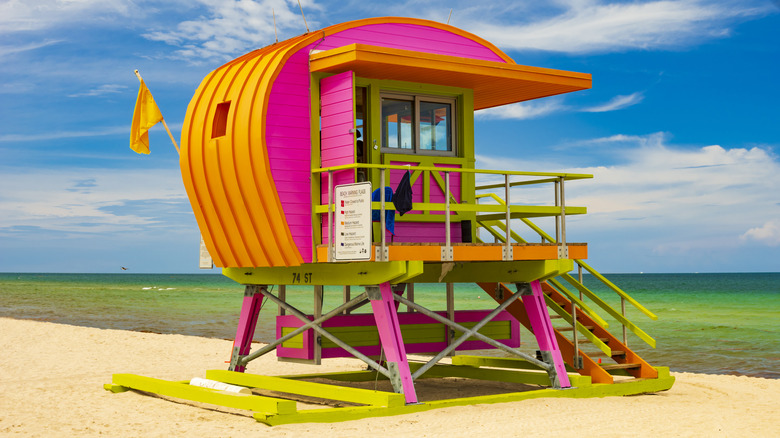
For travelers and locals alike, the Miami Beach lifeguard stands are more than just a shaded spot for the ocean rescue teams manning them. They're also colorful wayfinding beacons, whether you're trying to find your friends amongst the spring break crowds or enjoying a solo sunrise on the beach, one of the ways locals say you can enjoy Miami to the fullest. While the lifeguard stands have earned nicknames like "The Bed," "The Lighthouse," "Stars and Stripes," and even "Lisa Simpson," each of the structures is actually named after its nearest cross street.
A prismatic rainbow design feels right at home in the center of the 12th Street Gay Beach, an LGBTQ+ friendly stretch of powdery sand in the heart of South Beach. Strolling north along the Miami Beach Boardwalk takes you past these kaleidoscopic landmarks, including the Mystery Machine-esque teal and lime green 30th Street Lifeguard Stand. It sits a mile south of the famed Fontainebleau Hotel, whose own architect's bold and contemporary forms inspired Lane's sculptural approach. And while the rip currents at North Beach are just one of the reasons you may want to think twice before visiting the popular Florida beach destination, the whimsical stands are reassuringly situated all the way to Surfside.
According to Wallpaper*, each of the colorful lifeguard stands on Miami Beach towers nearly 8 feet above the sand and clocks in at just 260 square feet. They're made from simple timber and standing-seam aluminum materials, which can be easily manipulated to create the abstract shapes and rooflines. As William Lane explained on his firm's website, the award-winning towers "serve as powerful expressions of identity and culture ... transforming the beach itself into a dynamic environment."