
What Do White Buoys With A Blue Horizontal Band Mean In A Marina?
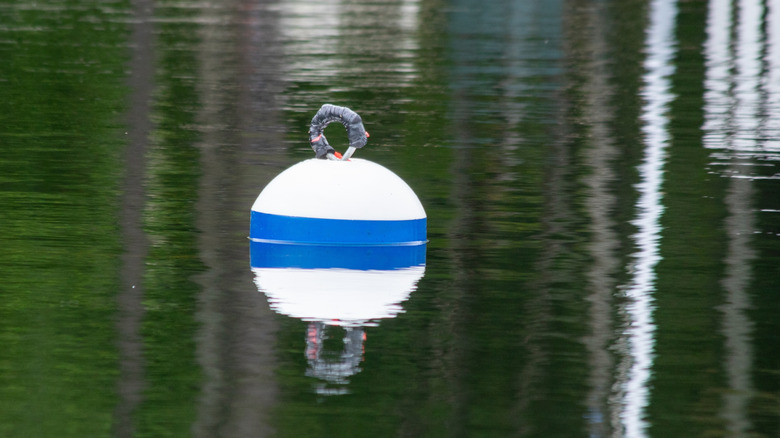
When boating on inland lakes or coastal waters, it is common to see buoys of various colors and shapes. As seasoned boaters know, these buoys aren't just decorative — they are intended to convey messages and directions. However, buoys aren't only found in open-water areas. Even in marinas, you will see a number of buoys, such as white-and-orange regulatory buoys. Depending on the marina, you may also see white buoys with a blue horizontal band. These buoys have an entirely different purpose than navigational or informational buoys. In simple terms, they create a parking lot for boaters.
In U.S. waters, white buoys with a blue horizontal band are mooring buoys. In relatively calm waters, such as inside of a marina, they are typically ball-shaped. In rougher waters, they may be tapered or conically shaped to provide more stability. Regardless of whether they are within a marina or not, mooring buoys are attached to the bottom via a heavy chain and anchor. This is the only type of buoy to which boats can legally tie off. In fact, these buoys are there for the purpose of providing boats a safe anchorage to which to tie.
There are a couple of reasons a permanent buoy ball anchorage system may be utilized, as opposed to having individual boaters simply deploy their anchors. One reason is to protect sensitive habitat on the bottom, such as coral reefs. In this case, the mooring buoy system acts as an environmental protection device, as it prevents the repeated dropping and scraping of anchors over these areas. Another reason a mooring buoy system may be used is to provide a safe, secure anchorage in a confined and possibly crowded marina.
Navigating to and around mooring buoys
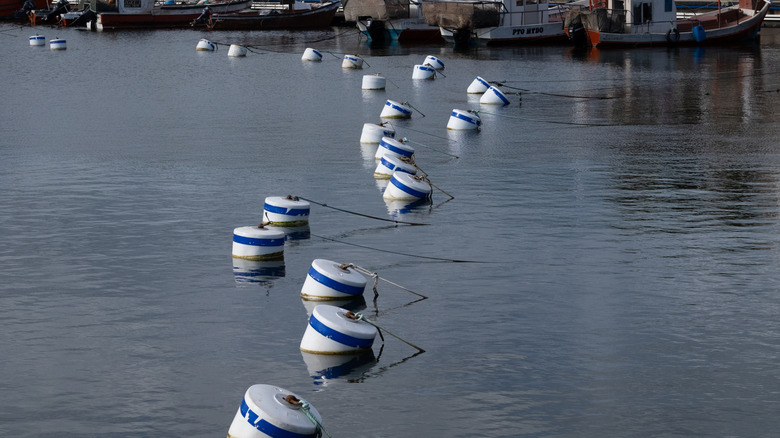
An area with multiple mooring buoys is referred to as a mooring field. It is important to approach a mooring field slowly. Assess the layout of the mooring area, taking into account wind and current direction, as there is often a line or chain stretching from the buoy on the surface to the anchor beneath. There may also be additional lines or buoys attached to the mooring buoy, any of which can foul a propeller. Additionally, in many areas where mooring fields exist, swimmers and snorkelers may also be in the water, so boaters should maintain idle speed.
If you intend to moor in the marina, first check if any mooring buoys are available. Keep in mind, just because a buoy is empty doesn't mean it is up for grabs. Most mooring fields operate on a first-come, first-served basis, but others need reservations. To be on the safe side, it is best to check with the harbormaster or marina office prior to attempting to tie off to a mooring buoy. Once you know you are able to tie off to a mooring buoy, approach slowly from downcurrent or downwind. Swimming up to a buoy is generally discouraged. Instead, while idling alongside it in your vessel, grab the buoy with a boat hook, thread your mooring line through the eye, and secure the line to a cleat on your boat.
It is important to note that not all mooring buoys follow the same color scheme. Although white-and-blue mooring buoys are used in other countries, mooring buoys in some places may be a variety of other colors. So, if you're planning your first sailing vacation outside of U.S. waters, don't expect to find only white-and-blue spheres and cones. However, when on a boating adventure in the U.S., like on America's Great Loop, you'll know what these buoys mean as you're navigating the water.