
Can You Opt Out Of The Full-Body Scanner At The Airport?
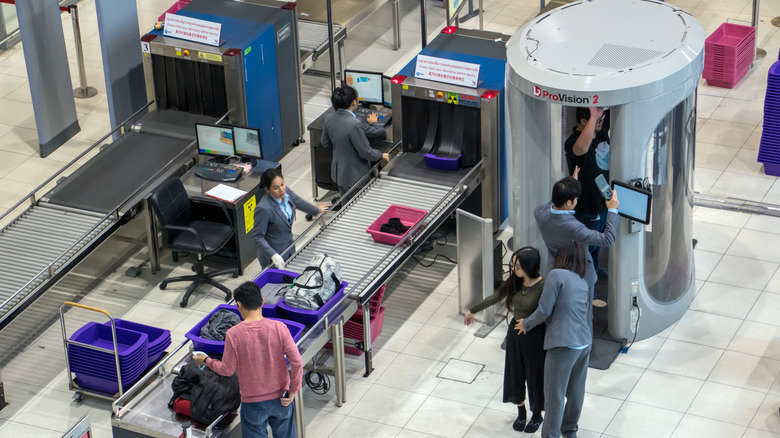
Vacations are fun. Airport visits, not so much. The news these days of ground stops and absent air traffic controllers can give travelers pause. Not to mention those serpentine Transportation Security Administration lines that passengers endure en route to their gates. One pleasant surprise for some jaded flyers is the ability to skip the full-body scanner portion of the procedure. However, this means you'll have to elect for a pat-down search by a security officer. In general, the full-body scanners allow TSA officials to verify that you're not carrying weapons and explosives.
After loading your carry-on luggage and personal belongings onto the conveyor belt that runs through the X-ray machine, you'll step into a scanner that can look like a hexagonal booth with see-through walls. There, you place your feet on the footpads and raise your arms overhead as transmitters rotate around you, using millimeter-wave imaging to identify any hidden metal objects in your clothing. Full-body scanners don't show all your personal details, as workers do not see body parts. "The body scanners provide a nondescript avatar image of the human anatomy," Eri Jenkins, an advisor who previously worked in uniform at a TSA checkpoint, tells Reader's Digest. "Images reveal items that might be on skin or inside clothing."
How did airport security get so body-conscious? The terrorist acts of 9/11 transformed airport security with the Aviation and Transportation Security Act, leading to tighter luggage controls and enhanced screening systems. Full-body scanners were fully implemented at airports after a terrorist tried to set off explosives hidden in his underwear in 2009 on a Detroit-bound flight. However, some TSA regulations have eased — for example, now most passengers are permitted to keep footwear on during security screenings. It may feel like TSA rules are annoyingly inconsistent, but such changes strive to keep passengers safe.
Why passengers opt for pat-downs
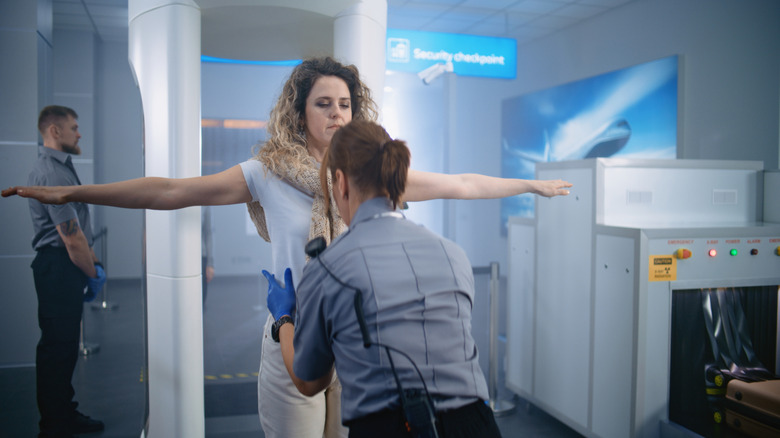
Travelers may want to bypass airport scanners for many reasons. On the TSA website, a section called "TSA Cares" lists categories of travelers who potentially need more help. Those with mobility issues and medical conditions, such as a pacemaker, may require additional assistance during screening. Some may worry about the safety of the scanner, but experts say the technology emits less energy than a cell phone, per the Environmental Protection Agency. Flyers with service animals will be screened together using the walk-thru metal detector. Those flying with infants can carry them through metal detectors. For more screening guidance, passengers can request the help of a TSA Passenger Support Specialist 72 hours in advance of their flight. These TSA officers are trained to work with travelers with extra physical needs.
Should you elect to have a pat-down, inform the agent when you arrive at the security line (note that some travelers may have been selected for enhanced screening on their boarding passes and can't bypass the scanners). An officer of the same gender will perform the procedure, which can also be done in a private room. The pat-down can cover the head, neck, arms, torso, legs, and feet, as well as sensitive areas such as breasts and groin, but officers usually use the back of their hands unless a threat is detected. Good news on the horizon is that TSA is working on a contactless technology using gloves with sensors that could hover above the body. It could save time, but for now, be prepared for a delay when choosing the pat-down. If you're in a rush, check out these hacks to zip through TSA when planning your getaway.