
What Does It Mean When A Buoy Has A Bell?

Navigational buoys are very visual. The shapes and color schemes of these buoys convey messages and instructions to boaters. In many instances, they're also affixed with lights emitting different patterns. Buoys can be hard to see in low visibility, even if they are lit, so to alert boaters to their location, they're fitted with noise-making devices. One of the earliest methods for doing so was placing a bell on the buoy.
This basic, low-tech way to allow buoys to alert boaters to their location in low visibility is still in use today. If a buoy has a bell, often referred to as a bell buoy, it means mariners will be able to hear it ringing out even if they are unable to see it. Bell buoys were first invented in the mid-1800s, long before digital and electronic noise-making devices. In fact, there were very few ways to create sound on an unmanned buoy.
So the only solution was to fit a bell onto a buoy and let the natural motion of the ocean ring the bell on a fairly continuous basis. These contraptions are particularly critical to mariners returning to port from areas such as the Grand Banks of Newfoundland, a historically important fishing ground, which is also among the foggiest places in the world. While some buoy bells have been replaced with other noise-making devices and others have been removed from their stations, many bell buoys are still active in critical ports and shipping lanes.
Limitations of bell buoys
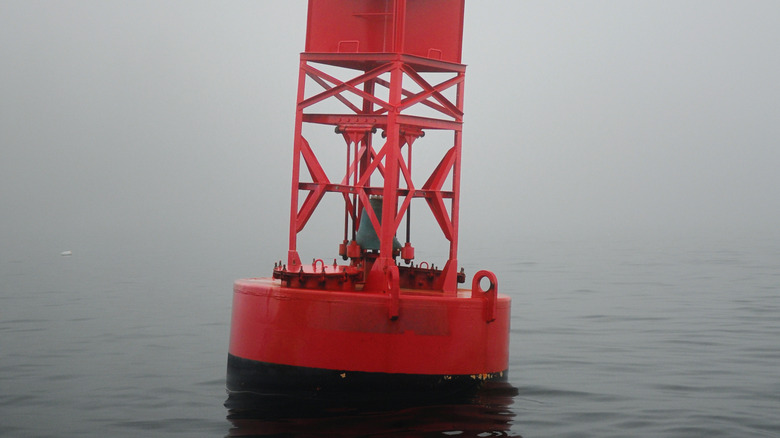
It turns out, placing a heavy bell on a rocking buoy was an effective way to alert boaters to the presence of the buoy in low-visibility conditions such as fog, which is why many are still in use today. Bell buoys aren't a perfect solution, though, and have some limitations. For starters, the ringing of the bell is initiated by wind and/or wave action, which means when conditions are calm, no warning will ring out. This is particularly unfortunate since quite often heavy fog sets in such calm conditions.
Another limitation is the type of sound that's produced. While heavy copper bells can be heard up to three miles away, the duration and cadence of the ringing are entirely dependent on the sea's conditions. A ringing bell can prevent mariners from accidentally running over buoys, but it doesn't indicate whether it's a red-and-green striped bifurcation buoy or a black-and-white buoy indicating a navigational hazard. Not to mention, the bell can be removed, and there have been instances where buoy bells have been stolen, thus rendering the buoy silent.
To that end, modern navigation equipment such as GPS units has largely reduced reliance on bell buoys. In fact, this has actually led to the Coast Guard removing hundreds of buoys from U.S. coastal waters. However, given that numerous bell buoys are still active, should you hear one, you can identify what type of buoy it is by referencing the location on a nautical chart.