
Why Some California Highways Have Orange Stripes (And It's Important For Road Trippers)
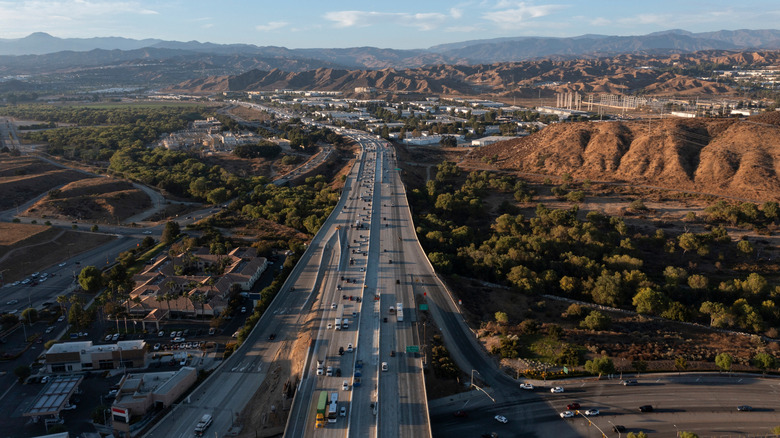
The best way to explore California is, arguably, by car. Road trippers have the best chances to discover hidden gems like the largest cattle ranch and historic roadside resort or hot springs among California's most iconic mountain and desert scenery. But before getting to the open roads, one needs to go through an unfortunate and quintessential experience: California traffic.
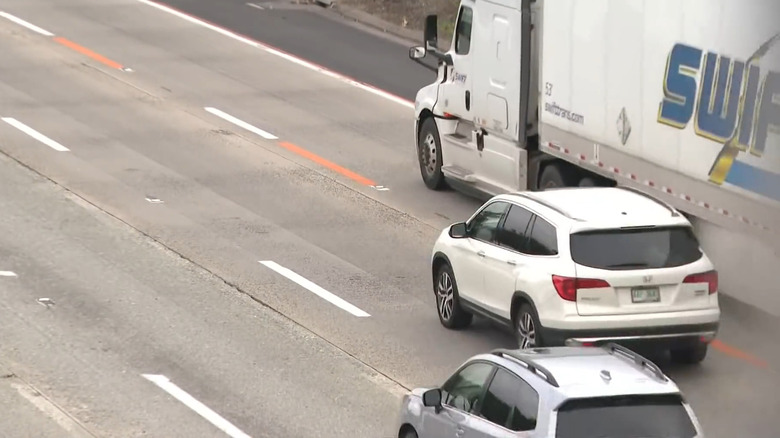
California, especially in the greater Los Angeles area and Southern California, is notorious for clogged highways. Road trippers should expect to slow down, and if not because of other vehicles sharing the road, because of a California Department of Transportation (Caltrans, for short) experiment: Orange lines along Interstate 5, a major interstate and America's busiest highway. Orange lines — in a shade not too different from your traditional traffic cones — started popping up along I-5 in March 2021 as part of a pilot program. Their purpose is to indicate to drivers that they have entered a construction zone. This is a practice that has been used in other countries, including Canada, Switzerland, and New Zealand. Other U.S. states, including Wisconsin, had also been testing this new technique and saw positive results, but until now, it had not been tested in the Golden State.
Construction zones in California usually have their own speed limits. Depending on the kind of work being done, these are often set at 10 to 20 mph under the standard limit. Failure to abide by the reduced speed limit could cost you double the amount of your regular speeding ticket, and points may be deducted from your driver's license, which is not something you want to worry about during a road trip adventure.
Orange stripes indicate that drivers should slow down, reducing the risk of accidents in construction zones
Caltrans is responsible for maintaining roughly 50,000 miles of state highways, and construction is ongoing throughout the year. Work-zone crashes remain a significant concern, and the agency reports that construction workers are killed each year in California due to crashes involving speeding or inattentive drivers.
The main purpose of the orange line pilot program was to test whether these colored lines would increase drivers' awareness on the interstate, therefore reducing the risk of accidents. The project includes trying out different line variations, including a single stripe painted ahead of the usual white line, as well as white lines with orange borders. It has been considered a success thus far. A Caltrans representative told KTLA in spring 2024 that "approximately 83.18% of road users who traveled in the orange striping experienced increased awareness of being in a construction zone." Survey results also showed that 72% of drivers slowed down.
The pilot program ended in the spring of 2025, as per research notes shared by Caltrans. Drivers shouldn't expect to see the white and orange stripes pop up around California until the official test results are announced, but it's looking promising. Locals are sure to get used to it, should this practice become standard procedure, but those from out of state should make note of this change if a California road trip is in the plans.