
West Virginia's Best-Kept Secret Is An Abandoned Mining Town Hidden In New River Gorge National Park
Visiting New River Gorge, a forested wonderland that draws in nearly 2 million people each year, is the apex of West Virginia experiences. The Mountaineer State is chock full of pretty much every kind of outdoor adventure, including hiking, whitewater rafting, rock climbing, mountain biking, cross-country skiing, and even one of the world's largest and strangest extreme sport events — BASE jumping. Travelers come here from around the world to picnic, camp, and test their physical prowess. New River Gorge is one of those perfect spots, a reasonable drive from bigger cities and fit for both families and super-athletes. Even if you're just driving through, a quick stop at one of the gorge's spectacular overlooks is a sight to remember for the rest of your life.
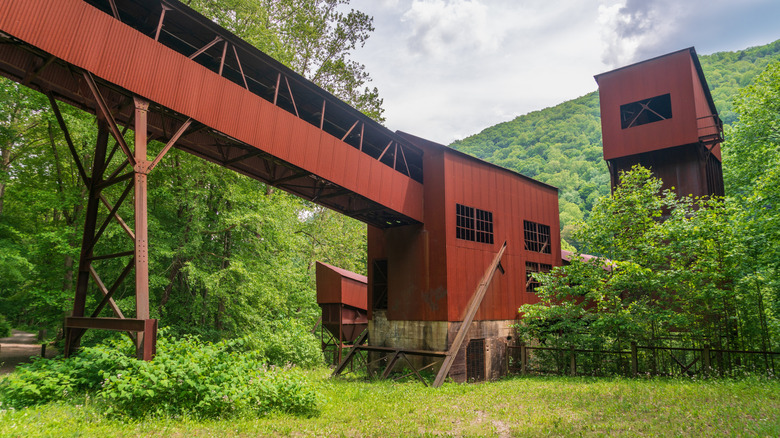
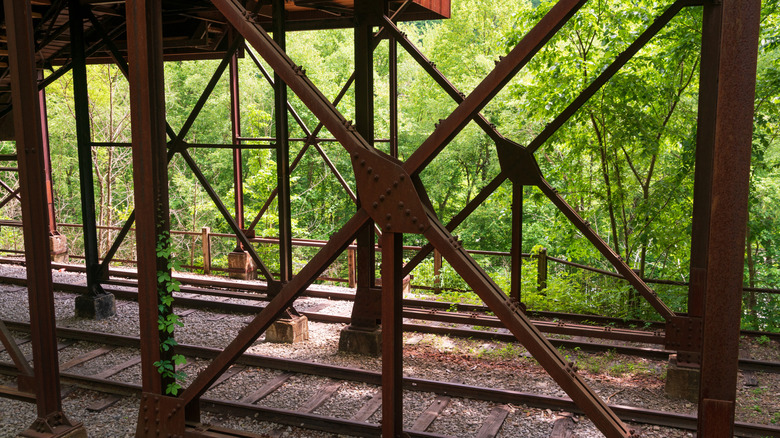
The gorge is full of nooks and crannies, but no site is more surprising than the collection of massive, maroon-colored industrial buildings hidden in the trees. These towers and conveyor systems are remarkably well preserved, even though they haven't been used since 1958. There's no glass left in the windows, and the steel beams are a little rusty, but the walls are free of graffiti, and the grounds are still maintained.
These structures are the quiet remains of Nuttallburg, a coal-mining community that was established in 1873 and ran continuously for about 85 years. Although the machinery has long stopped running and the coke ovens are cold, visitors can imagine what this place looked like in the first half of the 20th century. Unlike so many abandoned work sites, Nuttallburg is open to the public and is relatively easy to access, offering an illuminating glimpse into West Virginia's past.
Nuttallburg's history of West Virginia coal production

Many folks don't realize how historic Fayette County is, but these 70,000 acres of pristine woodland weren't always a national park. Indigenous peoples lived in this region for more than 10,000 years before the first European colonists came here, not to admire nature, but to seek their fortunes. First came the trappers, then the mine workers; for a long time, the slopes around the New River were busy with coal excavation. One of the most impactful entrepreneurs was John Nuttall, who migrated from England to the United States in the mid-19th century and decided to invest in coal production. About 50 such mining towns would come to be constructed along the banks of the New River, and Nuttallburg became a powerhouse of coal mining and carbonization.
Nuttall died in 1897, but the facilities he built continued to chug along. One of the most prominent overseers was automobile magnate Henry Ford, who attempted to modernize the coal-making supply chain. However, he ultimately became frustrated with the economics of the region and abandoned the enterprise at the end of the 1920s.
Appalachian coal mining was a contentious business, both for competing businessmen and the unpaid laborers who toiled for them, so it's no surprise that Nuttallburg eventually went into decline. While coal production is still a massive industry in West Virginia, the many mining towns of the New River have long shuttered and reverted back into forest. The alternative is for still-existing communities to quietly reinvent themselves, like West Virginia's Welch, which was once known as "Coal Town U.S.A." Nuttallburg didn't survive, but its ruins are vivid monuments to that bygone age.
Visiting Nuttallburg and where to stay
Nuttallburg isn't nearly as popular as the national park's more well-known landmarks, but the site is remarkably close to the world-famous New River Gorge Bridge; as the crow flies, they're only about 2 and a quarter miles apart. Yet this park can be tricky for visitors, as many of its roadways are rugged, narrow, and full of switchbacks. To simply get from the main visitors center to the designated Nuttallburg parking lot will take about 30 minutes by car. Remember to take these roads slow as wildlife and inclement weather are persistent dangers. You might consider strapping on boots instead; a walk here along the canyon trails takes about two hours.
If you're interested in the gorge's history, consider driving along the Fayette Station Road, a 100-year-old motorway that winds its way to the bottom of the canyon, crosses the river by bridge, and brings you back up the other side; budget about 45 minutes to an hour to complete this beautiful circuit. Once you rejoin the highway on the other side of the gorge, you'll have a new appreciation for the New River Gorge Bridge, which was completed in 1977 and takes less than a minute to cross by car. From there, you can drive into Fayetteville, a lively village with trendy restaurants, vintage buildings, and a fascinating Civil War history.
New River Gorge is surrounded on all sides by campgrounds and accommodations, catering to every budget and outdoor style. If you're yearning to live out a rustic cabin fantasy — as many would have lived in the early days of Nuttallburg — this is the place to try it. However, if you're interested in visiting more action-packed digs, West Virginia's all-inclusive ACE Adventure Resort with rafting and a water park is an adrenaline junkie's dream.