
5 Once-Thriving But Now Abandoned Ghost Towns To Visit In Utah
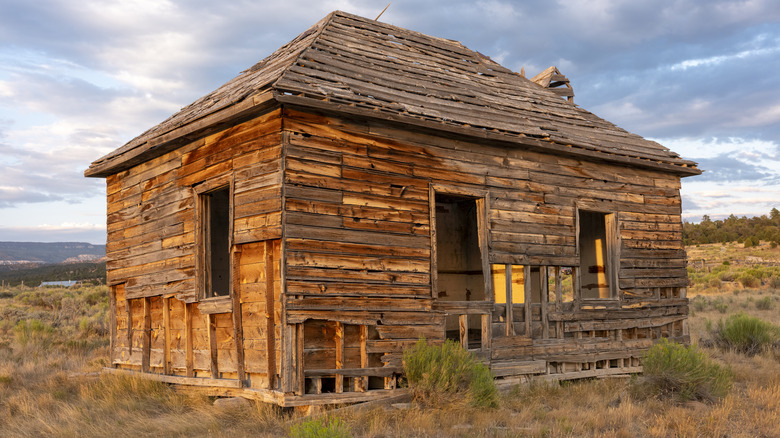
With its highland deserts, red rock canyons, and Rocky Mountain plateaus, Utah's beauty is undeniable. But out there, in all that vast wilderness, there's a storied history of hauntings, paranormal activity, doomsday cults, and boom towns succumbing to decline. If you're intrigued by the urban exploration, or "urbex," trend — in which travelers are drawn to dilapidated, abandoned, often creepy sites — then Utah might just be the perfect destination.
Ghost towns and supernatural sites hold a special place in the American public consciousness. Skinwalker Ranch, in Utah's Uintah Basin, was so rife with UFO sightings and cattle mutilations that aerospace mogul Robert Bigelow purchased the land in the 1990s to get to the bottom of the decades-long mysteries. An early 20th-century cement factory in Salt Lake City, now aptly called the Fear Factory, was like a setting from a Stephen King book, full of industrial machinery that seemed to wilfully crush, dismember, and bludgeon its workers to death. The state is replete with once-thriving towns, some of them serving as Utah's mining hubs, that have since been abandoned and are now visited simply because their auras are deliciously macabre.
From a travel perspective, there are lots of these ghost towns to explore, scattered across Utah's 84,900 square miles. You can visit all of the locations below — some with restricted access — each of which has a backstory that will have your imagination firing.
Cisco: When Art Meets Decline
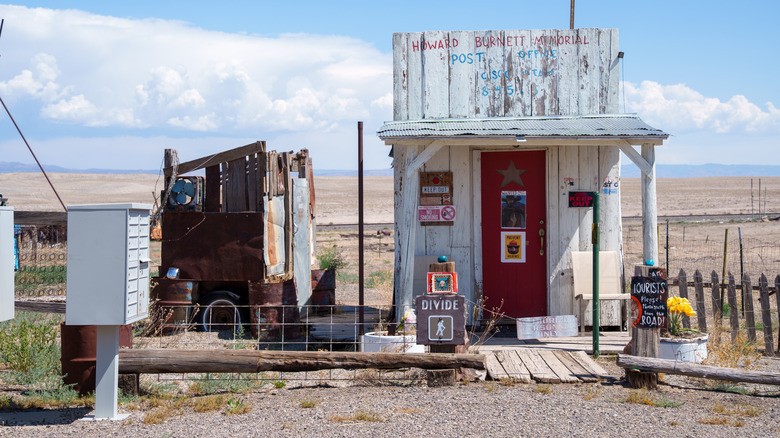
Ted Bundy was said to have visited the town of Cisco, in Grand County near the Colorado border, in the 1970s on one of his nationwide killing sprees. A connection to the "Campus Killer" could be enough to bring a town into disrepute, but Cisco was no stranger to shady characters. A 19th-century railway stop that later boomed when precious minerals and fossil fuels were discovered in the 1920s, Cisco harbored fugitives and saw frequent bouts of violence, including shootouts at the still intact Ethel's Cafe.
In 2015, the abandoned town gained a permanent resident, artist Eileen Muza. Muza, who spent four years restoring some of its decaying buildings and eventually established an artist's residency, called "Home of the Brave," in a rusty Winnebago amid the dust and dilapidation of the desert. Turns out there was one more resident in town, and he wasn't happy with the appearance of a creative interloper. After several years of harassment, including one afternoon when Muza was shot at by her neighbor and his brother-in-law, they decided to pass the residency onto a new owner, Kara Bard, who resurrected it under the name Held Horizon.
Despite their travails, Muza welcomed hundreds of guests, including artists, friends, and tourists, a tradition that Bard intends to continue. Though she did recently caution a reporter at the Southwest Contemporary, "You have to be brave to want to come out here." An hour's drive from the nearest city with accommodation, Moab, you'll need a car to get to Cisco. From there, you can explore the town on foot. There's also a general store, open March to November, where you can buy drinks, supplies, curios, and other random treasures uncovered in the desert.
Monticello: The Home of Truth
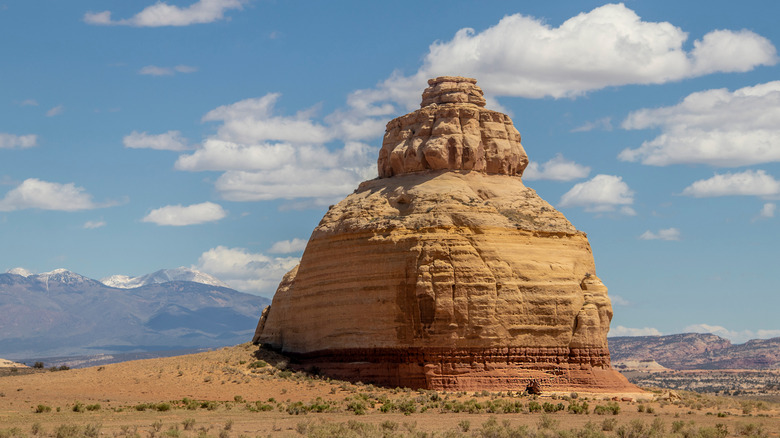
Monticello was the famous Virginia residence of America's third president and Founding Father, Thomas Jefferson, but this small Utah city of the same name has also earned its place in the history books. Monticello, Utah, was immortalized thanks to Marie Ogden, the leader of an end-of-days cult who believed that this empty corner of San Juan County would be the only place to survive the apocalypse and witness Jesus' second coming.
It was the 1930s, and Ogden, a New Jersey native, was beset by grief after her husband passed. Seeking answers in the Christian faith, she started to believe she was a conduit between God and the people. The impression of a higher power transmitting messages to Ogden through her typewriter garnered her a coterie of followers, many of whom she collected on her journey from the East Coast to Utah via America's Dust Bowl. Members of the cult, which Ogden named the "Home of Truth," practiced abstinence, Christianity, and astrology, and read Ogden's daily missives from the divine. The Home of Truth was perhaps destined to fail, but it came to an abrupt end in unusual circumstances, after Ogden tried (unsuccessfully) to reanimate a corpse with daily doses of milk and eggs for 2 years straight.
Travelers can visit the site of Ogden's failed dream, about 20 miles north of Monticello — English writer and academic Emma Kemp even spent several years there as a part-time resident researching Ogden. However, as the land is privately owned, you can't access the buildings directly without permission (though the landowner intends to reopen parts of the property for tourism). There are several motor lodges and inns offering accommodation in Monticello, as well as a glamping lodge on the doorstep of the Home of Truth.
Grafton: The Pioneering Latter-Day Saints
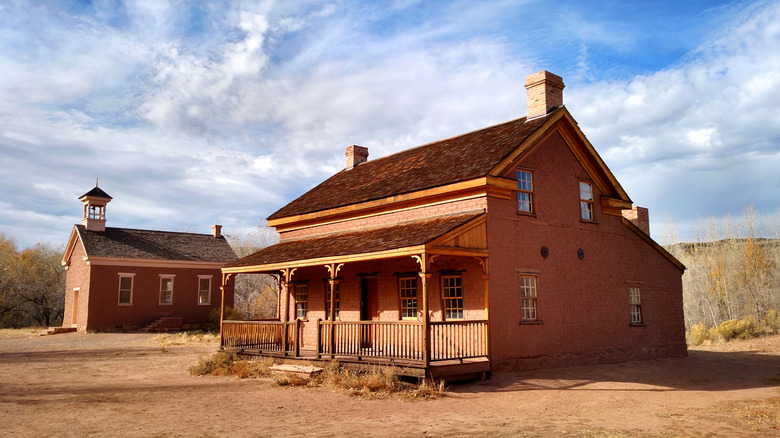
Grafton, a once-thriving settlement just outside of Zion, was first settled in 1859. Its earliest inhabitants were members of the Church of Latter-Day Saints, whose pioneering believers were establishing townships all across this sprawling, empty, and devastatingly beautiful patch of the Western United States during the mid-19th century. Those first Graftonites lived an agricultural lifestyle, harvesting and selling cotton, often with such zeal that it hindered their ability to grow edible crops like corn and sorghum. Adding to their misfortune, the town was essentially drowned by a flood in 1862, and then fears over Navajo raiders caused all the residents to temporarily desert it a few years later.
Grafton's population fluctuated over the subsequent decades, and by the end of the 1920s, it was basically uninhabited. The lack of prying eyes, well-maintained buildings, and a backdrop of frontier landscapes, big blue skies, and huge striated outcrops made it the perfect setting for the world's first talking movie shot outdoors, "In Old Arizona" (1928). Scenes from "Ramrod" (1947) and "Butch Cassidy and the Sundance Kid" (1969) were also filmed here.
Travelers are free to wander around the abandoned town and take in the epic surrounding scenery. Several of the buildings remain standing, some of them in good condition, like the famous adobe schoolhouse surmounted by a small bell tower. You can visit the town's cemetery with its preserved red-rock tombstones, and there are some signs near the entrance to Grafton offering a quick history lesson to visitors. For accommodation, consider one of the options in and around Zion National Park, like Amangiri, a modernist architectural masterpiece that could easily be mistaken for a moonbase, or (much closer) the glamping tents at Zion Wildflower Resort.
Silver Reef: Riches to Rags
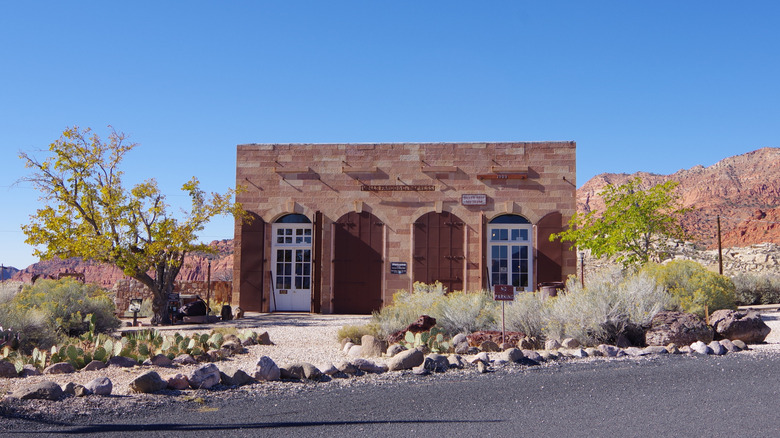
To the west of Zion National Park, Leeds is a fast-growing desert city home to another famous ghost town, Silver Reef. About 2 miles northwest of Leeds, the abandoned town of Silver Reef was established in the 1870s, at a time when people across America were rushing westward in search of precious metals, minerals, and gemstones. As the name implies, silver was discovered in the rock formations here, making it the only place in America where silver was found and commercially mined in sandstone.
The town grew with such profusion at the height of the silver boom that its Main Street grew to be a mile long. Surprisingly, Silver Reef also gave rise to a Chinatown district with 250 residents. Though it ultimately met its decline in the early 20th century when silver depreciated and the mining trade dried up, some of Silver Reef's buildings remain.
You can tour the Silver Reef Museum, located in a former Wells Fargo bank and express stop, and explore the walking trails throughout the crumbling township. The museum hosts a myriad of 19th-century artifacts, including an old stagecoach dismount step, the original silver bullion vault, ancient whiskey bottles, sepia-tinged documents, tools of industry, rifles, antique furniture, and much more. The museum is open Monday, Thursday, Friday, and Saturday from 10 a.m. to 3 p.m. (the last tour starts at 2:15 p.m.). The $4 admission fee includes a 45-minute tour and free printables, such as a trail guide you can use to navigate the town. If you want to stay the night nearby, there's a wide range of hotels and inns in the towns around Leeds.
Frisco: The Wild, Wild West
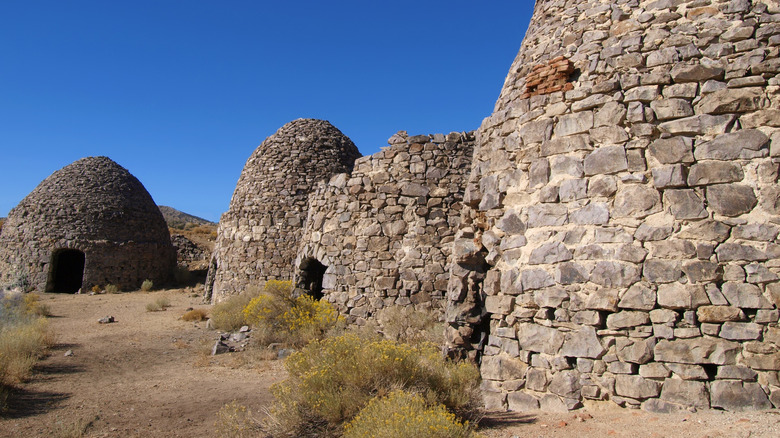
Another of Utah's late 19th-century mining hubs, Frisco has a familiar story of boom and bust. Fifteen miles west of Milford in the Great Basin Natural Heritage Area, the landscape is like that of ghost towns elsewhere in the state: dust and dry desert, tufts of hardy sage brush, a mountainous backdrop, and skies that seem to go on forever.
Frisco sprung up in the 1870s when silver was discovered and then feverishly mined in the area for the next decade. But amid this mining frenzy, Frisco became notorious as one of the wildest towns in America's already wild West. At its peak, there were as many as 6,000 residents and 23 saloons, as well as brothels and gambling dens, and a reported murder rate of one per day. No wonder a local newspaper editor described Frisco as "Dodge city, Tombstone, Sodom and Gomorrah, all rolled into one." But when the Horn Silver Mine, which had been yielding up to 1.5 million troy ounces of silver annually, collapsed in 1885, it brought an end to the silver trade, and, eventually, the town's notoriety. Frisco would continue to decline until it was fully abandoned in the 1920s.
Frisco's once-booming mining town is now an abandoned desert wonder, serving as an eerie playground to modern travelers. You'll find a crumbling cemetery on Frisco's southern edge, dilapidated buildings once housing inns, shops, and saloons, and a collection of beehive kilns used to smelt silver. The kilns look more like Neolithic dwellings than works of 19th-century architecture, and you can enter and explore them at your leisure. Be sure to take care, though, as structures throughout Frisco are in varying states of disrepair. If you do visit, there's a basic travel lodge offering accommodation in nearby Milford.