
Shinkansen Luggage Rules You Need To Know For Traveling On Japan's Bullet Trains
The Shinkansen, or bullet train, is as much a means of transport as a cultural touchstone, evincing Japan's storied engineering prowess. Boarding the train with a bento box and zipping across the country at speeds up to 200 mph has become an attraction in its own right, spurring an influx of YouTube vlogs on how to have the best Shinkansen experience. But as travel in Japan continues to boom — it's the most popular country in the world for repeat visitors — society is keeping a keener eye on tourist etiquette. This has, in part, contributed to the country revising luggage rules for its Shinkansen trains.
The rules are quite basic, covering size limitations, storage instructions, and reservation requirements. But Japan is a fastidiously rule-oriented country, and not adhering to a rule, even when it seems innocuous, could add fuel to the anti-tourist sentiment building in some corners of the country. Articles titled "The top 10 annoying foreign tourist behaviors on trains, as chosen by Japanese people" or "Should Tourists Be Fined for Stealing Reserved Shinkansen Seats?" are now dishearteningly commonplace. You don't want to be the unwitting subject of one of these pieces.
The thing is, you'll probably want to use the Shinkansen. It's a cool experience, especially if you're used to basic intracity commuter trains. On top of that, the efficiency, punctuality, cleanliness, and regularity of bullet trains put other national rail networks to shame. Also, if you're a tourist, you'll have access to the Japan Rail Pass, which, despite the occasional price hike, makes the Shinkansen a super-affordable way of traveling throughout Japan. Ultimately, the best way to enjoy your Shinkansen ride is to rest easy, and the best way to do that is to ensure your luggage is all in order.
What kind of luggage is allowed on a Shinkansen?
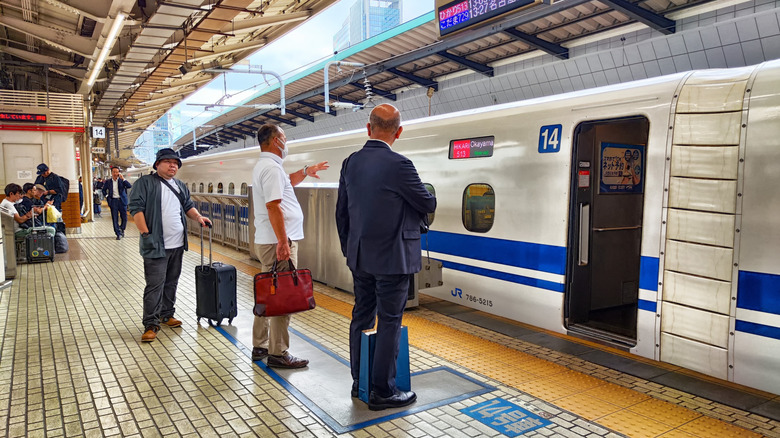
Shinkansen travelers are allowed two pieces of luggage, excluding handbags, small backpacks, tote bags, and other personal items. If the total dimensions of each unit of luggage (meaning height + length + width) are 160 centimeters (63 inches) or less, then you should be able to store these on the overhead shelves, or if need be, in the space between your legs and the seat in front. It's best to avoid the latter if you're sitting in the middle or aisle seat, as other passengers may need to shuffle past. Plus, train conductors are starting to tire of suitcases idly rolling down the aisles.
This is a fairly generous limitation. Medium-sized suitcases tend to top out at 70 x 30 x 50 centimeters (totaling 150 centimeters or 60 inches), which is quite a bit roomier than your average airline-approved cabin bag. Some airlines even require checked luggage to be no larger than 158 centimeters (62 inches). Luggage with total dimensions between 160 and 250 centimeters (63 and 98 inches, respectively) is considered oversized. These pieces are allowed on the train but must be stored in the designated oversized luggage areas. If you have a humongous piece of luggage with total dimensions exceeding 250 centimeters, you won't be permitted to bring it on the Shinkansen.
If your luggage is below the oversized threshold but no space remains in the designated storage or legroom areas, then you can place it in the oversized luggage areas as well. In this case, you're expected to inform a conductor and pay an additional fee. For this reason, it's best to pack wisely before hurtling cross-country on the Shinkansen.
Oversized luggage on Japanese bullet trains
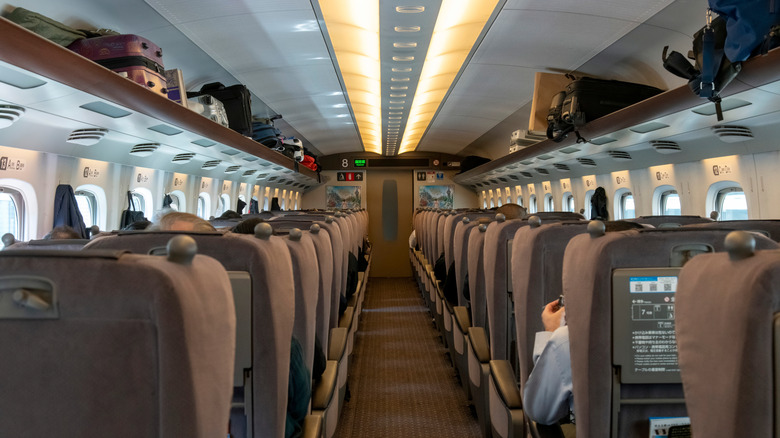
Oversized luggage generally applies only to the largest suitcases. For these items, you'll need to reserve either a seat at the back of the car with an oversized luggage space behind it — though this will prevent you from reclining — or a special luggage compartment located between the cars. These special luggage compartments are connected to specific seat numbers within the car, and you'll need an IC card (a digitized transport card used for commuter buses and trains) to lock them in place.
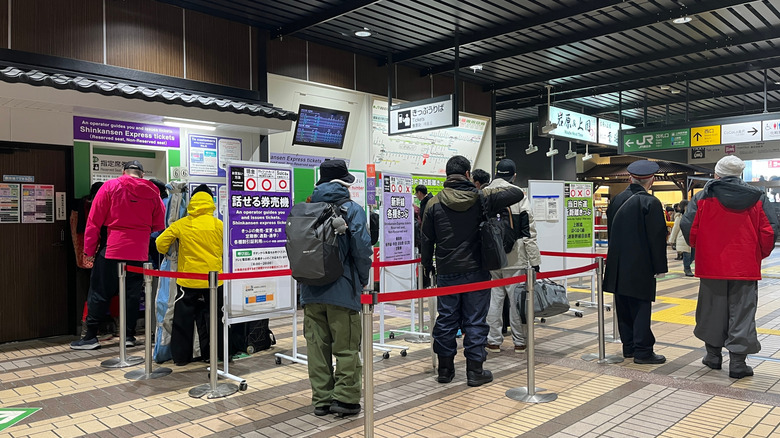
You can reserve either type of seat at ticket machines in the stations or through staff members at official ticketing booths. There is no extra charge for booking these seats, but if you're traveling with oversized baggage and you don't have a reservation, you may have to pay a ¥1,000 ($6.40) fee to store it. If no oversized baggage seats remain, a third option is to book a similar seat in the train's premium Green Car, which is technically business class, but the seats aren't much pricier than those in standard cars.
When the train is busy, like if you're traveling in Japan for cherry blossom viewing or during the chaos of Golden Week, you can instead send luggage through Yamato Transport's super-efficient, user-friendly TA-Q-BIN service. TA-Q-BIN also has limits on sending packages larger than 200 centimeters (78 inches) or weighing more than 30 kilograms (66 pounds), but it can often guarantee door–to-door delivery within 24 hours, or 48 hours for more remote locations.
Are there exceptions to the rules?
At the time of writing, luggage reservations only apply to travelers on four bullet train routes: the Tokaido Shinkansen, traveling from Tokyo to Osaka; the Sanyo Shinkansen, from Osaka to Fukuoka; the Kyushu Shinkansen, from Fukuoka to Kagoshima; and the Nishi Kyushu Shinkansen, from Takeo-Onsen to Nagasaki.
Tokaido is the busiest route, which the majority of first-time travelers will use, running along Japan's most densely populated urban belt and featuring destinations like Yokohama, Mt. Fuji, Nagoya, and Kyoto. The Sanyo Shinkansen, connecting two of Japan's liveliest cities and making stops in Himeji and Hiroshima, also ferries a lot of tourists across the country. Somewhat confusingly, trains on these routes are running a trial period of unknown length — in operation at the time of writing — where luggage can be stored in the compartments between cars, free of charge without prior reservation, if there is enough space.
For special luggage — strollers, skis, musical instruments, bikes, surfboards — you don't currently require a reservation on any Shinkansen train, irrespective of the luggage's size or the irregularity of its dimensions. That said, reserving oversized luggage space for a snowboard, for example, is probably a good idea. This will keep it from getting in your way, or that of the passengers around you, and is a more secure way to store the equipment. If you're heading for the slopes of a remote mountain town, like Zao Onsen or Minakami, you could either book an extra seat for said snowboard or use the TA-Q-BIN delivery service, as outlined above.