
Colorado's Hard-To-Reach Ghost Town Has The State's Most Idyllic Mountain Views
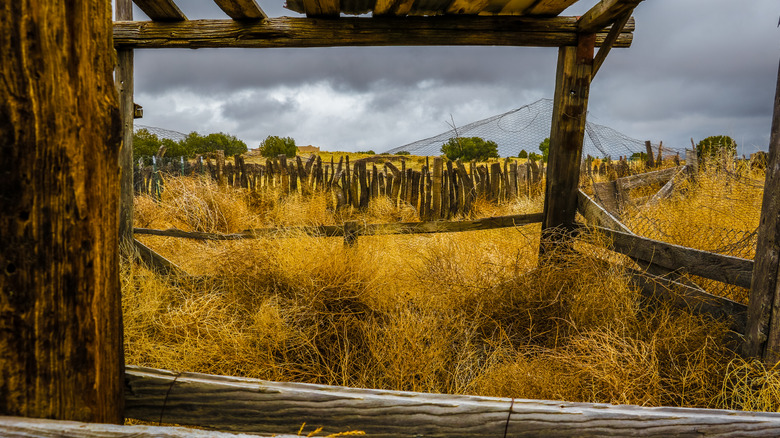
When it comes to old-timey ghost towns for sightseeing, Colorado takes the top prize. Clusters of creaky saloons, crumbling general stores, and once-fancy hotels are scattered all across the Centennial State. Clinging to the dramatic peaks of the San Juan Mountains is Animas Forks, one of Colorado's best-preserved ghost towns. And just under a two-hour drive southeast from there, you'll find Carson, the skeletal remains of another old mining town that succumbed to the same misfortunes as so many others.
The two-hour journey gives the impression you can just hop in your car and pull up to Carson's dusty, abandoned roads — you can, but it's not quite as simple as that. Tucked against the slopes of the Continental Divide, this high-altitude ghost town is notoriously difficult to reach. You'll need a vehicle with four-wheel drive and high clearance to traverse the rocky terrain up to Carson's mountaintop perch. In fact, the weary trek miners had to endure through the steep switchbacks and stream crossings of Wager Gulch just to reach town was one of the reasons Carson's population began to dwindle, until it was at last deserted.
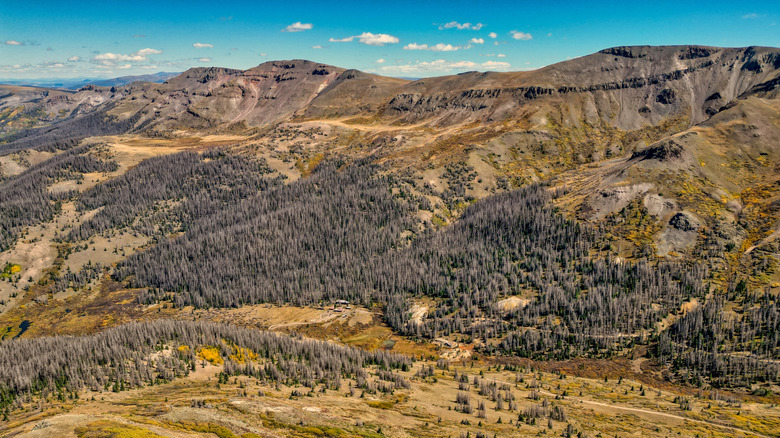
The rough roads are worth the effort. As you pull up to the smattering of rickety clapboard buildings against a backdrop of evergreens, look out across the slopes for sweeping views of the Rockies in the distance and Wager Gulch down below, flanked by rolling alpine meadows. Continue over the Continental Divide to visit the remains of Old Carson, the original mining camp, now merely a pile of rubble. Make sure to be respectful if you ever decide to visit, as the land is now privately owned. Though the gold mines have long dried up, the spirit of the mining town echoes in the air.
The haunting history of Colorado's Carson ghost town
Like many mining towns across the Old West, the population of Carson ebbed and flowed along with the presence of mineral-rich deposits. Waves of miners descended upon the town in the 1890s when a new vein of gold was struck, and Carson thrived. What had begun as a modest mining camp more than a decade earlier had grown into a sizable community with a post office and a saloon.
The newer Carson settlement likely developed because Old Carson was too severe. Established in the early 1880s, the mining camp at Old Carson stood at more than 12,000 feet above sea level, stretched across both sides of the Continental Divide, and no doubt exposed to the harsh winds and snowfall of the mountaintop. New Carson was established not long after, at a slightly lower elevation. The mines produced bountiful loads of silver, gold, copper, and iron, and a new smelter was constructed thanks to the mine's soaring profits, along with a boarding house.
But alas, the good times were not to last. By the turn of the century, Carson was all but deserted. Colorado winters became too unbearable even for the hardy miners to endure, and as the veins of ore dried up, they left to seek their fortunes elsewhere. Carson's dilapidated saloon still stands today, along with several other cabins. The planked roofs, which were once filled with gaping holes, have now been reinforced with sheet metal. Gaze out across the Continental Divide as the miners once did. From this vantage, the horizon rolls out in layers of peaks and valleys that seem to stretch on forever. The striking views of forested slopes and ridgelines make Carson one of the most picturesque remnants of the state's mining past.
Planning your visit to Carson, Colorado
While reaching Carson is going to be difficult, it's not impossible if you're determined. If you're flying in from out of state, the closest major airport is Denver International Airport, which offers the most accessible route via rental car. The nearest major destination to Carson is Lake City, a nearly five-hour drive from Denver. There are a few motels in Lake City where you can rest before heading to Carson. Try the Alpine Village, where log cabins are set against a backdrop of woodlands, or book a stay at the North Face Lodge, a wooden chalet clinging to the mountainside. Guest rooms are simple yet snug, and a communal terrace offers views of the alpine landscape.
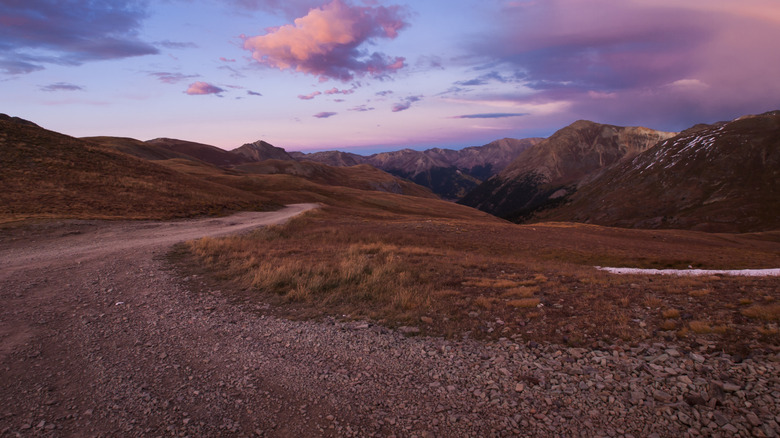
Heading south from Lake City, follow Highway 149 until you reach the turnoff for County Road 30, which is marked by a sign for Lake San Cristobal Recreation Area. During this leg of the journey, the roads are still paved, and the drive through the wilderness is incredibly scenic, with snow-capped mountains rising in the distance. Passing by the lake, you will then need to veer onto County Road 36, marked by a small blue sign. Here is where the terrain becomes rocky, and as you ascend Wager Gulch Road, be prepared for a bumpy ride dotted with steep climbs and several switchbacks before leveling out as you arrive at Carson.
Driving back down Wager Gulch to the intersection of County Road 30, you could go west through Cinnamon Pass to reach Animas Forks, then follow the road all the way down to Silverton, known for gold rush saloons and scenic trains. If you're looking for a Colorado ghost town with a fun twist, continue from Silverton to Dunton Hot Springs, offering century-old cabins and luxurious stays.