
The Way You Hold Your Fork In Europe Will Out You As An American Tourist

When you're eating dinner at home, it's pretty unlikely that you're thinking about which hand you're holding your fork and knife in. In fact, it's probably never even come up in dinner conversation. However, if you've traveled to Europe, you may have gotten some stares while dining that you didn't understand. The reason is that we, as Americans, tend to do something called the "cut-and-switch" method of cutlery use.
This means that, if you're eating something that requires cutting with a knife, you likely hold onto your fork with your non-dominant hand — which we'll say is the left hand, for this discussion — and the knife with your dominant hand (or your right hand, for our purposes). Then, once you've cut your food, you likely put down your knife and switch your fork to your right hand to take a bite. No biggie, right? Well, in Europe, that's not how it's done.
If you watch Europeans eat, you'll notice that they hold their fork in the left hand and knife in the right — pretty much the same way Americans begin. However, what changes is that they don't switch the fork back to the right hand — instead, they lift the fork to their mouth directly using their left hand. While cutlery use in the American style isn't a faux pas — like leaving chopsticks upright in a bowl of rice in Japan (which mimics a funerary practice) — it will certainly signal that you're from the United States. While a 2015 article from The Guardian mentions that some young people in the United Kingdom have adopted the American style of eating, it's still generally common to avoid switching hands in Europe.
The differences between how Europeans and Americans use a fork
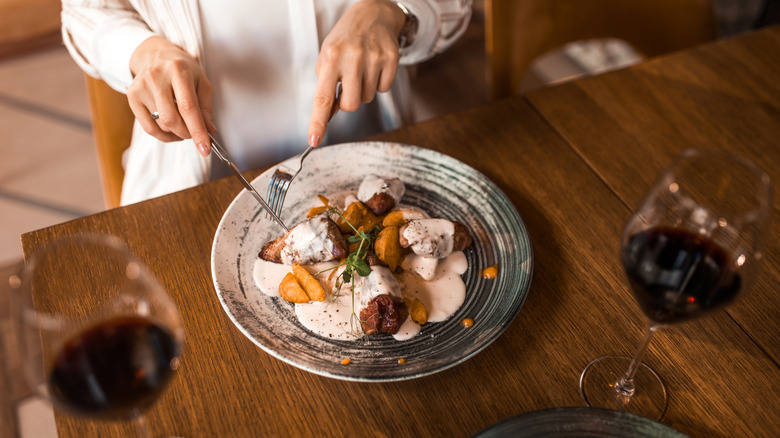
Cutlery use isn't the only thing to peg you as an American dining in Europe, as it's certainly not the only tell we have. For instance, in France, if you use a knife on salad, that's considered a faux pas as well. That said, knowing why there's even a difference in how we use our forks in the first place might help you better understand why it's worth doing things differently.
Forks haven't been in use as long as spoons and knives, showing up only around the 11th century as a tool for eating — despite pronged implements being typically used for cooking and serving before that. However, according to the book "The Elements of a Home" by Amy Azzarito, Americans didn't actually adopt forks for common use until the early 18th century, as British taxes on the colonies made them too expensive.
Beyond historical availability, there is another explanation for the American cut-and-switch method. According to an Instagram post by antique dealer and author Steven Moore — author of "The Stuff of History: A Curated Compendium of Curious Objects and Forgotten People" — Americans do the cut-and-switch for a very practical reason. "When people took wagon trains out to the West to pioneer new states, they had to be very careful about how much weight they took. So, taking a fork was sensible, taking a spoon was sensible, but a dinner knife was pretty useless," he says. As such, people resorted to using the side of their forks to cut food and lift it to their mouths, making the use of the fork in the dominant hand a habit. Ultimately, though, if you're trying to blend in like a local in Europe, mastering the art of keeping your fork in your left hand might be key to avoiding unwanted attention at the dinner table