
Colorado's Once-Thriving Gold Mining Hub Is Now An Abandoned Ghost Town

A once-thriving Colorado gold mining hub that was the seat of Park County is a ghost town with a strange ending: After being abandoned, it came back to life before meeting its final end at the hand of one of the (lesser-known) Koch brothers. About 2.5 hours from the remaining Old West legacy of Denver, you'll find the cemetery of Buckskin Joe, a mining town that popped up in 1859. Although officially named Laurette (for Laura and Jeanette, the only two women in the town), the town has always been known as Buckskin Joe, the nickname of prospector Joe Higgenbottom, who first found gold in the area.
Legend has it, the fur-loving Joe was out hunting and slipped on ice. His gun went off and shot a rock, revealing gold beneath. Others soon followed to dig up the gold in the area. Originally a tent city, the town grew to about 2,000 (some say as many as 5,000 lived there). By the early 1860s, Buckskin Joe had a grocery store with a post office, saloons, hotels, and a gambling hall.
As with so many ghost towns, Buckskin Joe saw its decline once the gold ran out, which it did around 1866, when the mill closed. By 1880, the town was essentially empty, with most people moving on elsewhere and even some of the buildings leaving, too (the courthouse was moved to Fairplay). Unfortunately, you can't say this is one of the American West's best-preserved ghost towns, since all that remains of the town is the cemetery with 19th-century tombstones marking the lives and struggles of those living in Buckskin Joe.
The resurrection of Buckskin Joe
Buckskin Joe was home to some of Colorado's most recognizable figures. "Silver King" Horace Tabor, who later became one of the wealthiest men in Colorado and a senator, owned the general store and post office with his wife, Augusta. When a smallpox outbreak hit Buckskin Joe in 1861, Silverheels, a popular masked saloon dancer, took care of those afflicted with the disease. When the residents went to thank her afterwards, they found that she had disappeared into the mountains, possibly sick herself. Now, Mount Silverheels, named for her, serves as a reminder of her selflessness.
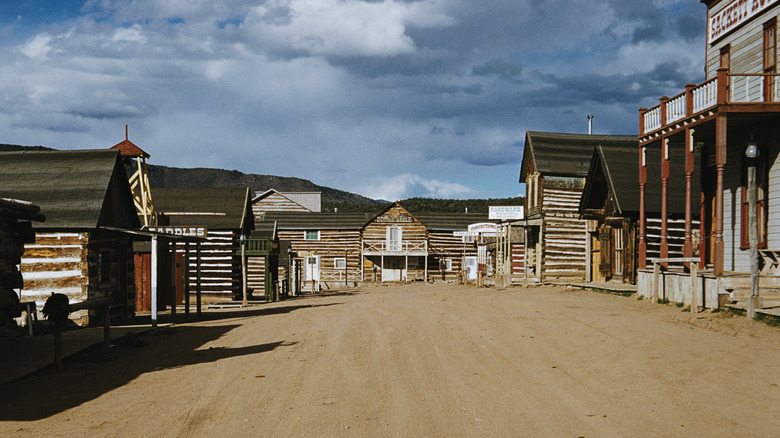
Nearly a century after its abandonment, Buckskin Joe was resurrected thanks to Hollywood magic. In 1957, MGM director Malcom F. Brown had a custom Old West set built a few miles outside the rugged river town of Cañon City. Original 19th-century buildings from all over the state were brought to this "town," including Horace Tabor's general store from Buckskin Joe. That wasn't all they took, either; this new town was named Buckskin Joe, which served as a film set and opened as a tourist attraction in 1958.
Buckskin Joe was "the largest authentic Old West Theme Park in the nation," per the Cañon City Daily Record. People flocked to see its historic buildings and to get a taste of that wild West life by watching actors have shoot-outs in the streets lined with stagecoaches and wagons. Buckskin Joe was a successful theme park and film set for decades. But over time, people stopped visiting it, and in 2010, billionaire and Old West afficionado William Koch bought the entire town for $3.2 million and had it transported — board by board — to his private ranch, where it stands today.