
How Americans Can Visit Easter Island And Explore Its Ancient Mysteries Amid Volcanic Landscapes
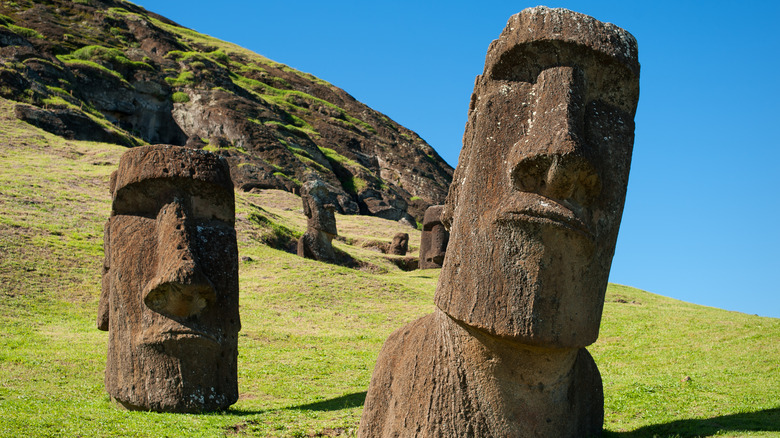
Known indigenously as Rapa Nui, Easter Island has an irresistible magnetism for many travelers, if not for its giant, uncanny moai statues, then for its sheer remoteness. It's often ranked among the most mysterious places around the globe that leave more questions than answers: How did its first inhabitants even get there, and how did they adapt to such an isolated environment? What's the purpose of the moai, and how were these heavy statues moved, considering the largest weighs nearly 86 tons? Beyond its historical mysteries, the island is simply stunning, with dramatic volcanic terrain, a crater lush with fruit, and shores of pitch-black basalt lapped by the Pacific.
For anyone who wants to add the beautiful Polynesian island to their bucket list, they should know it will take some work to get there (though, no doubt, at a great reward). The closest continental land, Chile, is around 2,300 miles away from Easter Island, so visiting this secluded destination is difficult – travel time is long, flights can be harder to come by, and the costs for travel and accommodations can be exorbitant.
Since it's home to such significant archaeological sites, there are strict rules in place to protect Easter Island from overtourism. Stays on the island are limited to 30 days maximum, they require authorization from Chile's National Tourism Service, and some areas are off-limits without a professional tour guide. Nonetheless, once you've understood the rules and gotten the proper permissions, it's totally feasible to visit Easter Island and marvel at its wonders.
What to know about flying to and staying on Easter Island
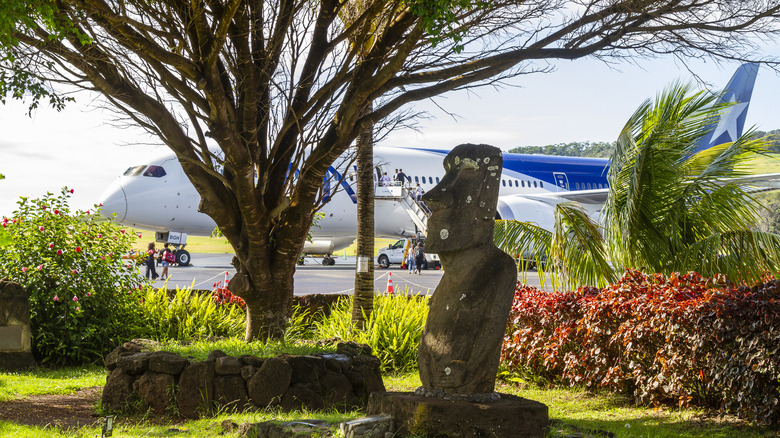
The first step of planning a trip to Easter Island is booking a flight, which itself is difficult. Tahiti once offered direct flights to Easter Island, but COVID-19 changed that. Now, the island's sole airport, Mataveri International Airport, only has flights from Santiago, Chile, offered by just one airline: LATAM, which, to be fair, has a convenient and classy reputation in the airline industry.
Luckily, per Google Flights, travel between Santiago and Easter Island is offered daily, with round-trip costs ranging anywhere from $300 to $800 — it's a good idea to check regularly, as the prices fluctuate a lot. The fastest flights take about five or six hours. Before you get to the airport, make sure to fill out a Single Entry Form, one of the requirements for entry, and don't bring any honey products (they're prohibited on the island to protect its ecosystem).
With a flight booked, you'll also have to find proper accommodations. In order to travel to the island, you need to have proof that you've booked accommodations that are registered with the National Tourism Service (SERNATUR), typically in the form of a confirmation email. The good news is that it's required for local lodgings to register with SERNATUR, so it should be an automatic feature for reputable places. Travel blogger Worldly Adventurer recommends the campsite-hostel hybrid Tipanie Moana, which offers tent stays and bedroom rentals, starting around $60 to $80 per night. For a luxury stay, the blogger suggested Hare Nua Hotel Boutique, which has a more chic resort-like feel. You can find room rates starting around $300 to $400 a night.
How to explore Easter Island's parks and landmarks
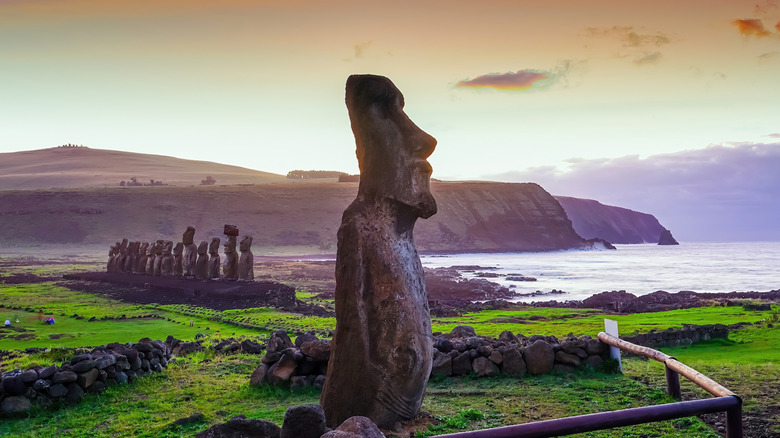
There's a good chance that the top item on your Easter Island itinerary is seeing the moai, statues with particularly massive heads carved up to a thousand years ago by the Rapa Nui people out of lava tuff. These statues are located in the UNESCO-protected Rapa Nui National Park. The park is open to visitors under a few conditions: You have to enter with an accredited guide, you need to get a ticket in advance (about $100 each, as of this writing), and you need to stick to demarcated boundaries.
The park encompasses about 40% of the island, so you'll want to set aside plenty of time for sightseeing. The moai are scattered around different sites, with many clustered together on an ahu, a type of ceremonial platform. Beyond the moai, the park also contains the remains of several ancient villages and the quarry, located in a volcanic crater, where most of the statues were excavated from.
When you want to venture out to the island's other landmarks without having to follow a guide, one of the most beautiful spots you can enter guide-free is Anakena Beach, the biggest sand beach on the island. The beach is watched over by towering, restored moai, and encircled by a hilly, basalt-strewn volcanic landscape. Another outing you don't need a ticket or guide for is the hike up Mount Terevaka. It's one of the island's three volcanoes and its highest peak.