
This Island In Europe Just Ranked No. 1 For Hiking (And It's Loaded With Scenic Trails)
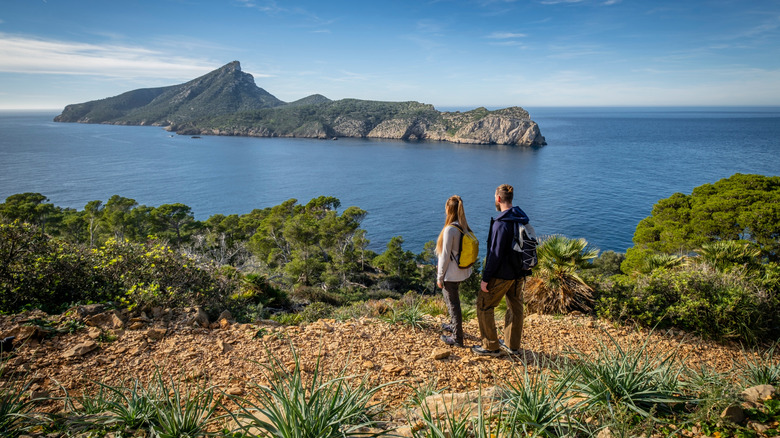
From Portugal's Camino de Santiago, a scenic and less-crowded version of the famous hike through France and Spain, to Sentiero Azzurro, one of the Belpaese's best walking routes connecting all five of the charming Cinque Terre villages, the four corners of the Old Continent are full of beautiful trails for every kind of hiker — seasoned and beginner. However, there's one place — or, better, an entire island — that, according to a recent study, beats them all. Island Hopping's travel insiders have identified the Spanish island of Mallorca as Europe's top destination for hiking.
This 1,500-ish square mile Mediterranean island, home to less than one million residents — the largest in the Iberian Peninsula and, along with Minorca, Ibiza, and Formentera, is part of the popular Balearic archipelago — manages to pack an incredibly high number of trails, especially considering its relatively compact size. Hikers can take advantage of more than 500 mapped and marked paths, a number shared with the following three destinations in the ranking — Crete in Greece, Sicily in Italy, and the Portuguese island of Madeira. For reference, California, the U.S. state with the most hiking trails, boasts over 16,000 trails, but its land area is about 110 times larger. But this is only one piece of the puzzle.
As reported by Travel + Leisure, the survey took into consideration a wide pool of both experiential and measurable metrics – in random order: trail distance, ease of access, security, weather conditions, lodging prices, and online buzz — and applied them to a selection of 20 destinations. Each of them was then given a Hiking Quality Index score. Unsurprisingly, Mallorca (Majorca for locals) excelled on all fronts.
Top hiking trails for families and beginners in Mallorca

With so many trails crisscrossing Mallorca, it might be hard to choose where to start exploring its wonders — be it the golden beaches of Cala Mondragó and Cala Figuera in the South, the dramatic cliffs of Cap de Formentor on the opposite corner of the island, or the quaint villages of Sineu, Fornalutx, and Valdemossa in between. Beginners and families can get a feel of the island's raw and untouched beauty by tackling the 4,200 acres of the S'Albufera de Mallorca Nature Park wetlands near to Alcúdia Bay (pictured). A true paradise for bird-watchers and nature photographers, it hosts over 300 avian species, including the iconic flamingos and herons.
Here you'll find a network of wide, generally flat paths, most of which are also suitable for mountain bikes and e-bikes. AllTrails notes the longest trail here is a loop that stretches approximately 8.4 miles and connects Cami d'en Mig to the viewpoint of Ses Puntes. The park is open year-round and entry requires a permit, but it's free. From April 1 to September 30, hours are from 9:00 a.m. to 6:00 p.m., and from 9:00 a.m. to 5:00 p.m. during the remaining months.
Wandering the cobblestone streets of the insula maior's main hub, Palma de Mallorca, is another easy way to squeeze in some good old sightseeing while also staying active. AllTrails' 3-mile Palma de Mallorca Walking Tour starts and ends in the historic heart of the city, not far from the beautiful Plaça de Santa Eulàlia. Along the way, some of Palma's most iconic landmarks, including the exquisite Palacio March Museum with its lush gardens, the stunning Gothic Cathedral of Mallorca, and the legendary Drac de la Coca looking toward the water.
Advanced hikes in Mallorca for the brave and bold
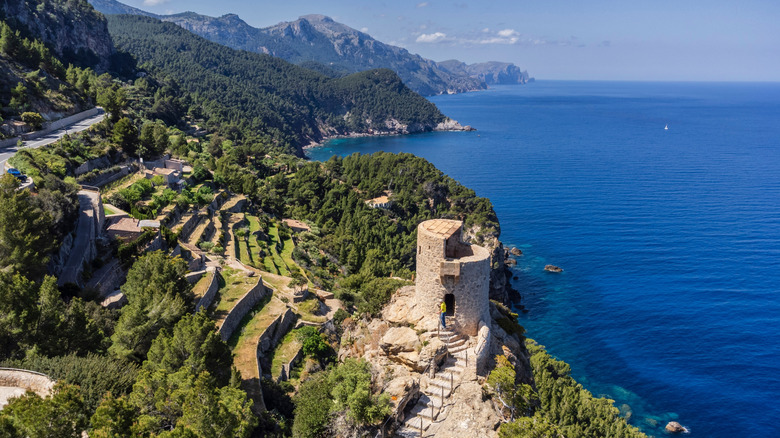
If you're ready to embark on a more challenging path, Mallorca will not disappoint. The UNESCO World Heritage Serra de Tramuntana mountains feature more than 50 summits over 3,200 feet high – 54, to be precise, with the highest being the Puig Major, almost 4,921 feet. With a NATO military installation on top and incredible views, it stands as a true playground and breathtaking vista point for more advanced explorers.
Perhaps the most iconic is the GR221 (Gran Recorrido 221), the approximately 87-mile "Dry Stone Route" crossing the Tramutana range from Port d'Andratx in the southwest to Pollença in the north. Celebrated internationally as one of the Old Continent's classic long-distance trails, with epic scenery ranging from quaint villages, to olive groves, to imposing cliffs rising above the Mediterranean Sea, it takes about 8 to 10 days to complete, mostly depending on your level of fitness, with the possibility of tackling it in shorter sections, or taking part in organized expeditions. Conquering the Puig de Galatzó, hailed as "one of the best natural viewpoints" on Mallorca, is another feat that proves particularly rewarding for advanced hikers. The ascent and return from the Estellencs Route takes about 4 hours, for a total of 2,360 feet of elevation gain and about 6.5 miles.
While Mallorca is a scenic paradise for outdoors adventurers, it's incredibly easy to reach. Domestic and international flights connect the island to all major European airports, with low-cost carriers like Ryanair and easyJet offering frequent — often daily — routes. For reference, Milan-Bergamo is less than two hours away, while Barcelona is about one hour. The same goes for ferries and fast catamarans, which keep Puerto de Palma de Mallorca well-linked to the Spanish mainland (the main departing and arriving ports being Barcelona, Valencia, and Dénia).