
5 Of America's Most Diverse Cities Are Vibrant Destinations Travelers Will Love
Why do we travel? Each of us has our motivations, but many seek out human diversity. We take heart in the range of foods, faiths, fashions, and languages of our single world. Such places serve as melting pots, drawing in all kinds of demographics and mixing them dynamically together. Global restaurants stand side-by-side, serving everything from chalupas to curry to injera bread. The communities are enriched by a magnificent range of ethnicities and gender identities, abilities, and orientations.
In early 2025, the financial institution WalletHub published data identifying the "Most Diverse Cities in the U.S." Chip Lupo, a WalletHub analyst, stated: "WalletHub tallied the scores across the five major diversity categories for 501 of the largest cities across 13 metrics." These included cultural, socioeconomic, economic, household, and religious diversity. It's easy to find slightly different studies with wildly different results, like U.S. News and World Report's "10 Most Racially Diverse Big Cities" from 2020, or Quicken Loans' "10 Most Diverse Cities in the U.S." from 2024. There is very little overlap from these three studies, suggesting very different parameters.
The recent WalletHub report is striking because it doesn't point to major metro areas like Los Angeles or Chicago: the top three locations are in suburban Maryland, and the next two are in Texas. With the exception of Houston, none of these communities are a household name — yet they all make for fascinating visits. All these destinations thrive on diversity, which should be evident the second you arrive. Yet each offers unique experiences that would be hard to replicate anywhere else.
Gaithersburg, Maryland
Until the 1970s, Gaithersburg was a sleepy town about 25 miles north of Washington, D.C. The town was actually incorporated in the 1800s and served as a rural railroad depot for many of the intervening years. Yet the construction of the National Institute of Standards and Technology in 1961 triggered a profound migration, drawing a variety of diverse newcomers. Over the next few decades, the population surged to about 71,000 in 2025, and today, America's most diverse city is full of history, global dining, and cultural festivals. It's also a well-to-do suburb, with a median household income of $141,000 and vast stretches of new development.
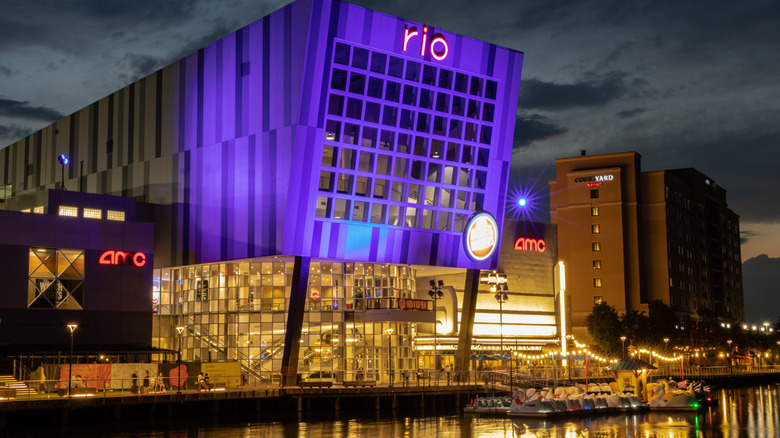
For travelers, the main attraction is the Rio Lakefront: This entertainment district is packed with restaurants, retail, concerts, and even an old-school carousel. During the many warm months, you can hop a ride on a paddleboat, admiring the skyline from a swan-, flamingo-, or dragon-shaped vessel. The Rio district also has a dozen or so hotels, several costing under $100 per night.
Silver Spring, Maryland
Just down the highway from Gaithersburg is Silver Spring, a longtime bedroom community for D.C.'s government workers. This robust suburb grew exponentially during the second half of the 20th century, and the population has ballooned from around 70,000 to 84,400 just since 2010. Georgia Avenue is a major artery that bisects Silver Spring and cuts south into the city. But part of the area's appeal is its accessible transit: The local metro station is just a half-hour ride from the National Mall, so you can skip driving altogether.
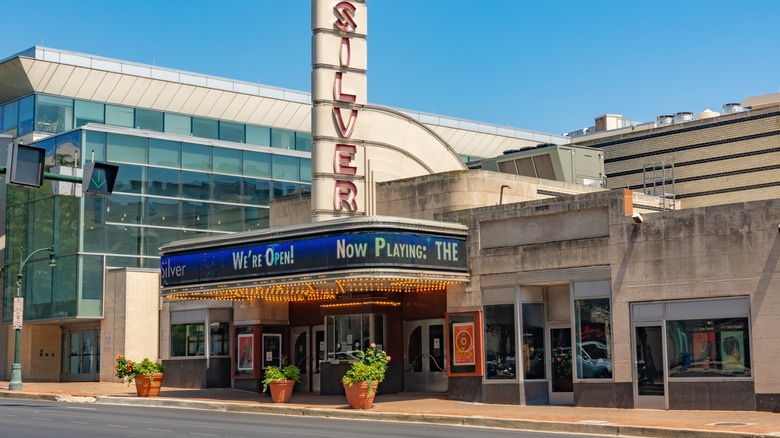
This suburb is well known for its strip malls and subdivisions, but developers have spent years cultivating a central commercial district. Today, Downtown Silver Spring is one of the most attractive destinations in Montgomery County. You'll find every kind of meal, from falafel to hibachi, and the AFI Silver Theatre has screened independent and global films since 1938. One of the most unusual institutions is the National Museum of Health and Medicine, which spotlights medical breakthroughs and the impressive diversity of healthcare professionals through history.
Germantown, Maryland
True to its name, Germantown started as a tiny village of German-speaking immigrants in the early 19th century. Oddly, Germantown was never actually incorporated, so about 90,000 people live in what is technically an "urbanized, census-designated place" (via Waterford Place HOA). It's quite the census: The population is almost equally divided among white, Black, and Asian residents, with another quarter that's mostly Hispanic. It's rare in the U.S. for ethnic demographics to be so evenly dispersed, and Germantown benefits from a high-middle-class income bracket and a relatively low crime rate.
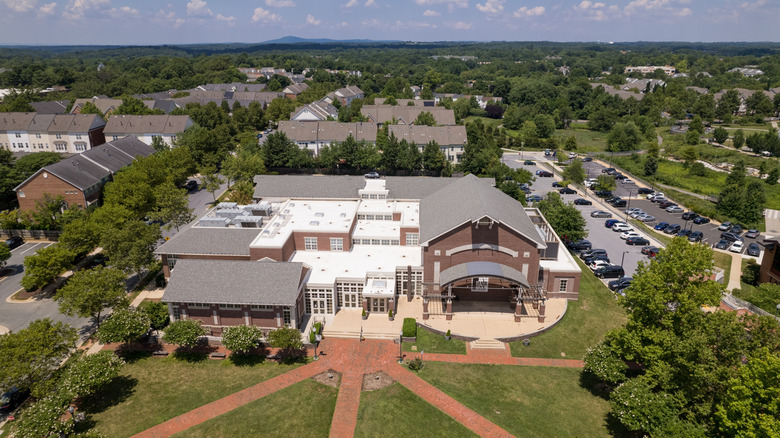
Like the other Maryland suburbs, Germantown is pretty spread out and composed mostly of residential subdivisions, but it's also an artsy D.C. suburb with outdoor fun, markets, and shops. One of the most revered local institutions is the BlackRock Arts Center (pictured above), which houses galleries, hosts events and fine arts classes, and serves as a hub for Germantown's creative community. The area has family-friendly parks and green spaces, such as the 1,557-acre Great Seneca Stream Valley Park, and you'll find a handful of affordable hotels along Interstate 270, most under $100 per night.
Arlington, Texas
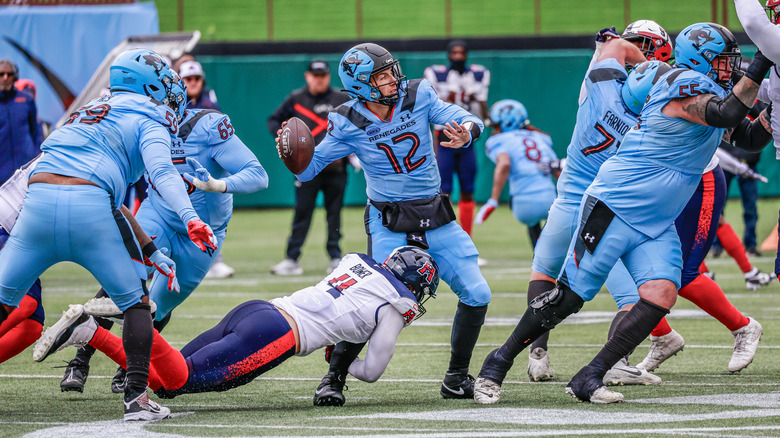
They say everything is bigger in Texas, and in Arlington, that includes its demographic diversity. The population is almost equal parts white, African-American, and Hispanic, and about one-fifth of its residents were born outside the U.S. The city of about 400,000 is wedged between Dallas and Fort Worth; the municipality can feel like a shared suburb, and it doesn't have a skyscraper-studded skyline like its two neighbors, yet Arlington has a distinct personality and is known for its sports and entertainment complexes.
Arlington's biggest draw is the AT&T Stadium, home of the Dallas Cowboys, a billion-dollar facility with seating for 80,000 spectators. Football is a sacred sport in Texas, and the city is flooded with fans on game days. The Texas Rangers play ball at Globe Life Field, a state-of-the-art facility completed in 2020, while their former stomping ground, Choctaw Stadium, hosts a wide range of sports and cultural events. Meanwhile, the first Six Flags location was opened in Arlington in 1961 and is still going strong, with 41 amusement parks across the country.
If you're looking for something a little more low-key, the International Bowling Museum & Hall of Fame is also located in Arlington. This may sound like a weird roadside attraction, but the museum is masterfully curated and includes 18,000 square feet of exhibits, with a history that dates back to the Pharaohs. Finally, you're just a quick drive from the cowboy charms of this overlooked Texas city known as "Where the West Begins."
Houston, Texas
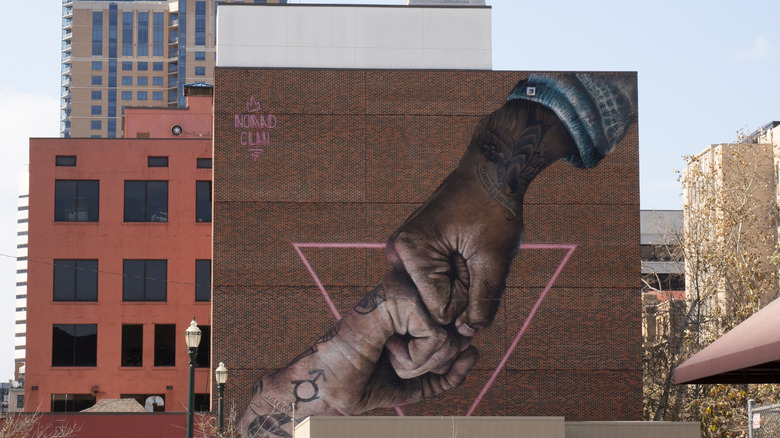
Right in the middle of downtown Houston, you'll find the mural "Inexorable" (pictured at the top) created by a pair of artists known as Nomad Clan. The mural shows two fists giving each other a "pound"; one hand has darker skin, the other lighter, and their tattoos are symbolic of LGBTQ+ identity and empowerment. The mural speaks to Houston's growing intersectional culture — and its remarkable ranking as the fifth-most-diverse city in the United States. Houston is definitely big; 2.3 million residents make it the fourth-largest city in the country. Yet the Texas oil capital also beats out New York and Los Angeles with its ethnic spectrum (per Culture Map), and this range of people extends into gender and sexual identities as well.
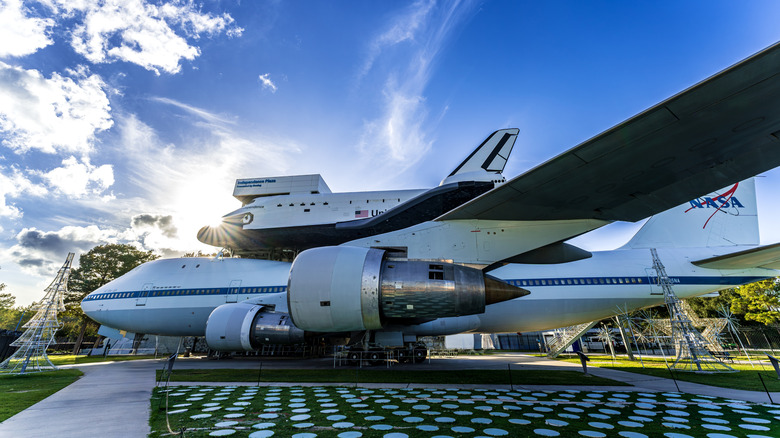
Houston is by far the most action-packed city on this list. You can fly into Houston's colossal airport — America's 15th-busiest hub according to Stratos Jets — and beeline to Space Center Houston, a multi-media museum complex that introduces astral exploration to the whole family. This sprawling metropolis boasts a Museum of Fine Arts and Museum of Natural Science, and the dining scene is an eclectic mix of steak houses, taquerias, and international menus. One of the most striking surprises is the city's underground system, which connects 95 blocks with a maze of retail "tunnels." Scores of festivals take place in Houston throughout the year, including the decades-old Art Car Parade. Not only are the participants diverse, but so are the wildly imaginative machines they've customized.
Methodology

Diversity is a tricky concept. As mentioned above, these "top 5" most diverse cities were based on the 2025 WalletHub report, which earned a lot of attention across the media, especially in the communities listed. The author doesn't mention other categories for diversity, like age, primary language, or sexual orientation, which might have led to different results. The WalletHub post also refers to the "501 most populated cities," but this can get confusing when municipalities overlap.
Our interest in this particular study was largely its unexpected findings. The author has spent a good amount of time in suburban Maryland, and the richness of its population is palpable. At the end of the day, the exact mathematics of diversity isn't as important as how safely and happily people coexist in a community, and all these places seem to strive for a healthy balance.