
Two Of Chicago's Most Iconic Tourist Attractions Are A Walkable Pair (And Both Free To Explore)
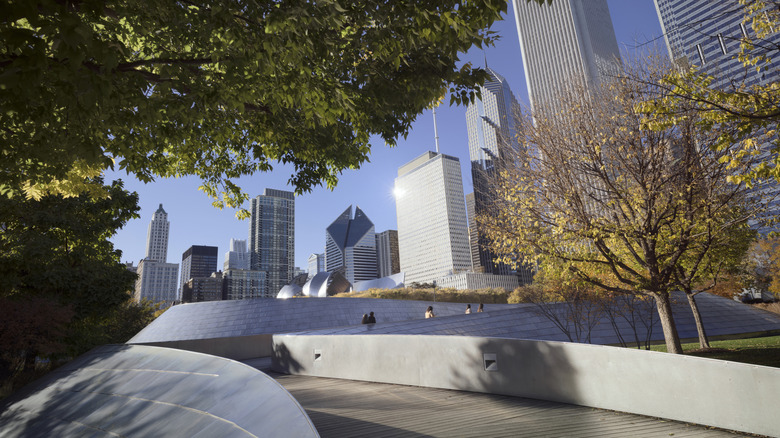
From the gleaming high-rises that line Michigan Avenue to the 28-mile manmade shoreline along Lake Michigan, Chicago remains one of America's most vibrant, celebrated cities. A world-class destination densely packed with skyscrapers, parks, shops, restaurants, and museums, it's virtually impossible to run out of amazing things to do here — especially on foot. Peripatetic tourists will want to slip on their comfy shoes and beeline to The Loop, the energetic epicenter of downtown Chicago, home to some of the city's most emblematic buildings and spaces. Within this central district lies the sprawling Millennium Park and the historic Chicago Cultural Center, two of the Windy City's most iconic attractions. Not only can you cozy up to both of these legendary landmarks for free, but you can stroll from one to the other in a zippy two minutes.
Walkable, family-friendly, and busy year-round, Millennium Park and the Chicago Cultural Center are quintessential Chi-Town destinations that rank among the very best free Chicago activities. Although the Chicago Cultural Center is just across Michigan Avenue from Millennium Park, both venues are part of the Millennium Park Campus, which is also home to The Art Institute of Chicago, Harris Theater, Lurie Garden, and Maggie Daley Park. You can easily reach both sites via buses and trains run by the city's major transportation providers, Chicago Transit Authority and Metra, the latter of which stops at the Millennium Park Station located right below Millennium Park. Once you arrive, prepare to stroll and be wowed.
Millennium Park is an urban refuge teeming with art, good times, and beautiful landscapes
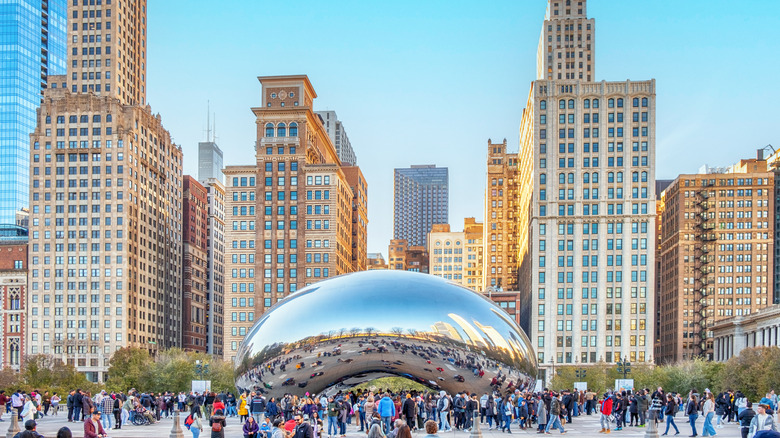
Chicago's 24.5-acre Millennium Park is an urban escape in the heart of downtown, brimming with plenty to do. A jaunt through the northwestern section of the park — bordered by Michigan Avenue and East Randolph and East Monroe Streets — yields an open-air museum filled with artistic treasures. This area is famously the home of British artist Sir Anish Kapoor's sculpture "Cloud Gate," a glimmering, bulbous metallic archway that also goes by the nickname "The Bean." Nearby, the North and South Boeing Galleries function as a pair of outdoor artwalks that regularly showcase exhibitions by local and international artists.
At the corner of Michigan and East Monroe, you'll find Crown Fountain, a stunning "live" fountain composed of two 50-foot-high glass towers that flash with the faces of Chicagoans. This conceptual piece by Catalan artist Jaume Plensa is set inside a black granite basin where you can join visitors cooling off in the fountain's refreshing sprays. Another lively place to join reveling crowds is at the Frank Gehry-designed Jay Pritzker Pavilion, a performance venue where you'll be spoiled for choice with free and budget-friendly entertainment, including the Summer Music and Film Series and World Music Festival.
In winter, McCormick Tribune Plaza is turned into an ice rink, where skating is free, and skate rentals are available for a fee (bring your own if you have 'em). For more magical winter meandering, head over to Lurie Garden, known as Millennium Park's "secret garden." This four-season horticulture oasis is a beautiful, serene, and reflective space any time of year, but in winter, its icy shrubbery takes on enchanting artistic shapes.
Revel in splendid architecture and free activities at Chicago Cultural Center

Steps away from Millennium Park, the Chicago Cultural Center is an illustrious architectural gem bursting with free activities, which should help curb any temptation to visit notorious Chicago tourist traps. Free tours leaving from the first-floor welcome center (first-come, first-served) unveil the center's rich history and extraordinary design. Built in the Classical Revival style in 1897, the building, known locally as the "People's Palace," originally housed the city's main public library and also served as a meeting place for Civil War veterans' groups. It was later rechristened the Chicago Cultural Center and reopened as a free municipal cultural venue.
From an architecture and design standpoint, the Chicago Cultural Center is the apex of sumptuous, turn-of-the-century eye candy. Within, the gorgeous Preston Bradley Hall is home to the world's largest stained-glass Tiffany dome, a bewitching work of beauty assembled from 30,000 pieces of glass. Ornate design details abound, from curvaceous staircases and glass mosaics to shiny gold leaf and a lobby dripping in marble from the same quarry in Carrara, Italy favored by the Renaissance master Michelangelo. Owing to its architectural heritage and rich history, the Chicago Cultural Center is designated a Chicago Landmark and is listed on the National Register of Historic Places.
A major hub for Chicago culture, the center runs over 700 humanities programs annually. These include free art exhibitions, free concerts that dazzle with sublime acoustics, and events including theater performances, lectures, and workshops. Many events are often complemented by free happenings in the interactive Learning Lab, an onsite workshop where artists, educators, and visitors of all ages can gather for a deeper exploration of the Chicago Cultural Center's various programs.