
California's Crowd-Free Desert Basin Near Death Valley Has Otherworldly Rock Formations
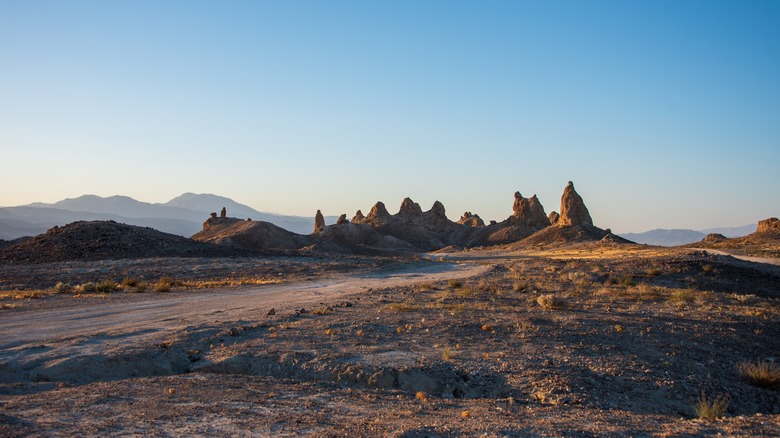
For obvious reasons, the corner of California known as Death Valley isn't for everyone. Put the scariest D word of them all into a place name and it will, understandably, put quite a few people off from ever setting foot there. Others are undoubtedly attracted to this morbidly labelled national park that's hotter, drier, and lower than anywhere else in North America. Precisely because of these extremities, adventurous souls are often unable to resist the almost gravitational pull of the valley's otherworldliness. Underlining that feeling of being transported to an alien planet here are seriously unique geological landmarks like the Trona Pinnacles, situated just outside of Death Valley National Park. Desperate to find out more about this breathtaking corner of the Golden State, and how you can visit it for yourself? You've come to the right place.
Situated in the California Desert Conservation Area, just over 140 miles from Ontario International Airport and roughly 185 miles from Los Angeles International Airport, the surreal and dreamy nature of this terrain means it has to be considered an essential part of any California road trip itinerary. Emerging up out of the Searles Dry Lake Basin like giant rocky moles sticking their head above Earth's surface, some of the more than 500 tufa spires you'll find here hit heights of 140 feet.
The history of the Trona Pinnacles
Made a National Natural Landmark in 1968, the Pinnacles — which consist mainly of calcium carbonate — have starred in many films including "Planet of the Apes" and "Star Trek V: The Final Frontier." The story of this famous geological marvel started way before the invention of recording cameras and cinema projectors, though. In fact, it came into being somewhere between 10,000 and 100,000 years ago. When Hollywood and moviemaking wasn't even a dot on the horizon, Searles Lake joined up various lakes that flowed all the way from Owens Valley to Death Valley.
While it might be hard to believe these days, especially based on how the area now looks in photographs, there was a time — during the Pleistocene — when this location sat beneath 640 feet of water. Once labelled "Cathedral City," the stunningly photogenic formation features towers (tall, narrow, and at least 30 feet high), tombstones (short and blocky), ridges (wall-like stretches of tufa), and cones (smaller points less than 10 feet high).
In 1862, a man by the name of John W. Searles was searching for gold and silver when he came across borax in these parts. Remarkably, it took nearly an entire decade and an encounter with Francis Marion Smith — also known as "The Borax King" — for him to connect the dots and realize there was money to be made from what he'd stumbled upon. Searles laid claim to some 640 acres in 1873, forming the San Bernardino Borax Mining Company in the process. This combined with the discovery of other chemical elements and minerals in Searles Lake, such as potash (used to make gunpowder in World War I), led to the establishment of the town Trona, 14 miles north of the Pinnacles.
Things to know if you want to visit the Trona Pinnacles
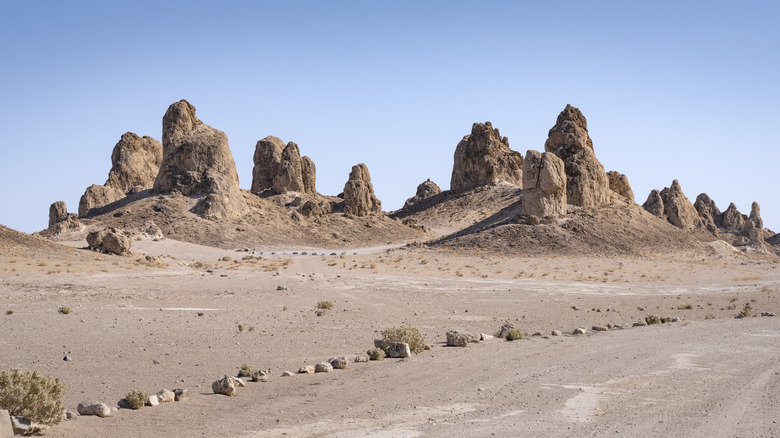
If you're serious about getting intrepid and paying the Trona Pinnacles a visit, there's some things you should know about them first. Firstly, you'll find them about 20 miles east of Ridgecrest. The specific 6-mile road leading to them is sandwiched between two excellent photo opportunities in the shape of Fish Rocks and the Welcome to Searles Valley sign. The former is a historic piece of graffiti art dating back to the 1940s, where boulders have been painted to resemble moray eels. The latter is a classic slice of Americana that road trippers will love. At the exact spot where you turn off to the Pinnacles down the suitably named Pinnacle Road, you'll come across the John and Dennis Searles Wagon Routes and Epsom Salts Monorail Marker — a nod to the region's industrial past.
Unsurprisingly, when you consider where in California it's situated, Pinnacles National Park can get extremely hot in summer. In July and August, daytime temperatures sail above 100 degrees Fahrenheit. Because of this unbearable heat, it's recommended to visit in spring and autumn when temperatures are at their most moderate and hiker-friendly. In winter, temperatures drop significantly, especially at night.
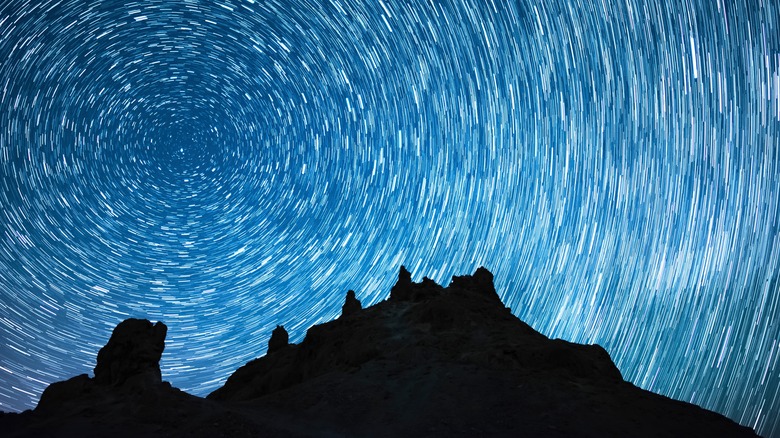
Also, remember to take a good amount of drinking water with you. Visitors getting dehydrated is a common issue that the area's park staff and volunteers have to deal with. There's also very little shade, so be sure to take some sun protection. Looking for somewhere to stay? Primitive camping is allowed around the Trona Pinnacles (remember, leave no trace), but there's little in the way of facilities to elevate your stay. Epic stargazing might make up for the lack of electric hookup points and shower facilities. After visiting the Pinnacles, and taking enough photographs there to fill up your phone's storage, look at the best sunrise and sunset views in Death Valley National Park. They're stunning.