
5 Midwestern Slang Terms That Will Make You Sound Like A Local
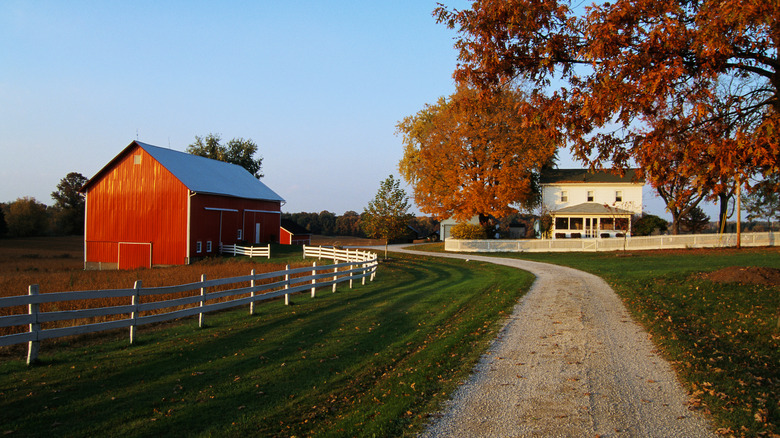
A plus of visiting the Midwest is the people. The Midwestern states have a reputation for their welcoming, neighborly attitudes, with Minnesota ranking as the friendliest U.S. state in a 2024 study by Big 7 Travel, and several other Midwestern states ranking high, too. There's a good chance that if you're visiting — whether you're making a road trip across the Heartland or seeking out the best destinations to spot Northern Lights — locals will strike up conversations with you, and, though wholly cordial, drop in a few words that might catch you off-guard.
According to Edward McLelland, author of "How to Speak Midwesterner," many inflections and regionalisms are rooted in linguistic influences from German and Scandinavian immigrants who populated the area in the 19th century, as he described in a WTTW excerpt. Some of those turns of phrase are easy to glean without much explanation — "come with" and "you betcha" are pretty self-explanatory and have become signatures of the Midwestern vernacular.
There are others, though, that might make no sense to someone coming from outside the region, with words borrowed from other languages and turns of phrase whose meanings are connoted rather than explicit. These are five slang phrases to know when you're visiting the Midwest — some are broadly used across the region, while others are more prominent in certain states.
Ope

It might be the most commonly heard non-standard word in Midwestern speech, slipping past your ears without much thought: "Ope" is a simple expression that has a vast, elastic meaning. Chicago Magazine calls it "the all-purpose expression of Midwestern politeness." You might hear it when someone bumps into you, reaches past you, or drops something — akin to "excuse me" or "sorry." For many Midwesterners, it's an unconscious vocal tic. "I don't know what other noise I'd make when I bump into someone other than 'ope.' It just naturally flows out of my word hole," as a Reddit commenter put it.
"Ope" is most likely a derivation of the more widespread English expression "oops," as linguist Ben Zimmer explained in Chicago Magazine. Crucially, though, the two words are not interchangeable in Midwestern speech. One Reddit poster explained, "It's a polite interjection so you don't scare someone," with a gentler, more disarming connotation than "oops."
So, if you hear "ope" in an interaction with someone, know that it's vocalized out of politeness, and you can catch on to return the favor when you're squeezing past someone or reaching over them to grab your Vienna Beef hot dog.
Jeet?
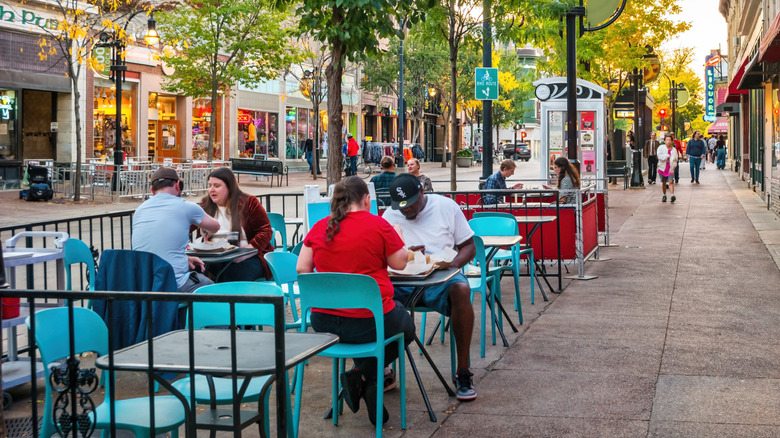
If someone in the Midwest asks you, "Jeet?" (sometimes spelled out "d'jeet?"), they're not mispronouncing "cheat." Rather, the word is an abbreviated version of the question "did you eat?" that you'll hear all across the Midwest, according to In Michigan. Spoken fast, it's merged into a single syllable that, to outsiders, might ring as completely nonsensical, but to Midwesterners, it's second-nature. "'Jeet' is used so often in my Upper Midwest/Yooper family that it's become a bit of a joke," a Reddit commenter said. (Incidentally, Yooper is a local term for someone from the Upper Peninsula of Michigan, pronounced like you would say "UP-er.")
There's a subtext to "jeet" as well. As the Visit Spearfish website explains, when someone asks you this in the Midwest, it's really a casual way of asking if you want to go out to get some food. It's a friendly and hospitable way to check in with your friend or relative. To really flaunt your fluency in Midwestern slang, you can respond with "squeet," as one TikToker noted — the natural complement to "jeet?" — a compressed version of saying "let's go eat."
Uff da

"Uff da" is a distinctly Midwestern exclamation that really has no other English equivalent. The phrase comes directly from Norwegian influence and is most commonly heard in Minnesota, the state sometimes called "Little Scandinavia," and the Upper Midwest. Norwegians formed immigrant enclaves in Minnesota around the mid-19th century, and certain words and traditions trickled into everyday expressions, with "uff" being the Norwegian counterpart to the more common English "oh" sigh and "da" meaning "there," as The Minnesota Star-Tribune explained.
Ironically, Norwegians don't use the phrase anymore — its Midwestern usage is a vestige of a linguistic tic that's outlived its origins. The connotation of "uff da" is highly contextual. Its expression can be good, bad, or neutral, evoking anything from surprise to exhaustion to distress. The unifying meaning, though, is one of an overwhelmed nature.
A Reddit user explained its meaning succinctly: "It's a remark on excess. You can use it whenever something is a lot." Someone might say it during a hike, for example, when coming upon a steep pitch you'll have to scramble up, or (a common example) when it's ungodly cold outside.
Hotdish
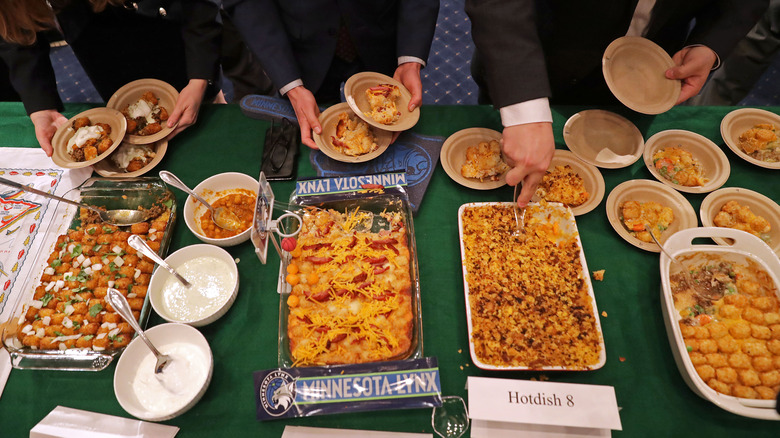
As you try out some of the local eateries around the Midwest — maybe, for example, on a visit to the Wisconsin city known as the "culinary capital of the Midwest" — you might come across something called hotdish listed on menus. The dish is a "Midwest staple," as KFYR called it, and it's essentially a subtype of a casserole. Kara Haff, the North Dakota State Historical Society's public information officer, told KFYR that the term could be another Norwegian import, adapted from the Norwegian "varmrett" meaning "warm dish." The dish — easy to make with leftovers and homegrown produce — became a fixture of Midwestern cuisine during the Great Depression.
There are some crucial nuances in how a hotdish differs from the broader casserole category. Firstly, a hotdish is an entire meal in itself, not a side. Secondly, because of its hearty nature, a hotdish typically needs four to five ingredients, including meat, starch, vegetables, and a cream or sauce. Often, it's made with ground beef, tater tots, and a cream soup.
You're also most likely to get a chance to sample hotdish when it's cold out. "It's a thing, but very much a seasonal thing, the season being winter; it's very hearty, it's the kind of thing you want on a cold, snowy day after shoveling snow," one Reddit user said.
Up north
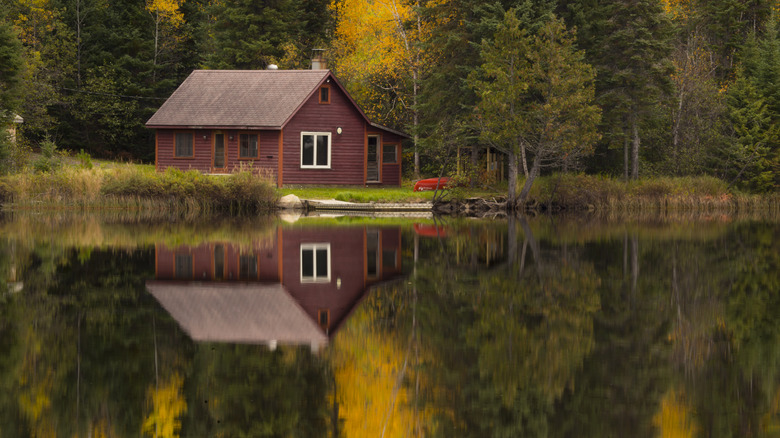
"Up north" is, like several uniquely Midwestern phrases, very flexible in its usage and meaning. On the surface, yes, it does literally indicate the northward direction, but there are specific contexts in which it's used. Mostly, you'll hear it in a sentence like "going up north for the weekend" or "taking a day trip up north," deployed to broadly mean heading to the more rural, lakeside areas of the northern Midwest to decompress and enjoy the outdoors, as In Michigan explains it.
What exactly qualifies as "up north" depends on where you're located when you say it. In Michigan clarifies that in its state, the phrase connotes heading for the rural northern end of the Lower Peninsula. However, someone from Minneapolis, for example, might use "up north" to refer to a lakeside getaway in the lake-filled upper region of the state, while someone from southern Wisconsin could just mean heading anywhere into the woods north from where they are.
An X post from the Midwest vs. The Rest account humorously designated Midwestern metrics for measuring distances and framed "up north" as anywhere between 15 and 100 miles from where you are.