
Japan's Quirky Retro Park In Osaka Still Looks Like It's The Summer Of 1970
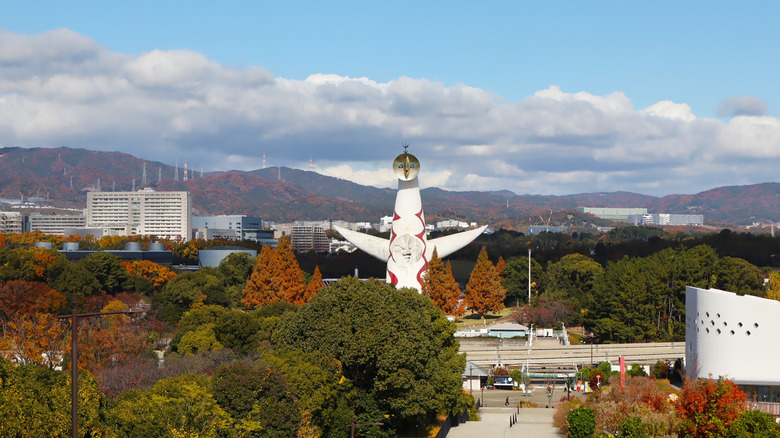
Although Japan's third-largest city, Osaka, is nicknamed "Japan's kitchen" for its vast food scene, the metropolis is also home to edgy high-rise architecture and a delightfully retro rarity. About 30 minutes north of the city center lies the Expo '70 Commemorative Park. The massive, 640-acre park was formerly the home of the Japan World Exposition, which ran from March 15 to September 13 in 1970. World Expos are held at different destinations around the globe every five years, and the fair in Osaka was Asia's first, so the Japanese stewards went all out to make it huge. And huge it was — over 64 million visitors graced the Expo, making it the biggest the world had ever seen, a claim it held for 40 years until Shanghai's 2010 Expo.
World Expos are huge exhibitions of new technology and wonder, where each participating country has a "pavilion" (a small gallery-like space) to showcase its advancements. The first was held in 1851 in London, and exhibitors over the years have included the likes of Nikola Tesla and Alexander Graham Bell. A handful of countries around the world choose to keep key architectural elements of their Expo site after the exhibition is over. Named and themed "Progress and Harmony of Mankind," the Osaka Expo is still felt in the park today, as 1970-esque statues and museums remain.
The Expo '70 Commemorative Park has a quirky retro tower
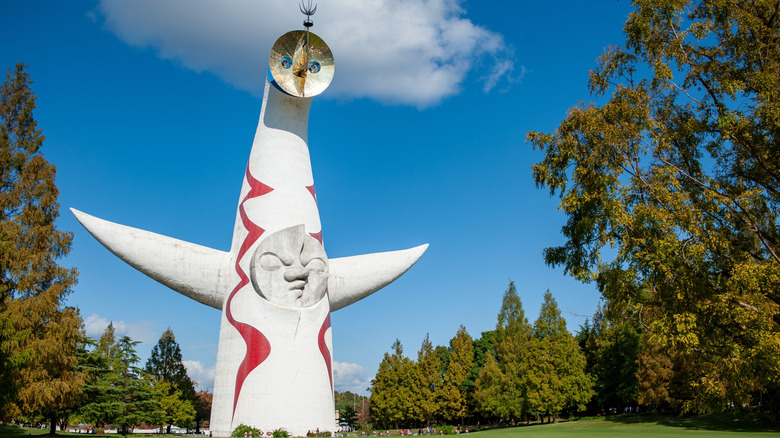
The iconic, 230-foot Tower of the Sun is emblematic of the Expo '70 Commemorative Park and the Expo in general. The multi-faced, surrealist treat was designed in 1968 by esteemed local artist Tarō Okamoto. The tower has four faces — three are on the exterior (titled "Golden Mask," "Black Sun," and "Face of the Sun"), and you can see these while standing in and around the park. But the fourth, titled "Sun of the Underworld," is displayed in the huge structure's underground foundation gallery space, which you need a ticket to visit.
Luckily, tickets to visit the interior of this impressive structure aren't too hard to come by with proper preparation. After a checkered history of disrepair and conservation, it was fully restored and preserved in 2018 when the Tower of the Sun Museum opened. Tickets cost ¥930 (around $6) and can be booked from 120 days in advance, but note that same-day entry tickets are not offered. You can also visit the magnificent installation titled Tree of Life that sprawls across the interior of the tower — a multimedia display of 292 creatures and organisms of the natural world, from reptiles to bacterial cells, and a colorful portrayal of the planet's varied forms of life.
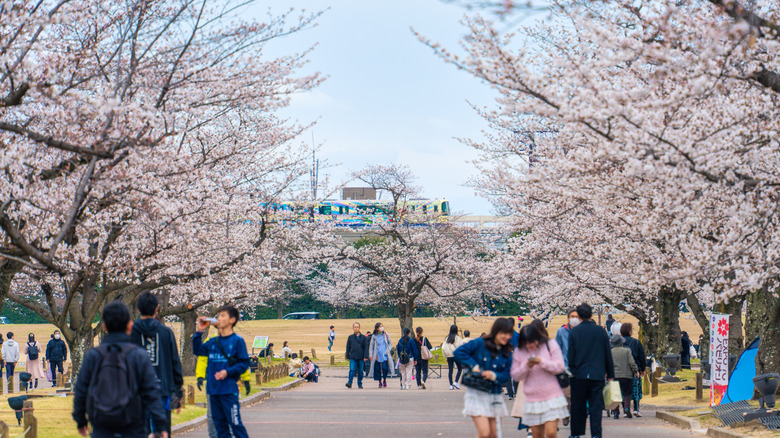
If you're not big on museums and elect to visit the park to view the exterior of the Tower of the Sun, the best plan is to visit during the spring, when the backdrop of the leafy expanse is a gorgeous baby pink (and here are some tips to get the best possible Japanese cherry blossom viewing). But no matter the time of year, the Expo Commemorative Park is brimming with vibrant nature.
Other unmissable features in Osaka's Expo Commemorative Park
Aside from Tower of the Sun, the park is teeming with life, full of interesting museums, carefully maintained gardens, and sculptural and cultural features that all celebrate the great international exhibition's legacy. The National Museum of Ethnology and the Japan Folk Crafts Museum are on-site, displaying a vast wealth of artifacts — the former focuses on objects from around the world, and the latter amasses ceramics, textiles, and artisanal items from across Japan. The Expo '70 Pavilion is a must for anyone interested in the history of the site and the Expo. The small museum houses displays of archive photography, uniforms worn by staff, maps and plans, and videos from the event itself.
The Japanese Garden spans 64 acres and features centuries of garden designs, all curated in this one park for the visitors at the Expo '70. It's still thriving after its creation over 50 years ago, as is the Rose Garden, which was also inaugurated at Expo '70, laden with rose bushes from nine countries across the world that donated their local flowers as a symbol of peace.
Also designed for the 1970 exhibition is the Dream Pond, where you can rent paddleboats and cruise between ducks, geese, and sculptures that protrude from the water. These features and the 5,000 cherry blossom trees that bloom during sakura season (cherry blossom season) in the spring all serve to put this Osaka gem on the map. Plus, if you're traveling on a budget, less-touristed areas like this make Japan way more affordable by avoiding Tokyo.