
How Do Airports Detect Unidentified Drones?
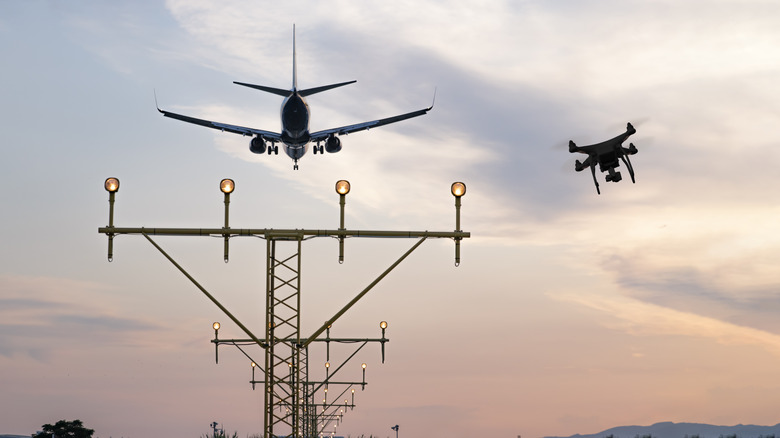
It doesn't seem that long ago that drones were a thing you only encountered in science fiction movies, first-person shooter games, and war reports on the evening news. But now, technophiles and camera enthusiasts the world over are flying their own little unmanned aerial vehicles (UAVs) over parks, coastlines, and city streets. Sensibly, officialdom doesn't want the skies turning into a Wild West, and since 2016, the Federal Aviation Administration (FAA) has enforced strict regulations for those operating them. These cover government-approved "B4UFLY" information apps and no-drone zones, including sports arenas, Washington D.C., and of course, commercial airports.
Airports are among the most carefully restricted sites in this context, where drones can infringe upon public privacy, be used to surreptitiously gather information, or put commercial flights at risk. Unfortunately, traditional radar systems struggle to detect drones. They were designed to spot craft with large cross-sections, like an incoming jet, meaning bird-sized objects like modern drones can slip through the cracks. Even if the radar system can detect the drone, it might not be able to distinguish it from a pigeon, say, and thereby mark it as a priority. Traditional radars are also poor at tracking multiple fast-twitching targets — like a drone swarm — and sometimes have range and depth-of-field issues.
In June 2025, the FAA tested drone-detection technology at several sites, with a view to implementing it at airports across America. They used advanced radars with ranges of several miles that could detect objects moving at speed and distinguish a floating craft from a soaring bird or rotating blades from a pair of flapping wings. Although not yet widespread, American airports are exploring the potential of counter-drone technology, and airports worldwide, from Dublin to Seoul, have started to introduce it following UAV-related issues.
Anti-drone detection systems
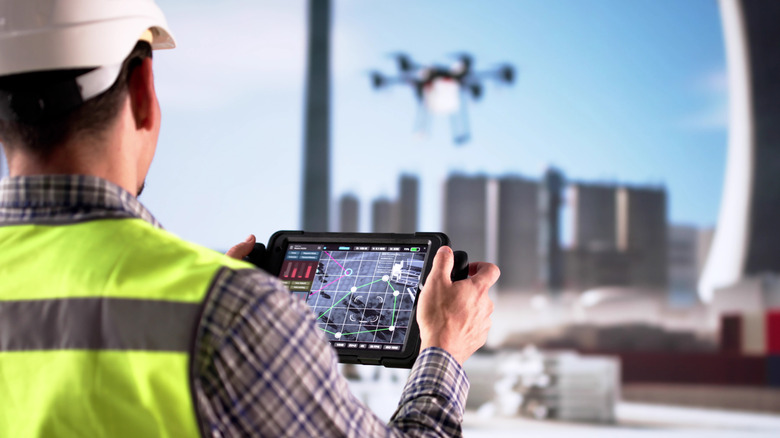
Making matters worse for airports, some decent drone models now cost less than $200, bringing them within the price range of a greater number of consumers. This is expected to result in more drones in the skies as the commercial drone market continues to balloon over the next several years — it could reach almost $700 billion in value by 2032. Airports, therefore, need to implement innovative ways of detecting drones, especially as drone technology improves and the devices get better at avoiding detection.
Advanced radars are part of a broader system of drone detection tools, including AI analysis of long-range security camera footage and integrated drone response protocols, like automatically notifying law enforcement when a UAV is detected in restricted airspace. Other countermeasures include acoustic sensors, GPS spoofers, control-frequency jammers, high-energy lasers, and good ol' fashioned nets, occasionally fired out of a cannon (add that to your list of the most bizarre reasons for flight delays).
You only have to recall the drone that brought London Gatwick to a 33-hour standstill in 2018 to see what really happens after a drone is spotted at an airport. That incident alone caused 1,000 flights to be canceled and affected around 150,000 passengers. The FAA receives reports of more than 100 drone sightings near airports each month, so the U.S. aviation industry will continue to make anti-drone tech a priority. To that end, a bill approved by the House Transportation and Infrastructure committee in September 2025 would require the FAA to facilitate the deployment of anti-drone systems at American airports. If passed, such technology could be commonplace throughout the country this decade.