
The Oregon Outback's 5 Best Spots For Dark Sky Stargazing
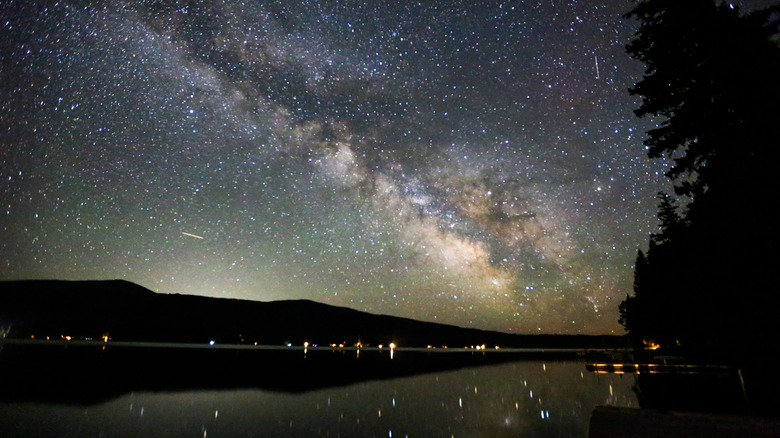
Travelers might know of the Oregon Outback for its high desert, natural hot springs, and scenic byway that snakes across vast, remote plains. These make up a stark landscape that's fascinating to explore during the day, whether you're going on a desert hike or soaking in the springs. But a shimmering panorama lies overhead come nightfall, when the motionless outback becomes a top-tier stargazing destination. In 2024, DarkSky International certified the Oregon Outback as the world's largest dark sky sanctuary so far.
The certified area is 2.5 million acres in Lake County, located in the southern part of the state just east of the Cascade Mountains. The expanse earned the dark-sky designation thanks to its sparse population and minimal tree blockage. The whole county has only two official cities, according to the World Population Review, one of which is Paisley, a hidden city with ancient caves and unmatched beauty. On average, the entirety of Lake County has just one resident per square mile (around 8,000 residents in total).
The dark-sky certification also ensures that it will maintain excellent night-sky experiences in the long run, with strict lighting standards and protection of local ecosystems. It gives local businesses and communities incentives to attract and support astrotourists who come for the starry skies. You can see the luminous spool of the Milky Way, meteor showers, and planets from various sites around the county, but here are some of the best spots to ponder the stars in Oregon's Outback, based on their viewing accessibility, seclusion from light pollution, and accounts from past stargazers.
Hart Mountain National Antelope Refuge

The Hart Mountain National Antelope Refuge is one of the most dependable stargazing sites, encompassing a stretch of untouched land with near-zero light pollution and low horizons in the desert uplands. It's listed as a top night-sky viewing area on the official Oregon Outback International Dark Sky Sanctuary (OOIDSS) map, and it was named one of the best spots for stargazing in the state by the Oregon Natural Desert Association, even citing it as having the darkest skies overall.
The payoff of the refuge's incredibly dark skies comes from having very little development. The area spans 278,000 acres, with no lights or highways to disrupt the nighttime sanctuary. There are, however, three campgrounds, suitable for tents or trailers, and available for free on a first-come, first-served system, equipped with vault toilets (and not much else). You can even venture further into the refuge with a backcountry permit, which allows camping at least one-half mile away from any roads (but without campfires).
The refuge is home to a concentration of pronghorn antelope, as well as around 300 other animal species, including sheep, mule deer, and sage-grouse. When you're not watching stars at night, you can watch wildlife during the day. Hiking is welcome in the refuge, though there aren't any established trails — instead, you can walk on dirt roads that are closed to vehicles from December through June. If you'd rather relax, you can soak in the refuge's natural hot spring.
Summer Lake

Another destination listed among the best stargazing spots by the Oregon Natural Desert Association, Summer Lake is a rural area encompassing the titular lake. It has the Winter Ridge fault escarpment on one side, and the Diablo Rim fault uplift on the other, serving as its unique, tectonic backdrop. Either of these elevated landforms can be climbed for spectacular, unobstructed nighttime views not only of the sea of stars, but also the broad Summer Lake basin below. The Fremont National Recreation Trail, a 147-mile hiking trail that crosses through the expanse of the Oregon Outback's Fremont National Forest, has a trailhead near Summer Lake at the Fremont Point lookout on the Winter Ridge. Interestingly, the lookout point also has a fire lookout cabin that's been reconstructed and now serves as a recreational rental managed by the Forest Service.
Staying around Summer Lake could be a good option if you want more robust lodging than a campsite or RV hookup. Aside from the Fremont Point cabin, the Stargaze Inn, which sits on the north side of the community, specifically caters to astrotourists. It's listed as a Guest Favorite on Airbnb, with an average rating of 4.95 stars. The cottage is surrounded by vacant salt flats and farmland, with a wraparound deck that's great for getting a wide night-sky view. It also has a private sauna and hot tub.
A more indulgent option for overnight stays is at the Summer Lake Hot Springs. The spot is listed as its own night-sky viewing area within Summer Lake by OOIDSS. It's a sprawling resort hinging on the natural hot springs that bubble up from the lake basin. There's even a historic bathhouse, first built in 1929, with outdoor rock pools where you can watch the stars as you soak.
Drake Peak Lookout (Warner Mountains)

The Warner Mountain range runs mostly across Northern California, but it stretches into Oregon just enough to provide a few great lookouts in the Oregon Outback for night-sky viewing. The mountain peaks around Lakeview are listed as a night-sky viewing area by the OOIDSS. If you're going to pick one spot among the range to post up with a telescope, Drake Peak is a good option, since it's easy to reach, has lodging, and offers some fun recreation.
The Drake Peak Lookout was originally established as a fire lookout, positioned over 8,200 feet above sea level, with views extending out to California and Nevada. The lookout cabin can be rented overnight, accommodating up to four people, and it's got windows on all sides, making it great for watching the stars as you drift into sleep. "The Drake Peak Cabin is an incredible spot to soak in the stars undisturbed by light pollution or noise beyond the sounds of nature," a Google Local Guide wrote, noting that, given the high altitude, it can get cold atop the mountain (which is why staying in the cabin might be a smart idea).
From Lakeview, Lake County's biggest town, it's about a 45-minute drive to the Drake Peak Lookout, which holds the distinction of being Oregon's highest drive-up lookout, according to the Every Lookout in Oregon blog. The lookout actually sits just to the west of Drake Peak's summit, but it's possible to hike directly from the lookout to the summit. According to AllTrails, it's a moderate 4-mile trek. If you'd rather do more overlanding and less hiking, the Great American Outback Trail, a breathtaking off-road journey through four states, also passes through the area.
Sunstone Public Collection Area

For a destination that makes for a one-of-a-kind daytime and nighttime activity pairing, Oregon's Sunstone Public Collection Area is an excellent candidate. The area, which sits in a desert north of the small community of Plush, was recommended by a Reddit user, who wrote, "So many stars at night and you can mine sunstones during the day." It's true: The area, overseen by the Bureau of Land Management (BLM), allows visitors to mine for sunstones, Oregon's state gem and a rare type of crystal formed by lava millions of years ago. Then, you can stay in the area after sunset to stargaze — it's another spot listed among recommended night-sky viewing sites by the OOIDSS.
The BLM cautions that the Sunstone Public Collection Area is very remote, with only rudimentary amenities, including a pit toilet and picnic tables. You can drive up to the area, which you'll see marked by BLM signposts. Make sure to collect gems only from the marked areas, as there are also areas in the vicinity that are private claims. Visitors are welcome to camp overnight in the Public Collection Area, too. Just make sure to fill up your water in Plush before departing for the rockhound site, since water isn't available in the area.
Fort Rock State Natural Area

To be exact, the Fort Rock State Natural Area sits slightly outside of the officially designated dark-sky sanctuary (albeit still in Lake County), but it offers some unparalleled stargazing opportunities for visitors and is very accessible. It's about an hour and 15 minutes by car from Bend, with a public day-use area with toilets and trails.
The natural area gets its fort name not from a military battlement but from the unique, ring-shaped rock tuffs that resemble a fortress. All around the rock fort is a vast high-desert plain, far removed from civilization and perfect for seeing the night sky without disruption. A state park, Fort Rock lets visitors park here for up to two hours to stargaze, so long as you fill out the specially issued Stargazing Permit (available on the park website). You can't camp overnight, though.
Something offered at Fort Rock that you won't find at other stargazing destinations in the Oregon Outback is dedicated tours led by professional naturalists. The stargazing tours, run by Wanderlust Tours out of Bend, last about five hours, beginning as the sun sets and ending when the stars are sparkling through total darkness. The tour includes a sunset hike to Fort Rock, astronomical and geological insights, and an optional add-on picnic-style dinner. The tour operator's stargazing-focused experiences get some of the best reviews of its offerings: "My moonlight stargazing tour with Wanderlust was an absolute dream! It was so wonderful to be out in nature, at peace with everything, and experiencing the humbling power of the stars," a Google Local Guide raved.
Methodology

The Oregon Outback International Dark Sky Sanctuary lists over 20 night sky viewing areas in the zone to date. We used the sanctuary's recommendations as a starting point to find the best spots for stargazing, sourcing further input from park sites, local bloggers, and online reviews.
The five that earned the top rankings for stargazing have minimal light pollution and few obstructions to block the night sky, while still remaining accessible to travelers. We prioritized sites that have something unique to supplement the stargazing experience, whether that be wildlife sightings, special overnight stays, or a professionally led guided tour.