
5 Things Allowed When Flying In The '80s That You Could Never Get Away With Today
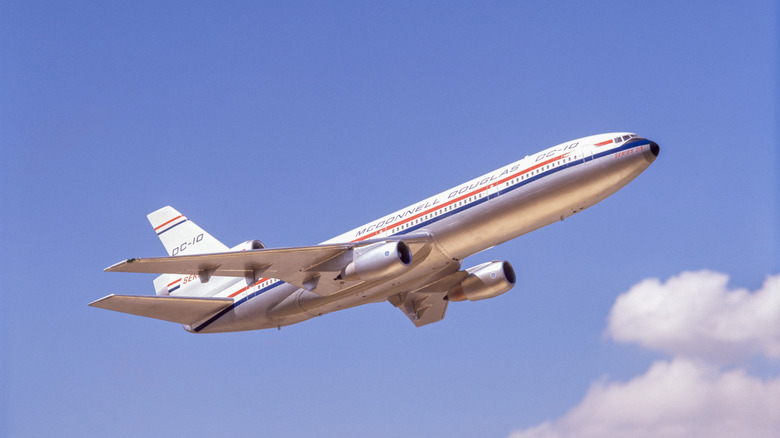
If you're old enough to remember flying before 9/11, you'll recall that airports weren't always such a drag. But when the Twin Towers went down that September morning, everything changed. Security presence was beefed up, advanced scanning technology was introduced, unattended baggage became a bomb threat, IDs were mandatory, and a good portion of the last vestiges of romance in air travel vanished. So when you look back at the 1980s, when things were decidedly more liberal and industry deregulation meant air travel was becoming more affordable to the masses, it seems a kind of halcyon era for flying. It's amazing, in fact, just how many behaviors that were commonplace in the '80s you couldn't get away with now.
Scenes from the classic '80s comedy flick "Airplane!" will give you an idea of what was once standard: buying tickets at the airport, choosing between smoking and non-smoking seats, children visiting the cockpit mid-flight, and people roaming around the departures zone without a boarding pass. This really was a different time, before check-in allowances and excessive baggage checks and advice to arrive at the airport hours before your flight. It almost seems twee from our vantage point now, when innocuous items like books and salt can trigger a bag search, and travelers are regularly poked and prodded by TSA.
But there were some drawbacks, too. The budget airline boom didn't really take off until the 1990s, meaning people flew less often and were more selective about their flights to begin with. QR codes and smartphones didn't yet exist, so misplacing or damaging your ticket was a disaster. And in-flight entertainment wasn't quite up to the standards of the streaming age. We may sometimes yearn for the 1980s, but here are five behaviors that have been consigned to the dustbin of flying history.
Smoking was permitted
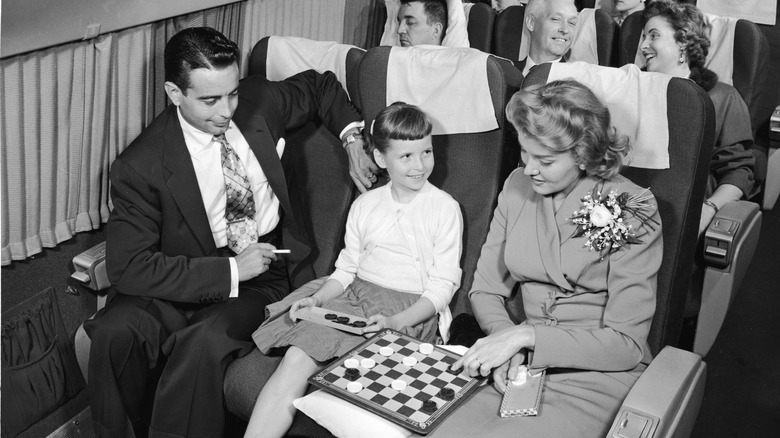
Smoking is so restricted in modern public life that it's hard to believe you could once do it just about everywhere: In restaurants and cafes, in movie theaters, in the office, in schools, and on public transport, including airplanes. You could even smoke in hospitals. Go back to the 1940s, and doctors were actually advertising cigarettes.
Flight attendants from the '80s talk of bronchitis, sinus problems, and other illnesses caused by working in smoke-filled environments, never mind the reality of coming off each flight smelling like they'd been dancing around a bonfire. Passengers smoked in their seats and airline staff smoked in the aisles and in the corridors — you've probably noticed that airplanes still have ashtrays in the event a (soon to be reprimanded) passenger decides to light up. Sure, back in the day, you could sit in the non-smoking section, but carcinogenic particles would drift around the cabin as Brownian motion dictates they ought to.
By the 1980s, it was becoming clear that secondhand smoke posed a health hazard, and many states began introducing smoking prohibitions in shared public indoor spaces. A federal ban on smoking in domestic airline cabins was introduced in February 1990, leading to a comprehensive smoking ban on all flights to and from the U.S. by the year 2000. Today, no major commercial airlines offer smoking sections, meaning there's a de facto worldwide prohibition on cigarettes and vapes while flying — though in rare cases, some chartered flights may bend the rules upon unanimous passenger agreement.
Turning up minutes before your flight departs
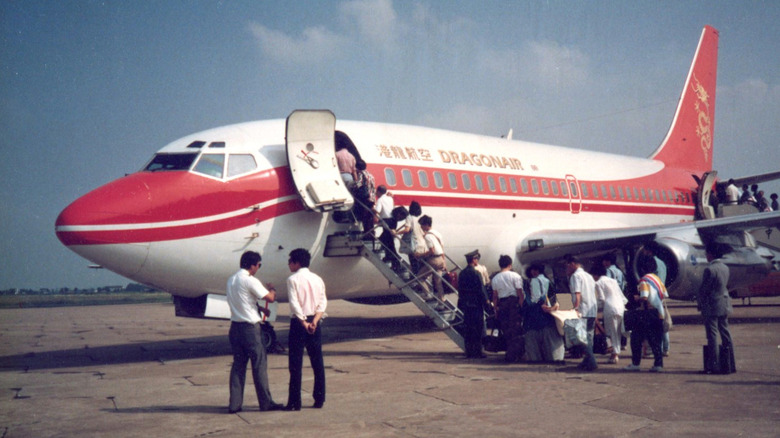
We take it as a given in most countries that you need to turn up at the airport well before your flight. At least an hour if the flight is domestic, the airport is small, and you have no check-in luggage. For long-haul, international flights at large airports, you're probably arriving two or even three hours early. That's just how the system works.
But it wasn't always that way. In the 1980s, passenger checks were more like those for fans at a sports stadium, and there wasn't the feeling of purgatory that 21st-century airport security lines and departure lounges instill. All you had to do was pass through a metal detector, removing nothing from your bags and keeping your shoes mercifully on, then you were ready to hop on the flight. Twenty minutes was usually ample. Your loved ones might join you in the departures section, seeing you off at the gate and waving to the plane as it took off. Such freedom of movement is why those romantic running-through-the-airport scenes in TV and film used to work; they're a lot harder to sell today, thanks to the Byzantine security infrastructure in place at most modern airports. No wonder people feel the airport experience has gotten worse in recent times.
In some countries, you can still show up minutes before a flight and expect to get on, showing that wait times don't need to be so interminable. If you're flying domestically in Japan, for example, it's common to turn up half an hour (or earlier) before departure, even at Tokyo's major airports. This suggests that airport infrastructure elsewhere is needlessly inefficient, but perhaps the bureaucratic and commercial incentives aren't there to improve it.
You could bring almost anything on a plane
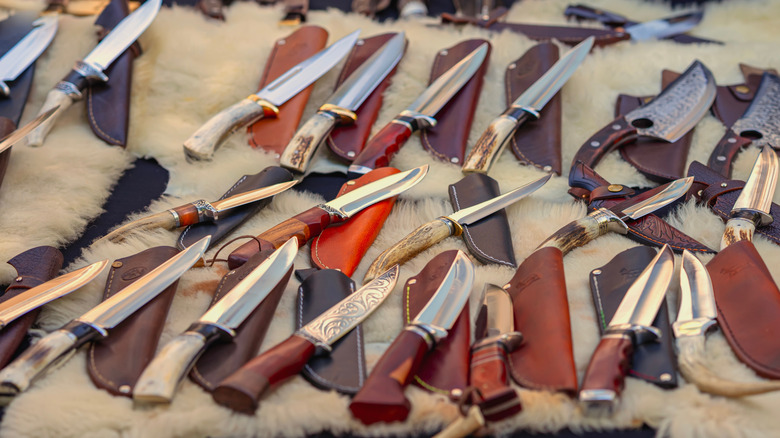
In a world where airport security can seize and destroy a pot of jam for not meeting arbitrary volume criteria, it takes some convincing that you could bring just about whatever you pleased onto a flight in the 1980s. Knives, blades, box cutters, scissors, darts, and knitting needles. A magnum of whiskey and a couple of bottles of wine to chase it down. Toiletries of every shape, size, and description. All were fair game on flights until restrictions were tightened following 9/11.
In the first decade of the 2000s, when in-flight terrorism was one of the great fears of the age, more restrictions were gradually introduced. By 2002, TSA was scanning shoes after a passenger, Richard Reid, flying from Paris to Miami had hidden (and failed to detonate) explosives in his boots. Coats and jackets soon attracted suspicion, and you could no longer enter the departures area without a boarding pass. Following a plot to blow up a transatlantic plane with liquid explosives a couple of years later, we got those frustrating restrictions on toiletries in carry-on bags that still plague passengers today. And before the decade was out, full-body scanners and comprehensive searches were introduced.
Things are looking a little better these days. The introduction of computer tomography (CT) scanners has expedited security screening in many airports, as passengers no longer have to remove liquids and electronics from their bags. In more good news, some European airports have relaxed their liquid rules, and TSA may soon follow suit. Such moves are still a few leagues short of the liberal, anything-goes approach of the 1980s, but perhaps that's for the best.
You could pack (almost) as much as you wanted
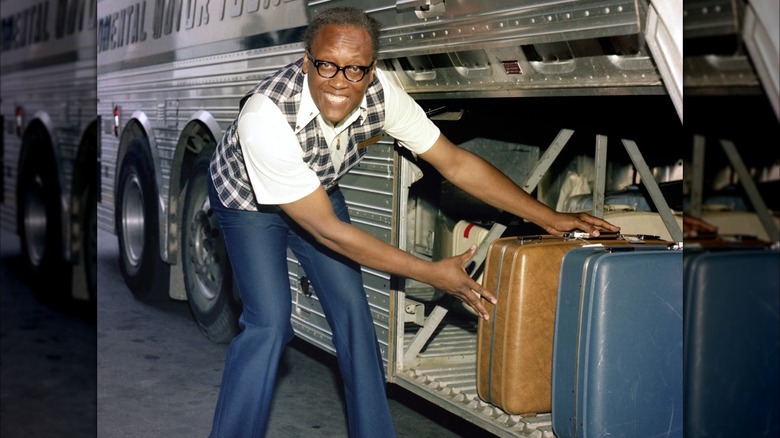
It's a sorry state of affairs in the travel industry when even premium airlines are selling long-haul tickets with no checked luggage allowance. But that's where we are these days; your bags are where the airlines make their money back. Luggage restrictions for economy bookers are now so draconian that it's imperative you know how to pack a suitcase as efficiently as possible, or face paying additional check-in or weight fees.
To put it in perspective, the BBC conducted an investigation that discovered free cabin bag allowances in the U.K. had shrunk by up to 55% since 2018. Budget U.S.-based airlines like Spirit and Frontier charge incrementally more for carry-on or checked baggage depending on when you try to pay for your bags: during the ticket booking, before check-in, during check-in, or at the airport. So it's unsurprising that there's an entire influencer sphere dedicated to luggage packing hacks.
Again, we can look at the '80s through rose-tinted shades here. Airlines often let you pack as much as you want, perhaps with some limitations, though these were considered flexible. The amount you could bring tended to vary with the route, and you could usually add a few extra pounds without causing much of a fuss. Moreover, rolling suitcases, popularized in 1972, were deemed too effeminate for masculine tastes and didn't gain real commercial traction until the late 1980s, meaning there was also a practical reason for having fewer bags. Travelers also weren't ferrying laptops, smartphones, iPads, handheld gaming consoles, or any other modern gizmos to their destination. Such relaxed baggage allowances suggest passengers were packing a bit more conservatively.
Visiting the cockpit was commonplace
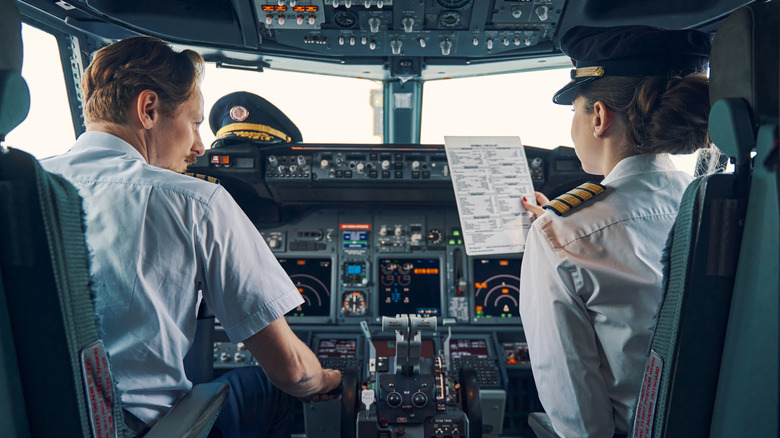
Most airplane passengers only get to see the world disappearing beneath the clouds through a small oblong window with a little sliding screen. In the cockpit, above all those dials and knobs and flashing lights, the windows reveal a panorama that only pilots and airline staff are privy to. In the '80s, though — again, this is where "Airplane!" is quite instructive — it wasn't unusual for kids to be invited into the captain and their copilot's secret world. They might have been given a little toy plane, too, or a pair of pin-on wings.
Unsurprisingly, 9/11 largely brought this practice to an end. According to federal law, you can only be admitted to the flight deck if you are a crew member, an air carrier inspector or evaluator, or other specialized personnel. However, the law also states you can be admitted with permission from the pilot and airline authorities, meaning cockpit visits are technically legal. Search briefly online, and you'll find many reports of passengers who access the flight deck regularly.
Cockpit visits vary by airline, and in many cases, you can visit only before takeoff or after landing. But you won't know when (or even if) you can access it unless you ask. Simple Flying recommends that you enquire about a cockpit visit when the plane is at the disembarkation gate and the pilots are done fulfilling their main duties. You're more likely to get a "yes" if you or your child (or both) are genuine aviation geeks, so you should convey that to the staff. Delta is seen as one of the most accommodating airlines for cockpit visits; its pilots even have trading cards they distribute to enquiring passengers.