
Colorado's Free, Natural Hot Springs Cascade Over Striking, Vibrant-Hued Formations Into Magical Pools
Soaking in one of America's amazing hot springs pools is a great way to heat up your outdoor adventures in the colder seasons, and if you've never done it, we highly recommend it. After a vigorous hike in brisk weather, there's nothing like easing into a pool of hot, steamy water in the middle of the snowy wilderness, where you can relax your sore muscles and warm your body to its core. Some of the most exquisite U.S. hot springs are found in the state of Colorado, from the scenic pools at Strawberry Park Hot Springs in the world-class ski haven of Steamboat Springs to the historic oasis of Glenwood Hot Springs Resort in Glenwood Springs, home to the largest hot springs pool in the world. But entrance to these popular pools comes at a price: $20 per person for a 2-hour soak at Strawberry Park and $38 to $58 for an all-day pass at the Glenwood Hot Springs Resort.
Meanwhile, access to some of the state's lesser-known geothermal sites remains completely free. Among these, one of the more unusual may be the colorful Pinkerton Hot Springs, 13 miles north of the town of Durango, a riverside hub near the Four Corners area with trails, trains, and mesa magic. These springs are also right off US-550 and are always open, making them a convenient stop for people traveling between Durango and the Purgatory Ski Resort, one of America's most affordable places to hit the slopes. Do note that the water levels at Pinkerton Hot Springs may not be deep enough to allow for full body immersion. But you can soak your tired feet in the 95-to-105-degree-Fahrenheit water any time of year.
Pinkerton Hot Springs' past and present
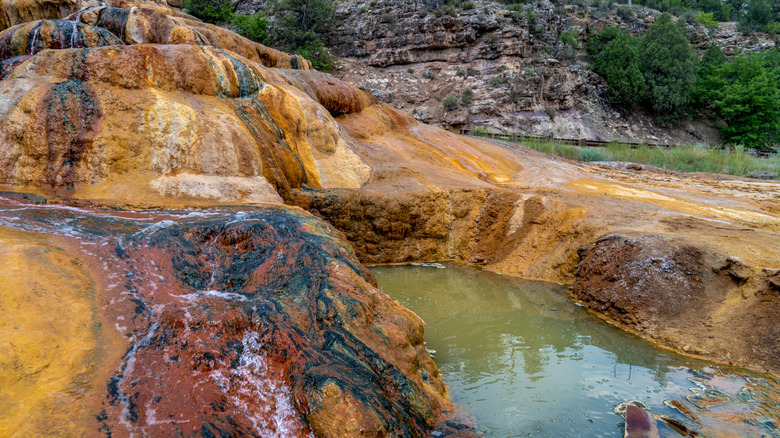
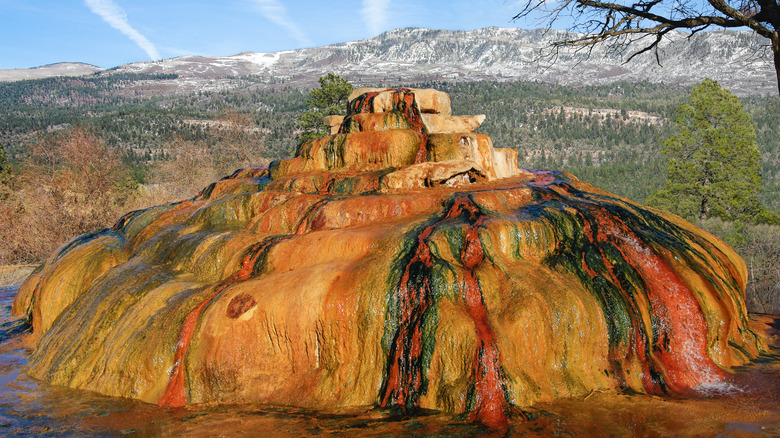
Whether or not a visitor chooses to dip their toes into the water, Pinkerton Hot Springs makes for an intriguing roadside attraction for those driving through the area. One of the most striking things about the site is the otherworldly color on the rock mound right where the hot water emerges from the ground. The deep golds, vivid greens, earthy corals, and fiery orange streaks on the rock are from minerals like calcium, magnesium, sodium, potassium, bicarbonate, and iron that are found in the spring water, which flows over the rock before entering the pool.
The hot springs and surrounding property were once part of a resort called Pinkerton-in-the-Pines, operating here in the late 1800s. A local newspaper, "The Silver World," described the property as "a fine ranch" with "several fine, warm mineral springs, particularly soda, near the larger of which he [the founder, Judge James Pinkerton] has erected an extensive ranch house, furnishing delightful baths for the use of his family and guests" (per Visit Four Corners). Believing that the spring water had curative properties, locals began bottling and drinking it in addition to bathing in it. Alas, Pinkerton-in-the-Pines' heyday came to an end when it suffered a devastating fire in the early 1900s and was abandoned. Today, the Colorado Timberland Ranch — a boarding school for adventurous youth — occupies part of the property, but the springs remain open for public use.
Here are some helpful things for would-be visitors to know. The small hot springs pool sits right next to the brightly hued rocks on the east side of US-550, where there's also a dirt lot where you can park your car. If you have children or pets accompanying you, don't let them drink the water, as it has not been tested in recent years. In addition, avoid climbing on the rocks, which are supposedly quite slippery. Be sure to test the water temperature with a finger or toe before submerging a body part (or your entire body) in the pool.