
Should You Really Worry About 'Exploding Trees' While Visiting The Woods This Winter?
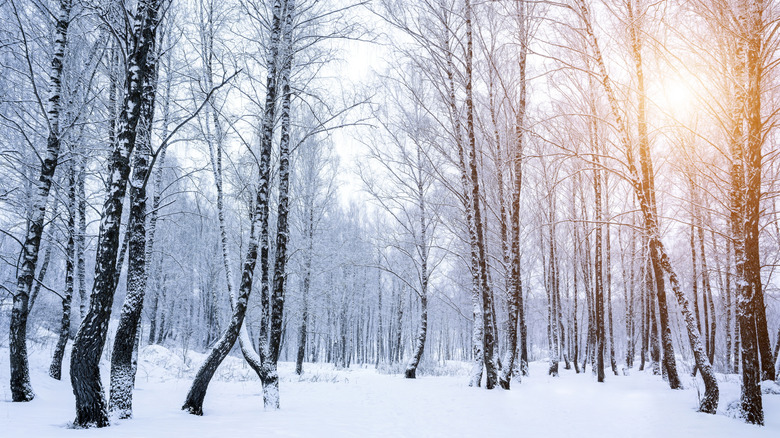
Whether you go to Canada, the world's coldest country, or travel for these cold-weather winter festivals around the world, it's important to consider the risks of winter travel. A major storm is affecting millions of Americans this winter, and alongside freezing temperatures and snowfall, a new fear has been unlocked. Social media posts, like this one by X user MaxVelocityWX, have started circulating a warning for exploding trees. While extremely frigid temperatures can contribute to dangerous medical conditions like hypothermia and frostbite, exploding trees don't necessarily pose the same type of health risk.
To understand the potential danger of exploding trees, it's important to understand what is actually happening inside the tree. Frost cracks, as exploding trees are called by scientists, according to CNN, happen when the liquid sap inside the tree freezes during a fast drop in temperature. While tree bark provides insulation to keep the sap inside warm, a quick change in temperature means the liquid sap doesn't have time to acclimate. The sap inside the tree starts to freeze and expand — and this pressure might cause the wood or bark to crack open, sometimes creating a loud, explosive sound. The trees themselves aren't necessarily exploding — just the pressurized bark from frozen sap.
Are exploding trees dangerous?
Whether you refer to them as frost cracks or the colloquial exploding trees, they aren't necessarily dangerous. John Seiler, a professor and tree physiology specialist at Virginia Tech, tells CNN that the incident is "loud, but it's not dangerous," while National Weather Service meteorologist Jake Beitlich informs the Minnesota Star Tribune that the term "'explode' is more of an attention-grabber than a threat or real hazard." And if the bark does split on the tree, it doesn't necessarily fly through the woods where it might hit and injure an innocent passerby.
This also isn't a new phenomenon — Indigenous people have witnessed this for thousands of years. Indigenous experts advise Outside that "in the lunar calendar of the Lakota, the month of February is known as Čhaŋnápȟopa Wí, or Moon of the Popping Trees. For the Cree, the final moon of the year is called Pawacakinasisi Pisim, or Frost-Exploding Trees Moon." These month names in Native American calendars highlight the ancient history of exploding trees; tree sap has been expanding and cracking bark for at least 3,600 years, according to Outside.
Experts note wet, heavy snow and ice accumulation on trees is more dangerous than frost cracks. Tree branches can snap under the weight of snow or ice, causing them to fall. This may cause serious damage depending on what — or who — is underneath. On your next winter walk in the woods, pay attention to heavy branches rather than a loud noise indicating frost cracks. As you plan your winter travels, read up on the Farmer's Almanac winter weather predictions for the season before you go.