
5 Best Abandoned Theaters To Visit In America, According To Research
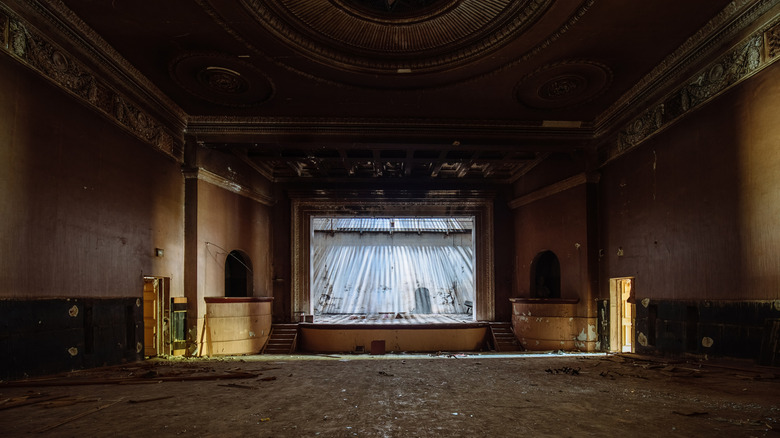
Many of America's abandoned movie theaters were once organ music-filled vaudeville houses, rife with magicians, comedians, and animal acts, but in the 1940s and 1950s these theaters truly hit their heyday. Developers built thousands of movie palaces, as they were known, across the U.S. Each of these massive theaters squeezed in thousands of people who were eager to watch the latest John Wayne Western or Shirley Temple musical.
While the Golden Age of movie-going is now a thing of the past, and many of the most popular theaters in California and New York have announced "The End" for good, several of the most ostentatious movie palaces still exist today. With their boarded-up auditoriums, concession stands that are gathering dust, and the imagined ghosts of former vaudeville stars performing to a silent audience of empty seats, these abandoned theaters are eerie, but fascinating, too.
Whether you're a movie fan, a history buff, or simply enjoy exploring deserted landscapes, like these spooky abandoned American shopping malls, you'll appreciate this meticulously researched roundup of the best abandoned theaters in the U.S.
Paramount Theatre in Newark, New Jersey
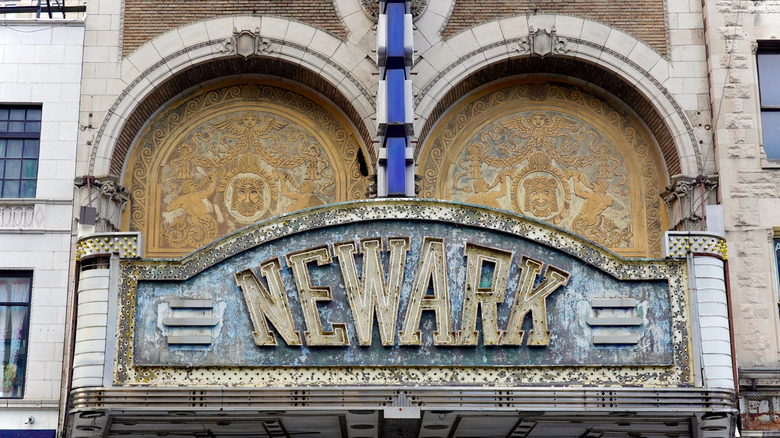
The Paramount Theatre, which opened in 1886 in downtown Newark, New Jersey, got its start as a vaudeville house, putting on variety shows accompanied by live organ music. Designed in a grand and ornate 18th-century Neoclassical style, the theater could once seat as many as 1,900 people.
The Paramount Theatre had its final curtain call in 1986, although it briefly turned on the spotlight again when the exterior was used in a Joaquin Phoenix film scene for the 2019 movie "Joker." Otherwise, this theater has largely sat abandoned for the last 40 years.
While the cinema's marquee sign is still intact, the theater's lobby and auditorium remain shuttered and in disrepair. A few years ago, a part of the roof caved in due to heavy snowfall. While you can visit the theater, you'll likely only be allowed to see it from the outside. To view the theater's interior, you'd need to get special permission from the owners to enter or settle for looking at the photos online.
Lowe's Majestic Theatre in Bridgeport, Connecticut
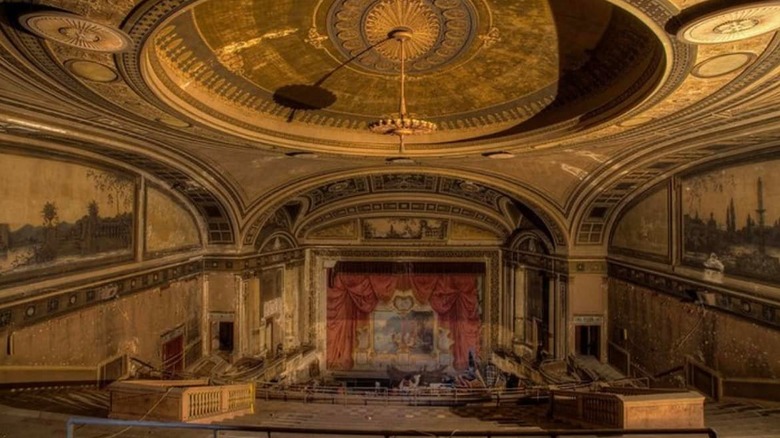
Designed in a neo-Renaissance style with elegant touches like real marble, a stained-glass mural in the lobby, and ceilings hand-painted with scenes of Italian gardens, the Lowe's Majestic Theatre in Bridgeport, Connecticut, was a sight to behold when it first opened in 1922. Though the theater has been closed since 1975, as these photos show, many of the ornate details that once made it famous still remain. For example, while the seats have been removed, the theater's chandelier still glistens from the auditorium ceiling.
In 1935, during a screening of the film "Mark of a Vampire," a woman in the audience screamed and fainted and was led to an ambulance. This was all part of a publicity stunt that the theater's owners cooked up to draw in audiences. Dramatic exploits like this were common during the heyday of American cinema, when numerous theaters competed to fill seats. In the 1920s and 1930s, Bridgeport, Connecticut, alone had 54 theaters.
While you can view the theater's sign from the outside, the theater's interior remains largely closed to the public, though one Facebook post claims that the theater offers tours a few times per year. Currently, Lowe's Majestic Theatre is being used as a storage facility for a local theater company.
The Sagecrest Drive-In, Yerington, Nevada
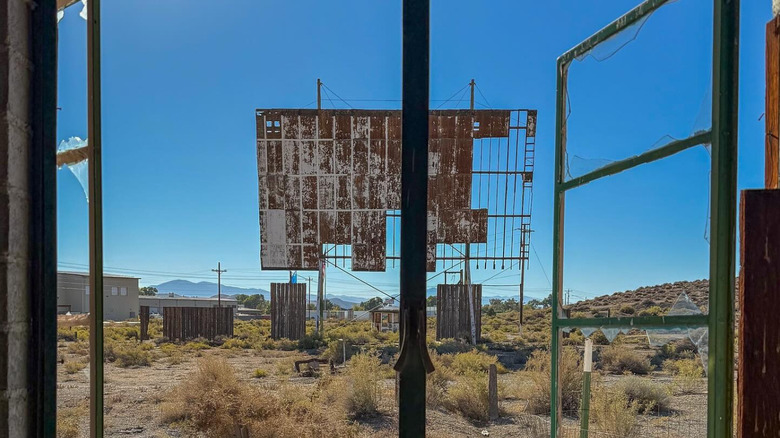
Unlike the other theaters included on this list, the remnants of the Sagecrest Drive-In in Yerington, Nevada, remain open to the public and free for curious history buffs to explore. While the desert heat and elements have weathered much of what used to be a small-town drive-in big enough to fit approximately 350 Cadillacs, you can still peer up at the theater's screen and wander through the blocky concrete ticket booth and concession stand.
The Sagecrest Drive-In first opened in 1954, and after changing owners a few times, played its final film in 1995. The land where the theater sits, baking in the sun, is outside of Yerington, a small town in Western Nevada, about 1.5 hours south of Reno.
Though Sagecrest's story isn't an uncommon one — many of the country's drive-ins have closed since the height of car culture — drive-in theaters are far from extinct. As of 2024, an estimated 283 drive-in theaters remain, including these 11 charming, fully operable drive-in movie theaters across America. Negotiations are also in place to possibly refurbish and reopen Sagecrest one day.
The Roxie Theater in Los Angeles, California
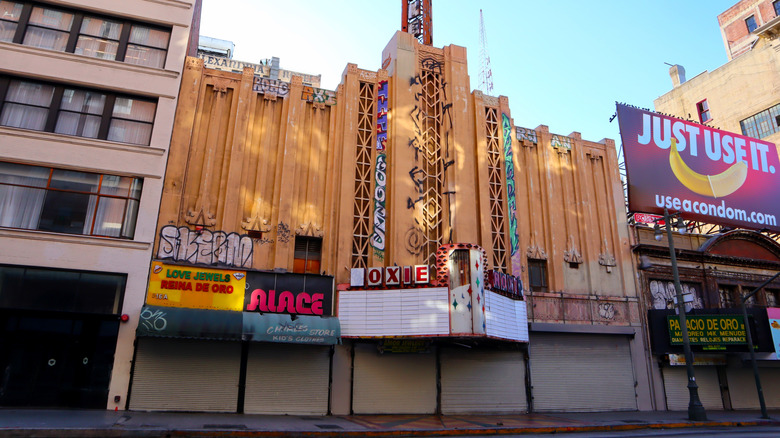
While many of today's most famous abandoned theaters were originally built to hold live performances, The Roxie Theatre in Los Angeles is unique in that it was designed with motion pictures in mind. The Roxie Theatre, not to be confused with the famous music venue The Roxy on the Sunset Strip, is located in L.A.'s Broadway Theatre District.
Opening in 1931, the 1637-seat theater had beautiful Art Deco design details, some of which can be viewed from the outside, above the theater's sign. It also experienced a string of tragedies in the 1940s and 50s. The theatre's manager died in the ticket booth, one of its patrons died by suicide in the middle of a two-film feature, and an usher kidnapped the manager and robbed the theater. Still, despite some bad press, the Roxie remained open until 1989.
You can still visit the theater today, though the theater's ticket booth was hauled away to make room for two retail shops that now occupy the space where the theater's lobby once was. The auditorium still remains, although access is limited to urban explorers and the occasional film crew.
The Westlake Theatre in Los Angeles
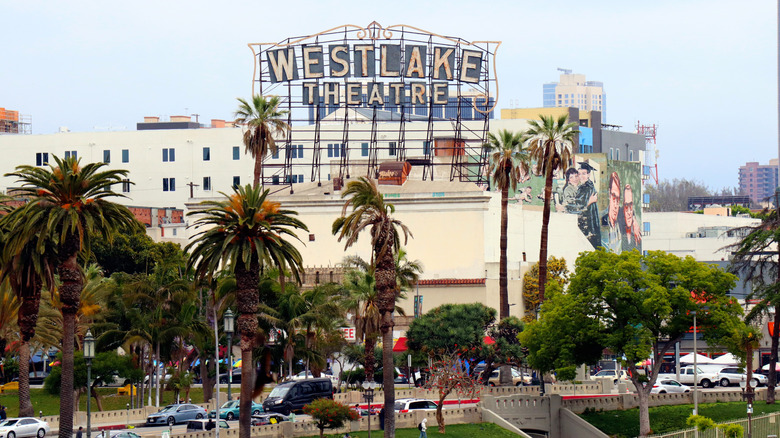
When the Westlake Theatre first opened in 1926, its elegant neon sign, Spanish Baroque-style architecture, and Renaissance murals made it appear right at home in what was a fancy neighborhood comparable to the Upper East Side of Manhattan.
Westlake Theatre is located in the Westlake neighborhood of Central Los Angeles, adjacent to Koreatown, one of Los Angeles' coolest neighborhood' and a trendy hub of culture. While exploring the area today, it might be hard to imagine it was once referred to as the Champs-Élysées of Los Angeles, as the neighborhood now struggles with crime, homelessness, and even gang and drug-related violence. The theater closed in 1991 when it was sold to a new owner who removed the theater's seats to create a space for an indoor swap meet. In 2009, the theater was added to the National Register of Historic Places.
The Westlake Theatre is up for sale and reportedly still being used as a swap meet venue, although at the time of writing, reviewers on Yelp report it is currently closed, and as of September 2025, the entrance has been blocked by a fence.
Methodology
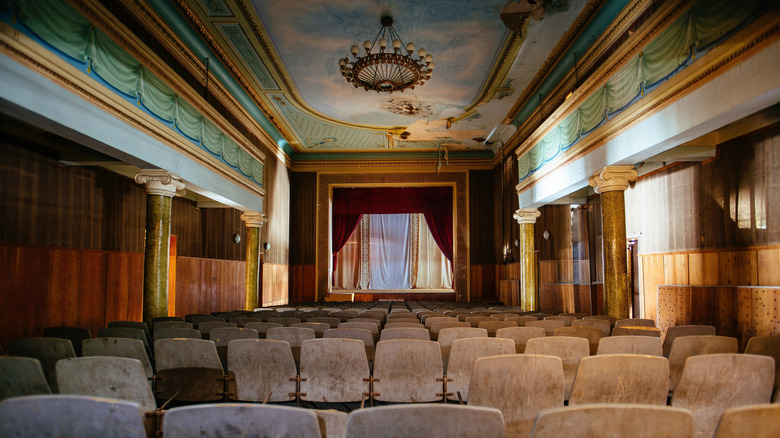
Research for this article was not an easy undertaking, as many of the eeriest and oldest abandoned theaters that show up in "the best abandoned theaters" articles have been recently renovated or, as more often is the case, completely demolished. Because of a theater's sloping floors and enclosed dark spaces, they're difficult to renovate into anything other than another theater, which is why, when they're purchased, developers often opt to knock the entire building down so that they can build apartments or retail spaces from scratch.
In order for a theater to qualify for inclusion on our list, it needed to be abandoned, which we interpreted as no longer in use as a theater. While urban explorers have made a hobby out of exploring abandoned or decaying factories, hospitals, and shopping malls, getting to those abandoned theaters is not only dangerous but can be illegal. Many of these theaters are private property.
After we ruled out the theaters that no longer exist or will soon no longer exist due to renovation plans, we were left with this short list. We made sure to fact-check all sources using recent news or magazine articles and Google Street View photos. The majority of the historical information came from the website of author and photographer Matt Lambros, who has dedicated himself to documenting America's abandoned movie theaters.