
5 Red Flags That Should Make You Turn Around Before Swimming In A Lake

Ready for a quick water safety quiz? You're taking a longer-than-usual afternoon hike on a late spring day in the Sunshine State, the ground muddy from a recent downpour. Sun's beating down. Sweat's pouring. Then, you come across a lake — quite likely, since Florida is one of the states with the highest number of lakes. The waters glisten, whispering, "You're welcome to cool off here." As you approach, you notice a patch of green floating across the cloudy water that looks like a piece of rebar is sticking out of the surface, and an acrid smell tickles your nose. Do you go in anyway? As it turns out, doing so would be ignoring five of the biggest red flags that should make you avoid swimming in a lake.
Swimming safety changes according to where you swim. Taking a dip in the ocean, for example, presents a host of potential dangers — which most often requires identifying dangerous rip currents while staying close to the lifeguards. Also, sharks can be a concern. Meanwhile, most pools, if well maintained and regulated, are only open when they're considered safe to swim in, but that doesn't mean they're not sometimes gross. Lakes, however, occupy a strange middle ground; many are just there, available without oversight. Although that daring freedom is part of the appeal, it's also a recipe for trouble.
Thankfully, easy warning signs exist. Posted water quality warnings and advisories, both in-person and online, can let you know what's brewing below the surface. Sometimes, you may even encounter literal red flags, the universal sign of danger. Meanwhile, the classic rule of thumb always applies: lifeguards know best, and you're likely safe within their territory. But all those easy warning asides aside, what if you find an inviting lake and you're alone? Let's take a look.
Stay away from mean, green blooms
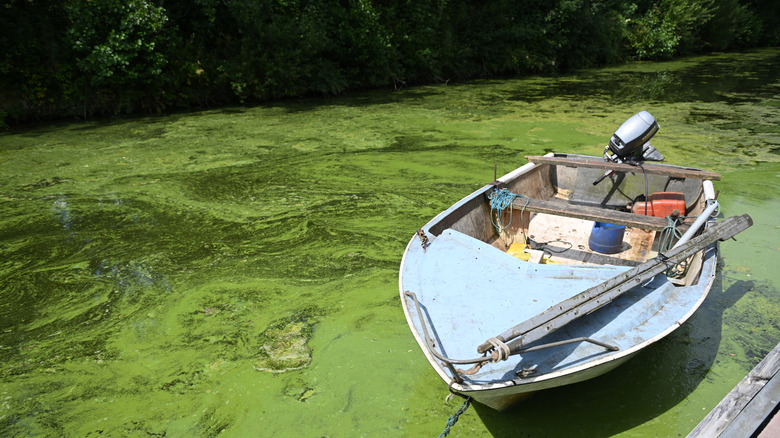
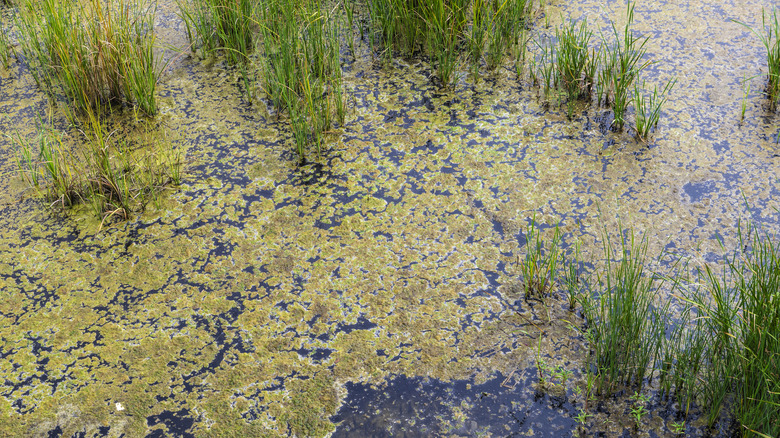
If you've ever chanced upon a lake that has as much green on its surface as there is water below it, beware. Lakes, as bodies of freshwater, are prone to a host of ills. The classic manifestation of this comes in the shape of algal blooms — those green, scummy scabs floating on the surface. Harmful algae caused by cyanobacteria (a.k.a. blue-green algae), dinoflagellates, and diatoms can show up as foam, gobs of green, or what looks like paint streaks, according to the Centers for Disease Control and Prevention (CDC). They also affect the color of the water, turning it into uninviting shades of green, brown, red, and blue.
Per the CDC and the UK Health Security Agency, coming into contact with toxic algal blooms can lead to nuisances like skin rashes, coughing, and watery eyes, or more severe symptoms like vomiting, diarrhea, muscle and joint pain, or fever. The tricky part, however, is differentiating dangerous from benign algae.
To do this, the CDC recommends a three-pronged approach to potential blooms. First, and most easily, avoid them. Any discolored, stinky water with bizarre growths on the surface is suspect. Second, keep an eye out for any posted advisories. This applies not just to swimming, but also to anglers — after all, if the water's bad for the fish, it's likely bad for you, too. Finally, municipalities often post advisories or water quality maps online flagging local bodies of water that are dangerous to public health.
Avoid extremely murky water
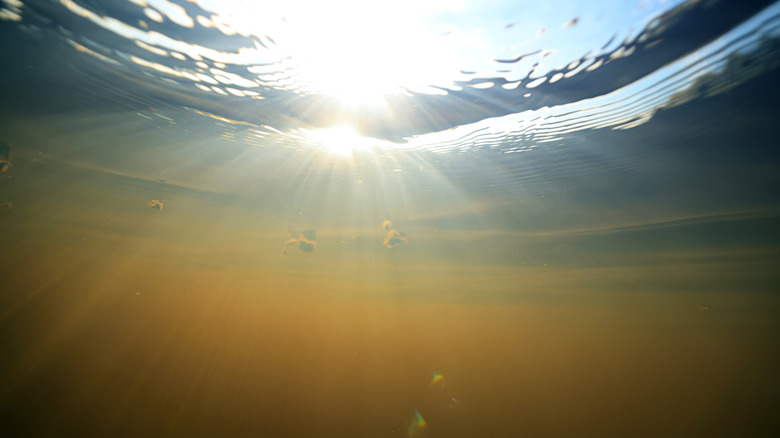
Few lakes share the crystal-clear waters of a Caribbean beach, and diving into a mysterious abyss remains one of the main tradeoffs with swimming in lakes. Or, it might be an advantage, depending on perspective. However, there's a fine line between the unknown and the unsafe — and water that's murky or cloudy presents a long list of question marks worth considering before diving in. Aside from bacterial blooms, cloudy water can also be the result of a host of potentially dangerous sources that include everything from runoff to contamination.
Even if opaque water isn't dangerous in and of itself, it may disguise hazards. Sharp objects, debris, and other dangerous materials may wait below the surface. Luckily, scientific devices like a Secchi disk — a black-and-white disk lowered into the water — may help assess the exact murkiness of the water. Unless you're a scientist, though, the resulting information is effectively useless, and the unknowns far outweigh the knowns. So, when in doubt, stay out. At the very least, do not swallow the water if you take a dip, and wearing a nose clip and earplugs helps as well. Finally, staying clear is also a solid way to avoid catching "swimmer's itch" on your lake trip.
Stormwater runoff is a hidden danger
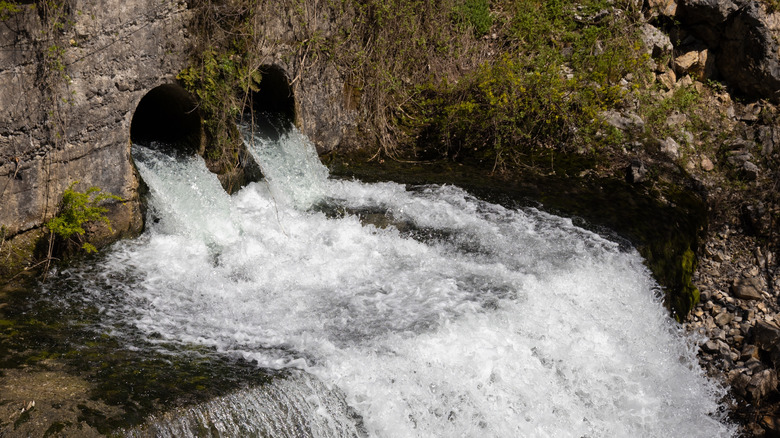
While lakes themselves may harbor nothing dangerous, the area around them might. All it takes is a good downpour to send a long list of ills washing into otherwise benign waters. For example, rainwater can bring debris from nearby farms (including feces), as well as pesticides, motor oil, and other pollutants from industrial operations. Similarly, culverts from roads can lead harmful particles toward lakes, and the resulting runoff can turn any lake into a mysterious stew of unknown chemicals and life forms.
The upshot is that rainfall accounts for more than half of all waterborne diseases that broke out over the latter half of the 20th century, according to a study by the Johns Hopkins Bloomberg School of Public Health. These diseases mostly manifested as gastrointestinal problems, and the presence of fecal matter, especially, increases the risk of E. coli contamination. While the Environmental Protection Agency does have acceptable limits for E. coli for recreational water — as well as other criteria — you're likely not in a position to test such levels.
To be safe, make sure you always let the lake settle after a good soaking, and give it up to 72 hours before assessing whether you should get in the water or not. You don't want to discover the danger of stormwater runoff when it's too late.
Debris or floating objects mean stay out
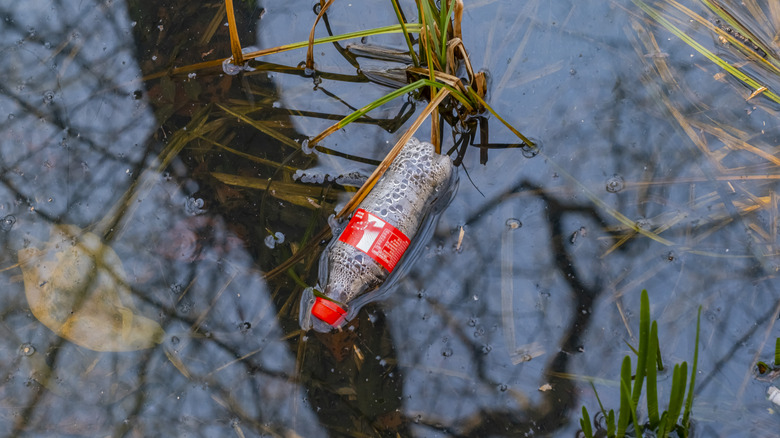
Coming across a clearly under-used and under-appreciated lake can feel like striking gold. Perhaps even one of the last frontiers of discovery. That said, while some may seem untouched, it's always worth taking a closer look. A lake, unlike books, can be judged by its cover — and it should be. More than the obvious dangers of algal blooms and discarded dangerous objects, debris floating across a lake's surface can reveal plenty about its life and status.
If you see cigarette butts, oil slicks, or random plastic objects or garbage bobbing on the surface like lily pads, it may indicate contamination, a nearby vessel needing a mechanic, or a lack of management and care by local authorities. Additionally, visible physical junk also offers a clear indication that there may be chemical or bacterial pollutants lurking in the water. The one thing a filthy surface doesn't promise? Safe swimming.
Bad odors signal unsafe water
The final red flag you may encounter when approaching a lake will come from the middle of your face. Specifically, your nose can be your last line of defense and best testing device, since nearly all of the above red flags create a funky odor. Bacterial, algal, and chemical toxins can hit your olfactory senses like a sledgehammer, and any rotten-egg smells may indicate algal blooms, which typically let off a sulfurous odor as they die off. Similarly, dead animal life, like belly-up fish, will do double duty by serving as both visual and nasal warning signs that something's going on.
Still, sometimes the sheer excitement of seeing a welcoming body of water overtakes you, and you sprint headlong into the lake only to discover, upon entering, that it's a veritable cesspool — and smells like one, too. Aside from immediately getting out, you'll need to wash up, quickly, and with a particular focus on your eyes, nose, and ears, along with any cuts or open wounds that could let bacteria in. If you feel unwell, see a doctor. And, next time, make sure to use your senses.