
5 Common Camping Rules That Change When You Go Glamping
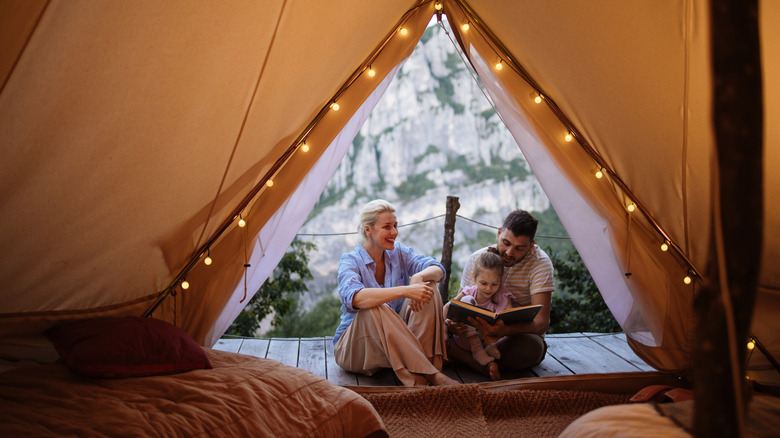
Part of the joy of camping is seeing how well you fare when you trade your domestic life for a life under the stars. Sure, you may have to go to the bathroom under a tree, bathe in cold water, struggle to get fires going, and try to ignore all that rustling in the night. But in return, you get something elemental: a reminder that you're a creature born of this planet just like the rest of them. However, for people who prefer to skip straight to the good stuff and don't want to get themselves dirty in the process, glamping offers a more luxurious take on the traditional DIY camping experience.
The origins of glamping are often traced back to 16th-century Britain, when a Scottish Duke created a glamorous camping experience for King James V and his mother. But really, glamping in its modern form arose in the 21st century, coming into common parlance as travel and tourism companies began offering glamping experiences among their luxury packages. The global glamping market is now a multibillion-dollar industry, with glamping sites appearing all over the world, whether you want to stay in a dreamy, canvas-tent resort in Zion National Park or an opulent glamping site in Thailand, Sri Lanka, or Botswana that looks more like a five-star hotel than al fresco accommodation.
You might not really be channeling your inner outdoorsperson when glamping, but then again, if you're paying thousands of dollars to sleep in the wild, you deserve a few comforts. Some basic camping rules go out the window when you make that switch: Bye-bye cathole bathrooms and firewood rounds, welcome back central heating and hot showers. Below are five of the biggest changes you'll encounter.
You'll have access to proper toilets
If, since you left diapers and potties behind, you've only used a toilet for doing your business, the idea of squatting over a hand-dug trench and using leaves as bog roll probably isn't appealing. But every wild camper knows this is just part of the deal — there are even in-depth YouTube tutorials on "how to poop in the woods" properly. Leave No Trace, a non-profit dedicated to environmental protection, says you should bury human waste in 6-to-8-inch catholes, at least 200 feet from camp, water, and trails to prevent pollution of water sources and the spread of disease. Some campers might prefer to lug around a portable toilet, though that can lead to weight and odor issues, never mind your becoming an increasing source of interest to insects.
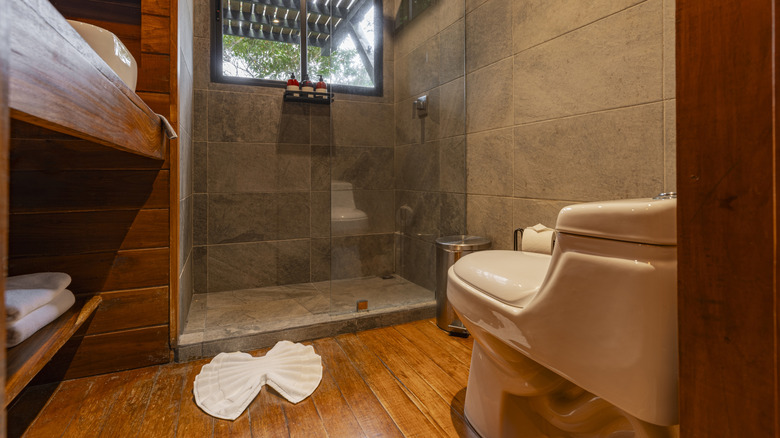
Official campsites often provide communal bathroom spaces for guests to use, and if you're in a glamping area, you may even get private toilets with all the bells and whistles: plumbing, a flush mechanism, perhaps electronics and a heated seat. Some other types of glampsite toilets include eco-friendly composting toilets, which look like normal toilets but use a plunger instead of a flush; chemical toilets, which use substances like formaldehyde and chlorine to break down waste, but can be damaging to the environment; and incineration toilets, which leave almost no waste behind, but are expensive and energy-intensive.
The quality and type of toilet will be dependent on permits, sewage availability, remoteness of the site, levels of investment, and other factors. It's also worth checking whether the bathroom facilities are private or shared, though high-end glamping sites will usually offer private bathrooms with accommodation. And you can still bring a trowel for digging a cathole, just in case all else fails.
You can have a hot shower
Just as going to the toilet is an al fresco experience for wild campers, so is performing your ablutions. Campers often substitute the shower for a river or lake, or in summer, a solar shower, whereby a black PVC bag is filled with water, heated by the sun throughout the day, then dumped over the camper before the water cools. Both options are predicated on the camper being close enough to a clean water source; if not, they may be dabbing their pits and bits with some wet wipes — what's sometimes known as a "field wash." Moreover, given space and weight restrictions in a backpack, re-wearing t-shirts, socks, and undergarments is commonplace, turning the notion of camping cleanliness into a relative concept.
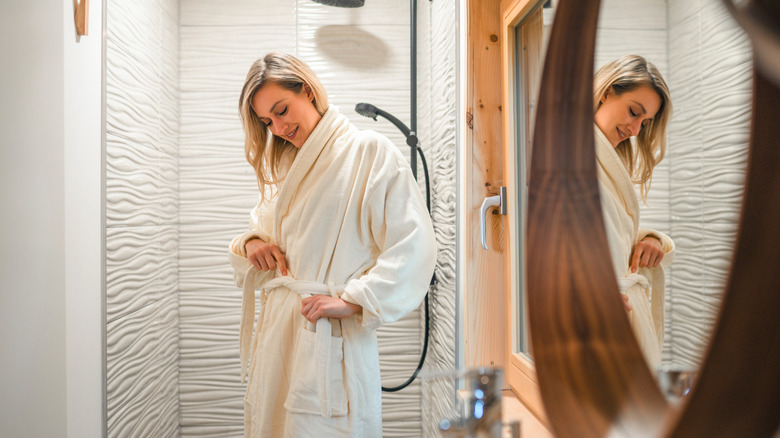
Having access to proper, hot showers is a unique selling point of glampsites and it also influences the cost of the accommodation. Different styles of showers are used, with access to plumbing and grid electricity dictating what guests can expect. Solar showers and portable showers, which can be battery-operated, controlled by a foot pump, or gravity-fed, are at the lower end of the glam spectrum. More boutique options include fixed communal showers, often connected to a main water system, and private en-suites, which are indistinguishable from a hotel bathroom. If you want even greater luxury, some premium glamping pods come kitted out with hot tubs and saunas to ensure you won't just feel clean but positively revitalized.
You'll sleep like a king (or queen)
Sleeping in a tent requires some getting used to. There's setting the thing up in the first place, adjusting to plunging nighttime temperatures, and struggling to find comfort on your sleeping mat or in the cocoon-like space of a sleeping bag. Even frequent campers aren't always settled at night, which is why some are trading their sleeping bags for sleeping quilts. Plus, sometimes when you're camping in the wild, you're going to wake up, realize you need to pee, and discover that it can be quite an ordeal.
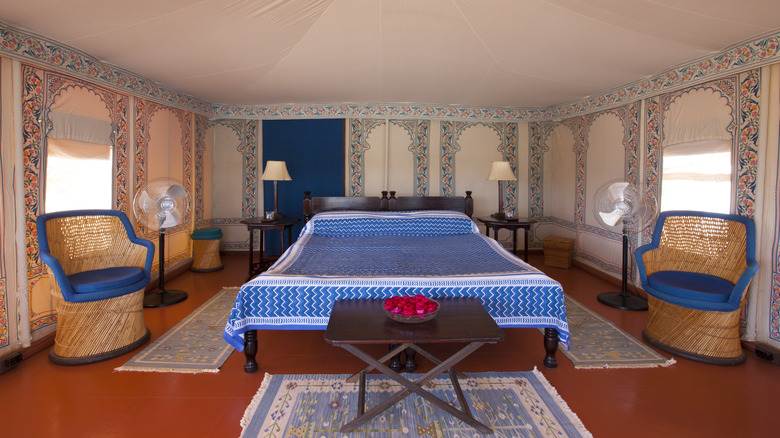
When people think about glamping, the hominess and domesticity of the space are probably the first things that come to mind. Whether you're staying in a luxury glamping yurt, a safari-style tent, or a clapboard glamping pod that's effectively a cabin, one thing you can expect above all else is comfort. And nowhere more so than the bed.
Glampsites around the world lure customers with their sleeping arrangements, including four-poster beds with cloud-like drapes, beds nestled within geodesic domes that look upon awesome alpine scenery, beds that sit in heated glass pods under the Aurora Borealis, and beds from which you can watch wildlife tottering up to the sliding glass doors of your tent-lodge. Even if your daytime experiences — hiking through the hills or birdwatching in the woods — mirror those of the wild camper, the feeling of a soft mattress and comfortable pillows at night places you in a land of relative luxury.
Meals can be extravagant
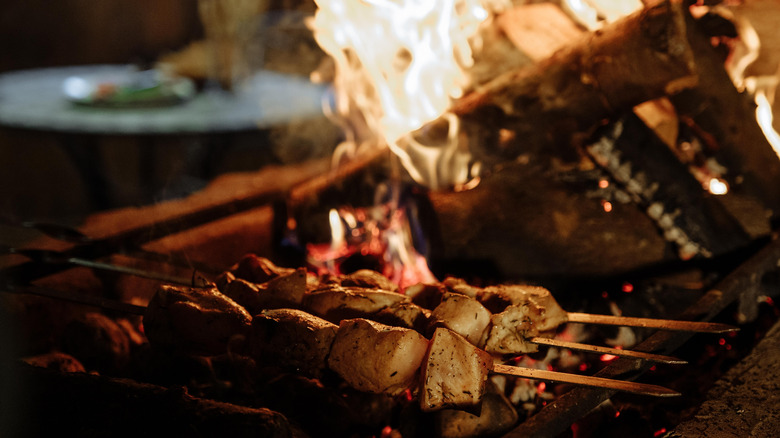
It's a common misconception that camping food means tinned beans, freeze-dried food, salted jerky, and ultraprocessed calorie bars, maybe a few toasted marshmallows if you're lucky. While these can be useful items in your portable pantry, many wild campers cook robust meals with all the necessary macronutrients, using portable boilers, camping stoves, and campfires. Some also swear by aluminium foil, an essential camp cooking method every outdoor traveler should know, which can mimic the effects of an oven. If you're not traveling too deep into the wilderness, it's possible to keep produce fresh using ice packs and cooler bags, and without adding much weight to your pack, you can bring salt and basic spices to imbue your meals with flavor. Although you do need to be wary of attracting bears and other wildlife, campsite dining is actually not that far divorced from home dining.
That said, meals at a glampsite can be ornate and extravagant. Some glamping cabins come with fully equipped kitchenettes, so you can cook whatever your stomach desires. Others offer boutique dining experiences and hotel-style room service. At Platte Canyon Glamping in Wyoming, guests can opt for the all-inclusive option, where three meals a day are cooked by a private chef. Alongside feasts centered on local, ranch-grown ingredients, you can pop into the wine cellar to pick some accompanying sips. AutoCamp, which has glamping and nature-based accommodations in locations around America — including Yosemite, Zion, Cape Cod, and the Catskills — offers restaurant-quality meals and a selection of craft beer to guests in between their daytime excursions. Some glamping sites are becoming such impressive gastronomic spaces that they're even appearing in the Michelin guide.
Drinking water is readily available
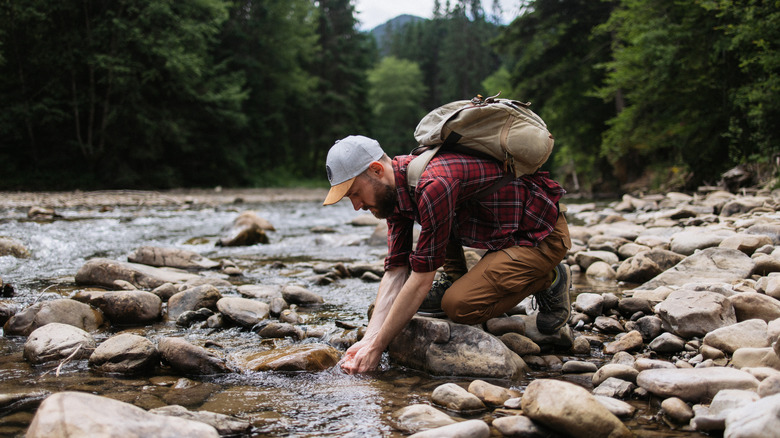
Knowing how to identify or generate clean, drinkable water is one of the most important skills for a wild camper. Humans can't live without water for more than three days, while drinking water contaminated with pathogens and parasites brings its own slew of problems. The cleanest water sources are usually natural springs and flowing water channels far away and upstream from urban areas. The National Park Service, however, recommends you avoid drinking water from natural sources unless you've purified it, as even clean-looking water can be riddled with waterborne diseases. Instead, you should collect the water, then filter and boil it to ensure it's purified. Alternatively, pack a hydration must-have for the trail, like a straw that filters out 99.99% of microbes and allows you to drink directly from the water source.
Fortunately, in many glamping sites, you don't need to fret about purifying water. As the glamping industry grows, so too does the demand for eco-friendly potable water solutions. There are different water systems at play: some collect and store rainwater to use for drinking, flushing toilets, and irrigation; others use technology to purify local water sources and manage water wastage. Even remote, off-grid sites can use innovative solutions to provide you with clean water, like tapping into boreholes and filtering the groundwater, or harvesting water from clouds, fog, and dew droplets. Still, there are cases where a glampsite might not be able to provide potable water, so it's always worth confirming before you reserve your spot.