
5 Of Bob Dylan's New York City Haunts To Visit That Are Pure Vibes And Creative Energy
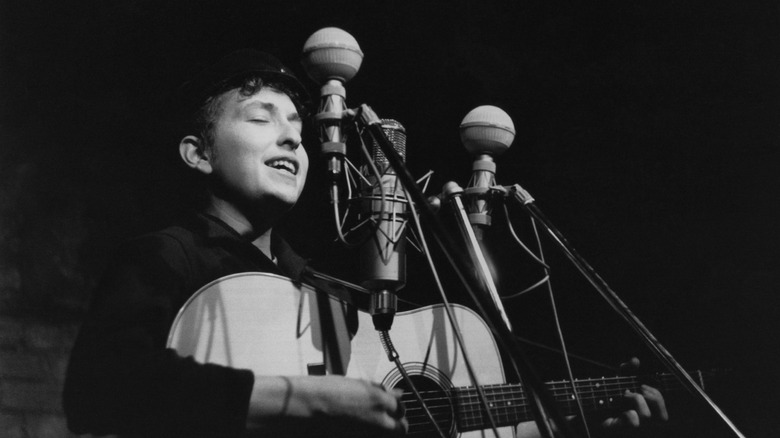
New York City moves fast, but in a few corners of downtown, you can imagine it's 1961, and you're in the same room with a newly arrived Bob Dylan. NYC both inspired Dylan and transformed him. It became the subject of multiple songs, but it's also where Dylan's musical identity unfolded. It was when he moved to NYC in the 1960s that he assumed the name "Bob Dylan." "New York City, the city that would come to shape my destiny," Dylan wrote in his memoir "Chronicles Vol. 1" (excerpted in Forbes).
Most of Dylan's time in NYC was spent in Greenwich Village, one of New York's liveliest and most artsy neighborhoods. Dick Weissman, a musician and author of "Bob Dylan's New York: A Historic Guide," described Dylan as "a creature of the Village" in an interview with The Gotham Center for New York City History. Another Dylan scholar, Sean Wilentz, told Forbes, "Dylan did a lot to shape the Greenwich Village scene, but the Greenwich Village scene did a lot to shape him as well." The Village is where Dylan lived, where he got his first major gig, and where he would have been seen scrawling song lyrics in the low light of underground bars.
Though the city has inevitably changed, many of Dylan's original haunts are still alive. Their historic status and ties to the folk singer are documented by institutions like The Gotham Center and the Greenwich Village Society for Historic Preservation (GVSHP), which has its own Bob Dylan-themed map of the Village. Using these records and details about Dylan's life shared by his chroniclers, we picked out five places in the city you can still visit today and are worth a stop for any music lover.
Cafe Wha?
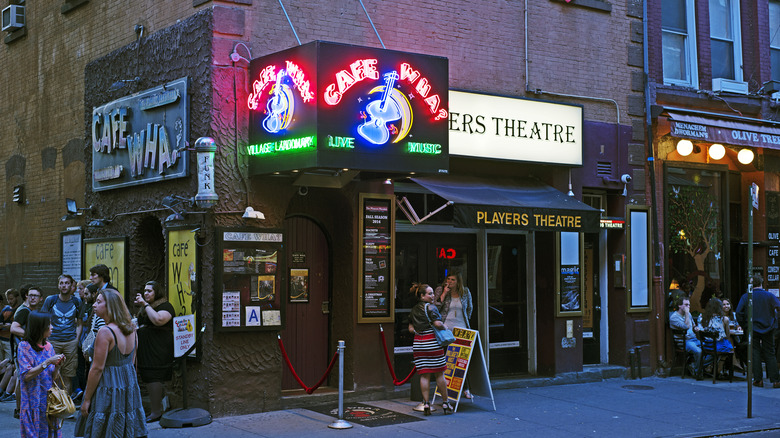
Dylan owed his start in Greenwich Village (and NYC broadly) to the cozy basement venue on MacDougal Street called Cafe Wha? On day one of his arrival, Dylan convinced the coffeehouse's show organizer, Fred Neil, to give him a slot on the Village stage, according to The New York Times. In one version of the story, recounted by former Cafe Wha? owner Manny Roth, Dylan admitted to the owner he had nowhere to sleep; Roth asked the audience for help, and a member offered a place to crash.
Dylan's first performance consisted of renditions of Woody Guthrie songs — fitting, since Guthrie was the reason Dylan came to NYC in the first place, as Weissman explained to The Gotham Center. After his initial set, Dylan got a job playing backing harmonica at the venue, "which paid him $1 a night and a free hamburger," Weissman said. The coffeehouse became a creative incubator in the '60s, with Dylan working alongside the likes of Mary Travers, who would soon form Peter, Paul & Mary. After just three gigs, though, Roth fired Dylan for repeated tardiness.
Cafe Wha? is still going strong, although it's moved one door down from where it originally was located, per NYC Tourism. It's two minutes by foot from the West 4th Street subway station. These days, the venue has drifted away from its coffeehouse origins and leans more into its musical reputation. It hosts live music every Wednesday through Sunday in the evenings, and it's best to make a reservation online ahead of time, since nights can sell out. The space is pretty compact, but as one Google reviewer put it, "It's a basement venue, so just consider it part of the experience."
Caffe Reggio
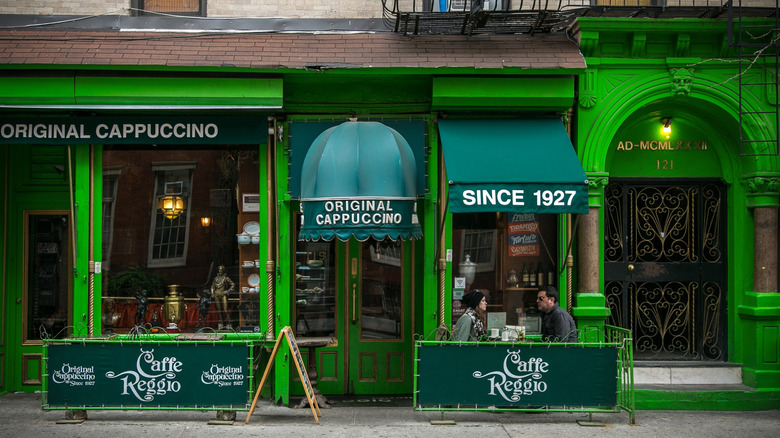
After his stint at Cafe Wha? was up, Dylan sought out other venues along MacDougal Street to stoke his musical passion. One of the spots he performed at in his early NYC days, as Urban Archive documents, was Caffe Reggio. Dylan described Reggio and the other corners of MacDougal Street he frequented as "loud and noisy and catered to the confection of tourists who swarmed through the streets at night," as excerpted in The New York Times.
Caffe Reggio has a long history tangled up in the creatives who've immortalized Greenwich Village. The cafe is nearly a century old — opened in 1927 — and over its many years welcomed fellow musicians Jimi Hendrix and David Bowie, plus other big names like Sophia Loren, according to The Saturday Evening Post.
But its roster of legendary visitors isn't the only thing that makes Caffe Reggio one of the best coffee shops in Manhattan. It's also a window into the past, with objects you might be surprised aren't behind glass. At the back of the cafe, shining faintly over its encircling tables, is what's alleged to be the first espresso machine brought to America (which the original cafe owner had shipped from Italy in 1902). There's an original painting from the school of Caravaggio hanging on the wall and a bench from the Medici family. The cafe no longer hosts live music, but you can still come in for a possible encounter with a scribbling songwriter in the late hours of the night. Reggio embodies NYC's never-sleep spirit, open from 9 a.m. to 4:30 a.m. on Fridays and Saturdays (until 3 a.m. all other days). You'll find its Italianate green facade at the corner of West 3rd Street and MacDougal, a two-minute walk from the West 4th Street station.
Theatre de Lys (Lucille Lortel Theatre)
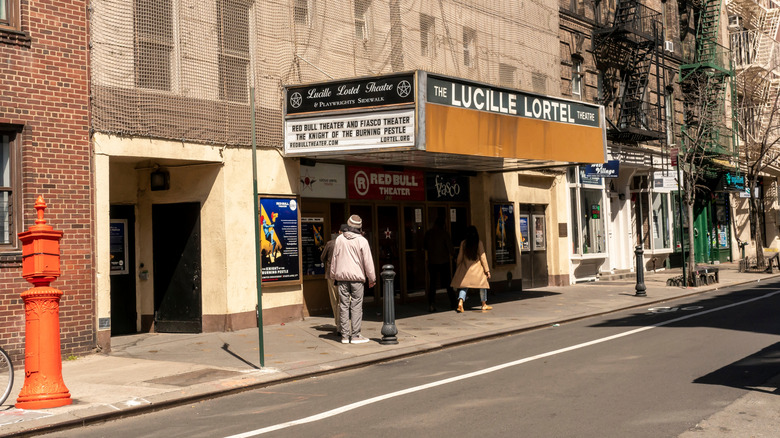
Greenwich Village in the '60s was a pastiche of art forms interacting, which greatly shaped Dylan's musical direction. As Wilentz said in Forbes, "It wasn't just the music — there was dance, theater, comedy ... All of it mattered to [Dylan]." In the theater sphere, there was perhaps nowhere more influential to him than what was named the Theatre de Lys, today known as the Lucille Lortel Theatre, on Christopher Street.
It was at the Theatre de Lys that Dylan saw a performance of "The Threepenny Opera" by Bertolt Brecht, according to the GVSHP. Music from the show inspired some of Dylan's most-recognized songs, including "It's Alright Ma (I'm Only Bleeding)" and "Mr. Tambourine Man." Dylan wrote in his "Chronicles" (excerpted in Gothamist), "If I hadn't gone to the Theatre de Lys and heard the ballad 'Pirate Jenny,' it might not have dawned on me to write them, that songs like these could be written."
"The Threepenny Opera" set records with its long run in the mid-20th century at the theater. Today, the Lucille Lortel Theatre is still a thespian mainstay. The building is historic, staging off-Broadway productions since 1955, and several of its shows have transferred to Broadway, including 2024's "Oh, Mary!" The theater has just one stage, and you can see what's currently playing and upcoming on its website. It's just a three-minute walk from the Christopher Street-Stonewall subway station. You could also walk there in six minutes from dinner at Sip&Guzzle, an exclusive NYC restaurant with a renowned burger.
The Bitter End
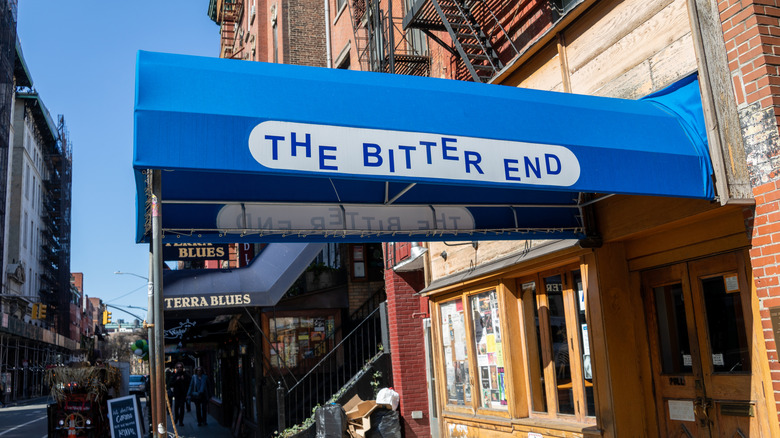
The Bitter End, a club on Bleecker Street, arrived in NYC the same year as Dylan, 1961. It served as one of the early venues to host Dylan in his first years in the city, as the New York Post reported, but The Bitter End gained a newfound significance in Dylan's life years later. After moving away from NYC with his wife upstate for several years, Dylan returned to the city in 1969, per The New York Times. This time, he came to Greenwich Village not as an unknown striver with nowhere to sleep, but as a distinctive songwriter with a robust following. Dylan found some respite at his former haunts, especially The Bitter End.
The Times describes Dylan as spending more time at The Bitter End playing pool or watching other shows than performing himself. At The Bitter End, "people like me and Bob Dylan didn't just perform, we came to hang out," said musician Kris Kristofferson in another Times piece. It's also where Dylan met long-time friend Patti Smith, coming to find her backstage after her band's show.
Amazingly, The Bitter End has remained largely unchanged in its look since Dylan frequented it. Archival photos of the club's interior in the '60s and '70s show the small stage, exposed brick wall, and close-to-stage seating that you can still find there today. The Bitter End hosts live music shows across a range of genres (not just folk), with various nightly billings. You can buy tickets online or at the door, though sometimes tickets cost less when you get them online in advance. The club is about a six-minute walk from the Bleecker Street subway station.
Washington Square Park
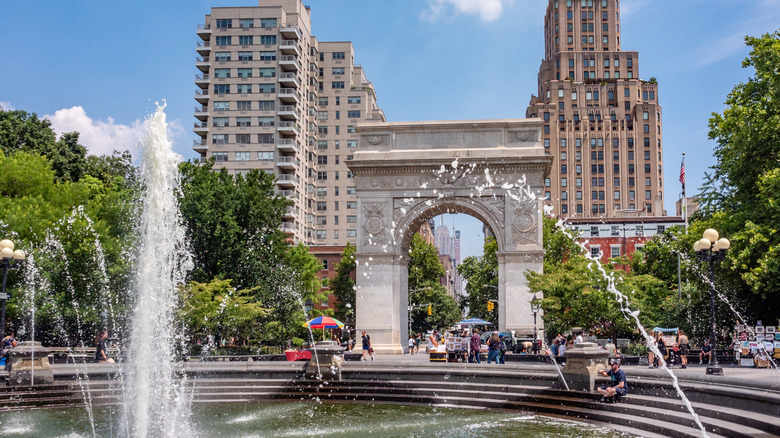
It could be argued that Washington Square Park was the epicenter of NYC's cultural scene in the mid-20th century. It's where the Beat poets congregated, where Lorraine Hansberry delivered speeches about racial justice, and where Dylan would play his guitar by the central fountain. "Washington Square was a place where people you knew or met congregated every Sunday and it was like a world of music," Dylan said in a Playboy interview, quoted in Far Out Magazine.
In 1961, the park decided to remove the musicians and buskers from its grounds, as the GVSHP recounted, and uproar ensued. Thousands of protestors came to the park and deliberately played music in retaliation to the ordinance — Dylan was one of them. The protest successfully overturned the ban, and it's why you can still find live performers there today.
Dylan described the park in the Playboy interview as a place where you'd find "[b]ongo drums, conga drums, saxophone players, xylophone players, drummers of all nations and nationalities. Poets who would rant and rave from the statues." The Village has changed, but the atmosphere of the park still has that hodgepodge, creative elation. It's common to see jazz musicians, impromptu breakdance shows, and rallies around the park's central ring, notwithstanding that it's beautiful in the warm months, when the fountain is turned on and framed by the Washington Square Arch. The park is open from 6 a.m. to midnight and is a two-minute walk from the West 4th Street station.
Methodology
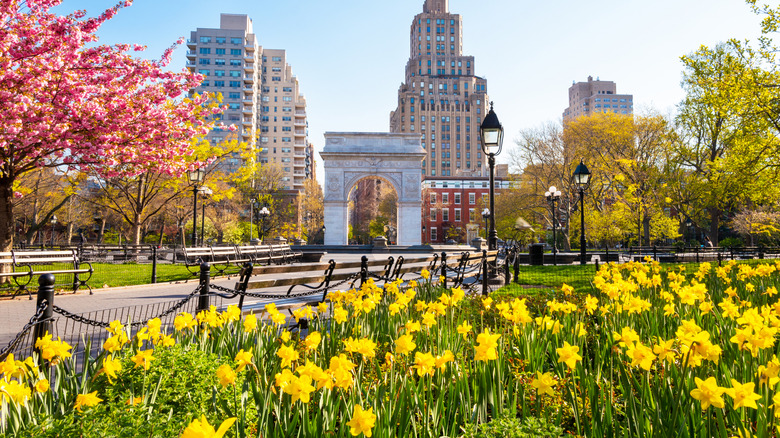
Bob Dylan has ties to many places around New York City, particularly around Greenwich Village, where he lived. These are well-documented by historical organizations like the Greenwich Village Society for Historic Preservation, The Gotham Center for New York City History, and Urban Archive, plus historical accounts in publications like The New York Times and Forbes.
We used these sources to find the spots Dylan loved, then we narrowed down the list to those that are visitable today. Only places that still operate mostly the same since Dylan frequented them were included, and we also limited our list to places with some creative offering, whether that be live shows or being a hangout of artists. For this reason, Dylan's residences — which you can walk past but not enter — were excluded.