
Rick Steves' Team Shares Why Spain Is A Hot Spot For 2026 Travel (And How To Prepare)

Spain-bound this summer? We reckon you won't be the only one with this European country on your bucket list. From Cádiz making it to Lonely Planet's Best Destinations of 2026 list to Madrid bagging the number one spot in European Best Destinations 2026, Spain is having another moment in the spotlight. On the heels of these accolades, two exciting landmark events involving a beloved Barcelona landmark and a celestial spectacle are slated to take place this summer — and the Rick Steves' Europe team wants travelers to come prepared. Steves' protégé Cameron Hewitt and colleagues Travis Parker and Amanda Kerzman unpacked these upcoming milestones in their Travel Talks episode.
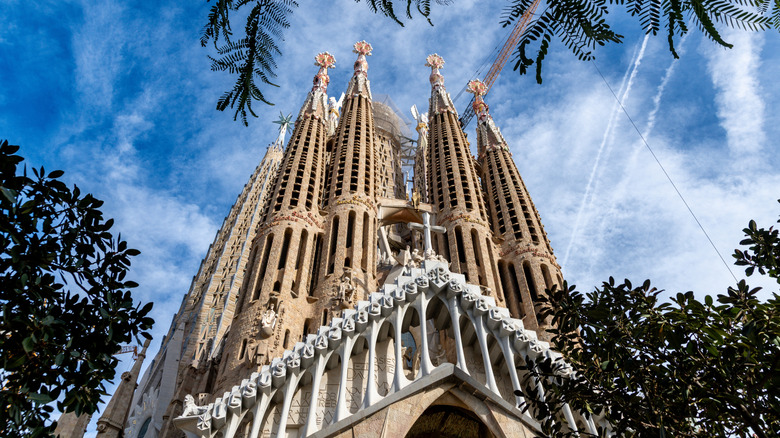
Travelers in the vicinity of Barcelona can now admire the Sagrada Família's recently completed Jesus Tower, the tallest central fixture of Antoni Gaudí's architectural masterpiece. The completion of the cross that sits atop the tower bumped the structure's height to 566 feet, making it the world's tallest church — a feat that will be officially inaugurated on June 10 to coincide with the 100th anniversary of Gaudí's death.
However, this doesn't mean that the church — a work in progress since 1882 — has called it a wrap. Construction will continue on the interiors and facades. "To their credit, completing the main tower is a huge achievement that's worth celebrating. But the church is still far from truly 'finished,'" wrote Parker, Rick Steves' guidebook researcher. Still, it's a great opportunity to see the tower without its scaffolding, which should be removed in time for the inauguration. "We definitely anticipate that during that day and probably well beyond, the Sagrada Família is going to be even busier, and Barcelona will also see an increase in foot traffic," said Kerzman, Rick Steves' European social media manager.
A total eclipse over Spain
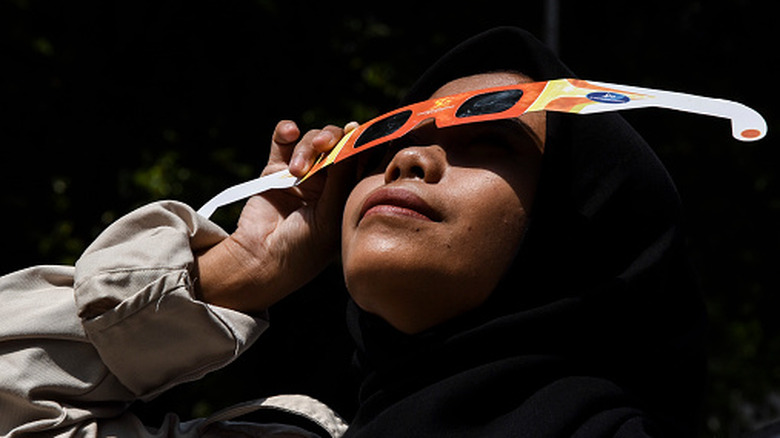
The Sagrada Família's highest tower isn't the only thing unveiling itself this summer. A spectacle of celestial proportions is set to take over Spanish skies on August 12: The first total solar eclipse over mainland Spain since 1912. The National Solar Observatory (NSO) announced that the path of totality — areas that will witness the total solar eclipse — will arc over the Arctic Ocean, Greenland, Iceland, Portugal, and northern Spain.
Spain is getting a lot of eclipse action this year. Over 40% of the country will witness the moon completely blocking out the sun, short-lived at two minutes max, but a guaranteed thrill from start to finish. If your coordinates aren't perfectly lined up with the eclipse's path of totality (like those of Madrid and Barcelona), you'll have to settle for a partial eclipse. But find yourself in spots like A Coruña, Bilbao, Valencia, Zaragoza, or Palma, and you're guaranteed front-row seats to this once-in-a-lifetime phenomenon. Just slip on those eclipse glasses, and you're good to go.
You may not be the only one planning a summer of sangria and tapas with a side of an eclipse. If there's anything to be said about astrotourism, it's that the sky's the limit when it comes to celestial interest and curiosity. Victoria Sahami, astronomer and founder of Sirius Travel, found the company's science-based tours solidly booked for the next four years following the 2024 total solar eclipse over North America. "We saw this huge increase after the April eclipse last year," Sahami told Travel Weekly.
How to prepare for Spain's key events this summer
These two events are cause for celebration, but Spain's overtourism problem — which Hewitt considers a major challenge when traveling in Europe — tempers the excitement a bit. Barcelona welcomed 26.1 million tourists in 2025, and flight capacity into the city is already up 3.8% from last year, per Observatori del Turisme a Barcelona's latest tourism activity forecast. If that's not a wake-up call to start booking your flights and accommodations early, we don't know what is, especially if you're planning to dodge crowds and save money while you're at it.
However, New York-based Spanish tourism office head Magí Castelltort believes Spain's current hotel capacity is equipped to handle the eclipse enthusiasts. "The solar eclipse will take place in many cities that already have large hotels, good hotels, and a lot of hotel rooms," Castelltort told Condé Nast Traveler.
Still, getting your flights and hotels locked down ahead of the eclipse-chasers is best done sooner rather than later, according to Kerzman. "They are hardcore, they love these events, and for good reason," Kerzman shared. "They do book accommodations pretty well in advance." Meanwhile, Parker also suggests keeping an eye out for the EU's rolling Entry/Exit System (EES) — which is expected to find its footing by April 2026 — in case you'll need to register or pay a fee before boarding the plane.