
How Long Does It Really Take To Refuel A Plane?
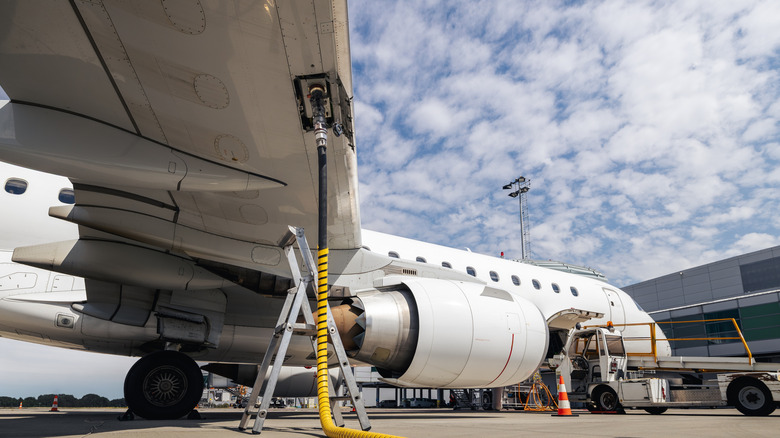
When you land at an airport, you may be thinking about the baggage handlers, hoping they manage to transfer your luggage to a connecting flight. You'll see the cleaners come rushing in their fluorescent yellow vests. You might even watch the workers lining up the ramp with the door and securing it in place. But you might not notice the people standing by, waiting to refuel the plane, or consider the 20 minutes to several hours it takes for refueling.
Fuel management is a big deal for airplanes, and it requires painstaking planning. It's one of the company's biggest operating expenses, it's the reason some planes avoid flying over the Pacific Ocean, and it's one reason airlines are adopting more sustainable aviation fuels. Factors affecting when, where, and how much fuel airlines might load on an aircraft range from what is legally required and how much is optimal for performance to the equipment available and cost at each airport. Airlines will often skip refueling at an airport if it is cheaper and faster to do it once the plane returns to their home hub, if safety permits.
The two systems airports use for refueling are underground pipelines, more commonly used at bigger airports, and fixed-base operators that deliver fuel to aircraft by truck. Since the trucks only carry between 3,000 and 20,000 gallons each, you'll find these at smaller regional airports with fewer flights and smaller planes. Fuel contractors at smaller airports may also handle lavatory maintenance and other upkeep services.
Factors in refueling a plane
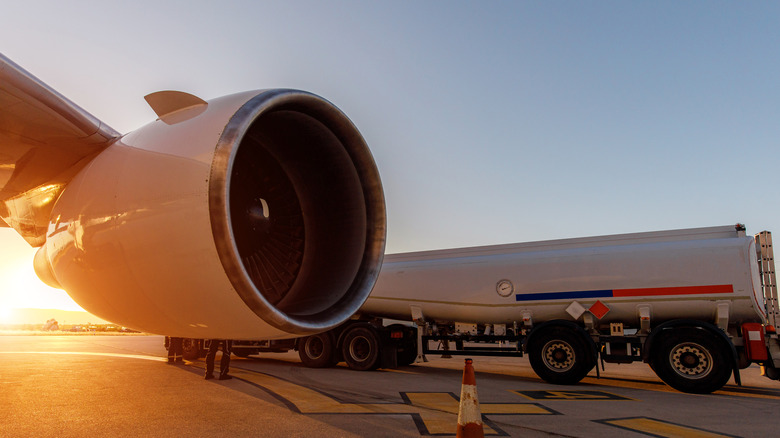
The two biggest factors in how long it takes to refuel a plane are the amount of fuel needed and the fueling method. A Boeing 737 Max, which can hold about 7,000 gallons of fuel, takes about 20 minutes to go from empty to fully fueled. Meanwhile, the gargantuan Airbus A380-800 — which can transport over 500 passengers — can drink up more than 85,000 gallons. Filling those tanks can take anywhere from one to five hours, depending on the equipment available.
Pipeline connections are the preferred way to refuel large commercial aircraft. According to Boeing's turnaround time analysis for the 747-8 (PDF), planners should expect the 467-seater to be ready for departure in about 110 minutes, of which about 55 minutes is spent fueling it. When filling planes from trucks, the fueling speed depends on how many trucks are pumping and with how many nozzles. For example, one truck with a single nozzle pumping fuel at 300 gallons per minute would take 3.5 hours to completely refuel a 747 with an empty tank. Multiple trucks with multiple nozzles will be significantly faster. It's also worth mentioning that planes seldom land completely empty — thank goodness — and they also do not always take off completely full.
Refueling planes is a critical task that requires safety measures, even for the shortest commuter flights. Fuel agents await arrivals, then refuel the plane once passengers disembark. Each type of aircraft has a specific location where the fuel agent must attach a ground wire to prevent static electricity from sparking a fire. While filling the tank, the fuel agent also holds onto a deadman switch — so named because if a worker dropped dead and released contact, the fueling process would automatically stop.