
North Carolina's Dunes At Bogue Banks Are Doing A Lot More Than Offering Coastal Beauty
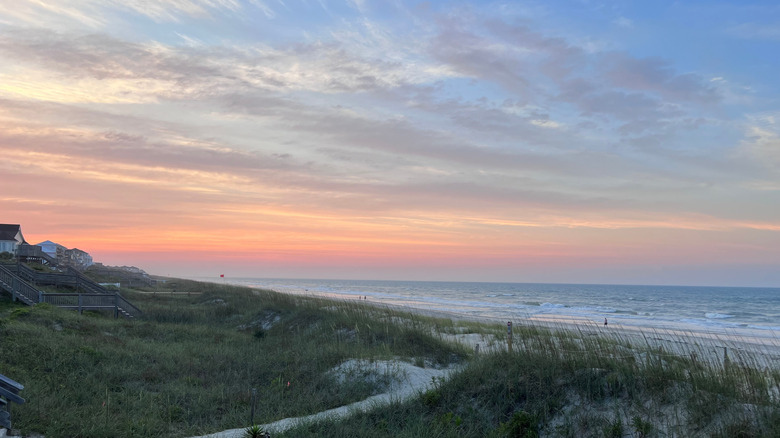
Tourists love to visit Bogue Banks because its warm, turquoise waters give it a Caribbean vibe. This 21-mile barrier island off North Carolina's southern coast is home to Fort Macon State Park, the North Carolina Aquarium, beautiful beaches, and hidden, uncrowded beach communities like Salter Path. North Carolina's $36.7 billion tourism industry relies on its beaches. And those beaches rely on dunes, because picturesque dunes in places like Bogue Banks aren't there just for coastal beauty — they provide protection against flooding and coastal erosion. While kids building sand castles and paddleboarders looking for marine life might not give the dunes a second thought, tourists might not be there without them.
First, a little Dunes 101. Sand dunes do a bunch of useful things. In areas prone to high waves, storm surges, or eroding shorelines, dunes often stand between the ocean and homes and businesses. They also provide sand storage, which can resupply eroded beaches. That's why Bogue Banks and many other coastal areas are recognizing the importance of protecting their dunes. Some try to further protect dunes by fencing them off and providing walkways around them, or planting beach grass to help hold them together. According to NOAA's National Centers for Coastal Ocean Science, the Outer Banks of North Carolina have some of the East Coast's highest rates of sea-level rise and coastal erosion.
How dunes protect Bogue Banks from coastal flooding
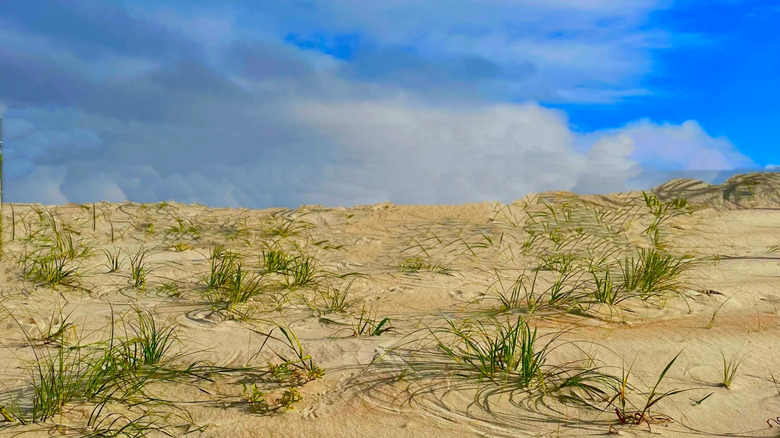
Academic researchers and the Army Corps of Engineers have long been studying the sand dunes on the Outer Banks. A joint team from the University of North Carolina and Oregon State University visited Bogue Banks in 2017, a few years after Hurricane Sandy ravaged the East Coast of the U.S. Researchers got interested in how dunes might help protect coastal communities during storm surges — those times when wind and dropping atmospheric pressure cause flooding during major storm events like hurricanes and nor'easters. "Locations that had a tall frontal dune fared much better than locations that didn't have a dune at all," Laura Moore, a researcher at UNC, told UNC Researcher Stories.
A strange fact about barrier islands: They move! Not visibly, but over time. "They have been evolving over the last several thousand years," Moore said. "In order for barrier islands to persist into the future, they need to be able to move landward and upward to maintain their elevation relative to sea level." This happens through overwash, a process where water covers dunes during storms, scraping sand off the dunes and beaches and dumping it on the side of the island closer to the mainland. As this happens over and over, the island creeps away from the open ocean.
Funding to preserve North Carolina dunes
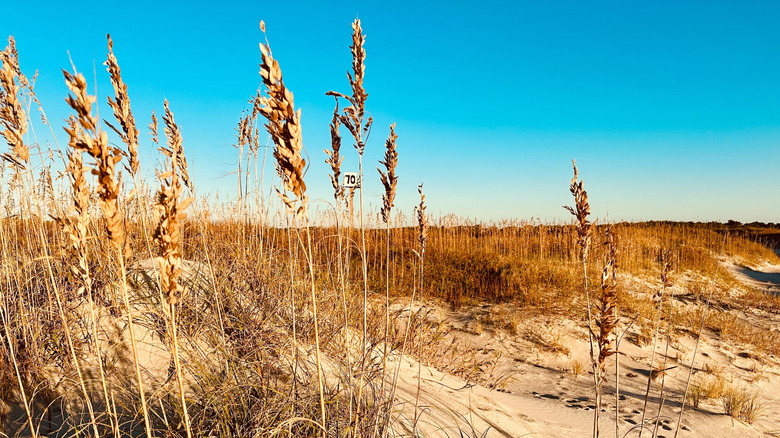
Fortunately, the powers that be in North Carolina recognize the contribution of dunes. The state's Division of Water Resources awarded more than $9.39 million in funding to five coastal North Carolina projects for 2025–2026, according to News 12. This includes nearly $665,000 for beach nourishment in Carteret County, where Bogue Banks is located. Beach nourishment is a common approach for improving North Carolina shorelines by bringing sand in to rebuild beaches. "The coastline is one of our state's natural treasures and serves as the livelihood of many communities in eastern North Carolina," said Governor Josh Stein in a press release. "These grants will help preserve our state's beauty, protect people's livelihoods, and keep communities safe."
Preserving the dunes will help tourists continue to enjoy North Carolina's charming seaside beach towns, like lively Wrightsville Beach. But they shouldn't take the dunes and barrier islands for granted. "Sometimes we forget that barrier islands provide more of a service than just a place for us to vacation or live at the water's edge," Moore told UNC Research Stories.