
Why The Great Lakes Have Glow-In-The-Dark Rocks (And Where You Can Find Them)
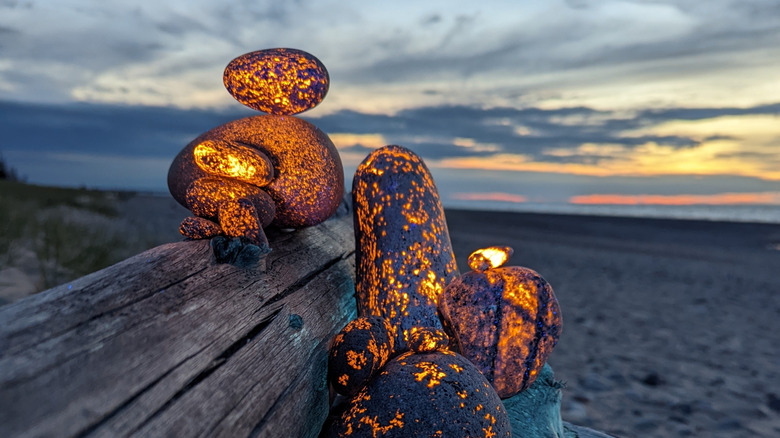
The Great Lakes, the largest freshwater system in the world, are home to a diverse geological makeup spanning hundreds of millions of years. While many head to the planet's largest freshwater body of water, Lake Superior, for its must-hike trails with unbelievable views, others trek here for a more unexpected reason: to find glow-in-the-dark rocks. For years, the Great Lakes have been known as a rockhound's paradise, and that reputation has increased even more since 2017, when Michigan resident Erik Rintamaki discovered Yooperite, a fluorescent rock concentrated on the shores of Lake Superior, the cleanest lake in America.
Named for the state's Upper Peninsula (whose residents are known as "Yoopers"), these seemingly nondescript gray stones glow orange under a U.V. light. Yooperlites (a name trademarked by Rintamaki) are comprised of syenite, an igneous rock that doesn't have any quartz in it. Instead, it has sodalite, a fluorescent blue to blue-violet mineral that glows orange in certain conditions. Initially formed in Ontario, these rocks were brought down to Michigan by glaciers and now line the shores of Lake Superior. Although they can be found all around the state and at the edges of all of the Great Lakes.
So, how does fluorescence work? Well, it all comes down to the mineral, which, in this case, is sodalite. About 500 minerals have fluorescent qualities, appearing when they're lit by a high-energy ultraviolet light. That light triggers activator elements, which absorb some of its energy while releasing the rest as a light that makes them glow. Yooperlite's glow is orange and yellow, although other fluorescent rocks can look green or pink depending on their chemical makeup and whether they're being lit by short or long wavelengths.
Where you can find Yooperlite
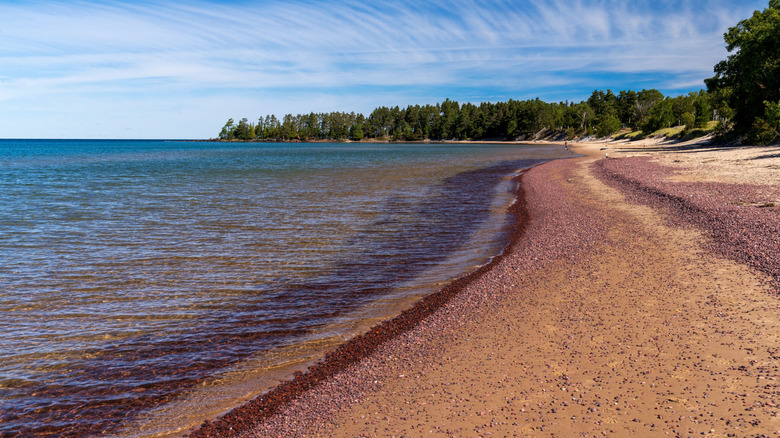
The Upper Peninsula is the best place to hunt for Yooperlite, particularly the rocky shorelines of Lake Superior. The Keweenaw Peninsula, known for its impressive scenery, is arguably the best place in Michigan to find rocks, period, and you can dig up some Yooperlite here. Other popular Yooperlite locations include the wave-polished pebbly shores of Whitefish Point and Grand Marais, near the Pictured Rock National Lakeshore.
Speaking of national lakeshores, it's best to keep in mind a few rules for rock collecting. It's illegal to take rocks from national parks or lakeshores or from private property without the express permission of the owner. You're safe to take rocks from state-owned land in the public trust, like most of the shores of the Great Lakes, or from private property with the owner's permission, but note that Michigan allows only 25 pounds of rock collecting per year. Be sure to leave no trace and consider limiting how many rocks you take, as doing so indelibly transforms the landscape and ecosystem.
The hard part of finding Yooperlite is actually finding the rock itself, as it looks like commonplace granite. In order to discern these glow-in-the-dark rocks, you'll need a U.V. flashlight and to search at low-light dusk or nighttime. Rintamaki suggests scoping out your rock-hunting area in the daytime to familiarize yourself with it. Bring a regular flashlight, so you don't get lost, and a friend, since many areas have limited cell service. Don't forget waterproof shoes either, as these stones are often in the waterline. The best time to find Yooperlite is in the spring, after the winter melt or after a storm, which can turn up hidden gems.