
5 North American Cities Where You Won't Regret Skipping The Rental Car, According To Data
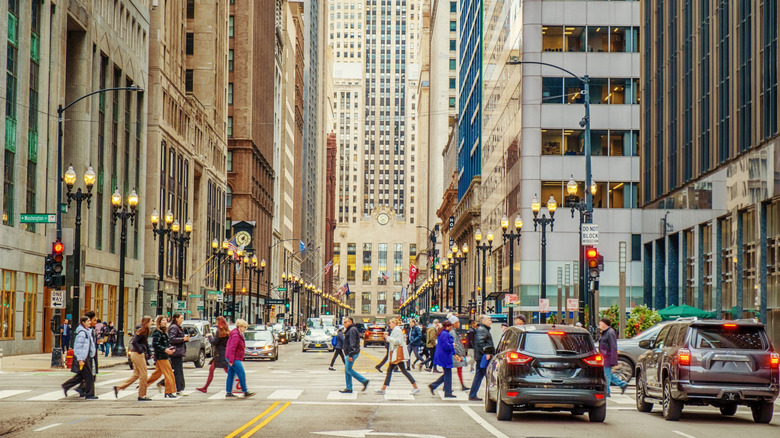
A surge in electric car rentals suggests travelers are opting for more sustainable ways to get around — a trend reflected in Trip.com's 2026 travel data. But there's also good news for those who want to take green travel even further: There are several North American cities where you won't regret skipping a rental car — electric or otherwise — altogether.
With a predicted 88% of travelers eyeing city visits in 2026, per Going.com's State of Travel report, destinations where walkability trumps drivability are shaping how we see cities. Ditching a rental car gets you up close and personal with what a city has to offer. Why waste time searching for parking or sitting in traffic when you could be walking or taking public transit instead? Professor Billie Giles-Corti, director of Melbourne's Healthy Liveable Cities Lab, likened walking to a "magic bullet" in a Forbes interview, touting its health, environmental, and societal benefits. And as for navigating an unfamiliar public transportation system, consider it part of experiencing the city like a local.
So skip the rental car kiosk and spend that gas money elsewhere. From a city where a subway network runs all night to another whose cobblestone streets are steeped in historic charm, these destinations are well suited to exploring on foot or by transit. After consulting each city's walkability, public transportation, airport-to-city links, tourist-friendly activities, and a hearty thumbs-up from travelers on Reddit, here are five North American cities that are particularly friendly to pedestrians and commuters.
New York City

Whether you're catching an early flight or heading back to your hotel late at night, New York City's subway, open 24 hours a day, has you covered. Pair that with ubiquitous yellow cabs, ride-hailing apps, a thriving bike-share program, and compact neighborhoods, and it becomes clear why rental cars are the last thing you'd need to make your way around the Big Apple.
Beyond transportation, 87% of locals vouched for the city's walkability, landing New York in fourth place on Time Out's Most Walkable Cities list. Many of its most famous landmarks — Central Park, the High Line, the Empire State Building, the Brooklyn Bridge, Rockefeller Center, and its wealth of cultural hotspots — are an easy walk, bike ride, or subway trip away. From SoHo's stylish boutiques and Greenwich Village's laidback vibe to Williamsburg's hipster scene and the Lower East Side's late-night buzz, each neighborhood feels intimate and tailored to its own rhythm. "Many people can get to a bodega, to shops, to a dozen restaurants and bars, to medical facilities, to schools, etc. just by walking," a Redditor enthused. "Other transit exists to get people to further destinations, but there's a LOT of stuff that's within your neighborhood for your day to day needs."
Landing in one of New York City's three major airports? Public transportation from John F. Kennedy International Airport, LaGuardia Airport, and Newark Liberty International Airport often involves a combination of trains, subways, or buses, but the surprisingly affordable prices — as little as $3 to $12 depending on your airport — beat driving and parking a rental car hands down. New York City has a Walk Score of 88.
Boston
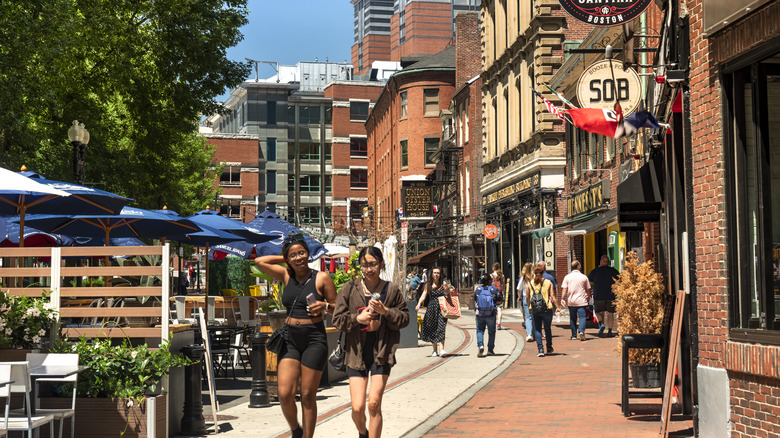
Boston's moniker "America's Walking City" makes it clear that a rental car is rarely necessary here. For starters, getting to downtown from Boston Logan International Airport is as straightforward as catching the Blue Line subway, which gets you to the centrally located Government Center in about 30 minutes (the Silver Line bus also serves the airport terminals and downtown Boston). Its compact center, studded with brick-lined sidewalks, charming brownstones, and historic sites around every corner, has rightfully earned walkability accolades from publications like Time Out and USA Today. The Freedom Trail makes exploring especially easy.
Follow the 2.5-mile red line that connects 16 of downtown Boston's historic landmarks, churches, and museums — each one a significant touchstone of the American Revolution. The trail winds through several iconic neighborhoods: Beacon Hill, where well-preserved ivy-covered brownstones exude quaint New England charm; the compact yet lively North End, packed with restaurants, bars, and cafes; and Charlestown, where the trail culminates at the USS Constitution, afloat since 1797.
Veering off the Freedom Trail doesn't disappoint, either. One Redditor suggested staying in Back Bay — where famed Newbury Street's boutique-lined blocks beckon shoppers — and taking the commuter train to coastal towns along the shore. And when your feet get weary? Boston's well-connected subways and shared bike network offer reprieve from all the walking. As Redditor u/SummitingMtJohnston shared, "You will have a much better time without having to worry about parking, can confirm. I used to drive up to Boston and probably spent untold hours trying to find a place to park that wouldn't try to charge me $35." As of this writing, Boston's Walk Score is 83.
Chicago
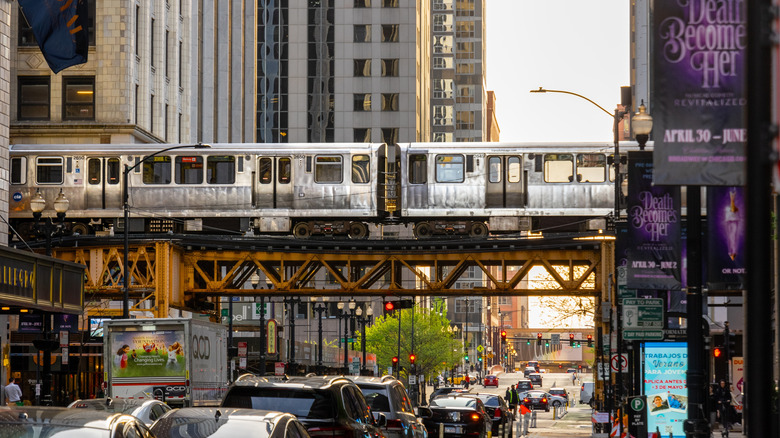
For a city that Condé Nast Traveler readers have repeatedly voted the Best Big City in the U.S., Chicago is surprisingly easy to navigate without a set of wheels. Credit largely goes to a reliable public transportation network and an easily navigable street grid system that makes walking and commuting the most convenient and affordable ways to get around. Chicago flexes its commuter-friendly muscles as soon as you land at Chicago O'Hare International Airport, named America's Most Connected Airport in 2025 by aviation data company OAG (Official Aviation Guide) — the Blue Line whisks you to downtown Chicago in 45 minutes for only $5.
Chicago is also considered extremely walkable. Its walkability ranks fourth in the U.S., according to Walk Score, which gives it a score of 77 — an impressive feat for a city of its size. And the locals agree. "I always found that for most errands, driving really didn't save me much (or any) time," commented u/ChicagoDash in a Reddit discussion on Chicago's walkability. "By the time I drove through traffic, found a place to park (hopefully for free), and walked the last bit to my destination, I often could have walked there faster."
Riding the "L" is a quintessential Chicago experience — one Redditor described it as "a museum artifact that doubles as a transit system." Serving commuters since 1892, the beloved "L" train is an artery of elevated, ground-level, and underground lines. Several lines circle the Loop, and with good reason: Chicago's most iconic sights are clustered in this central area, including the pedestrian-only Chicago Riverwalk, Millennium Park, its river boat tours, and a myriad of museums to explore. For a break from all the walking, hop on a Divvy bike, Chicago's shared bike system.
Washington, D.C.
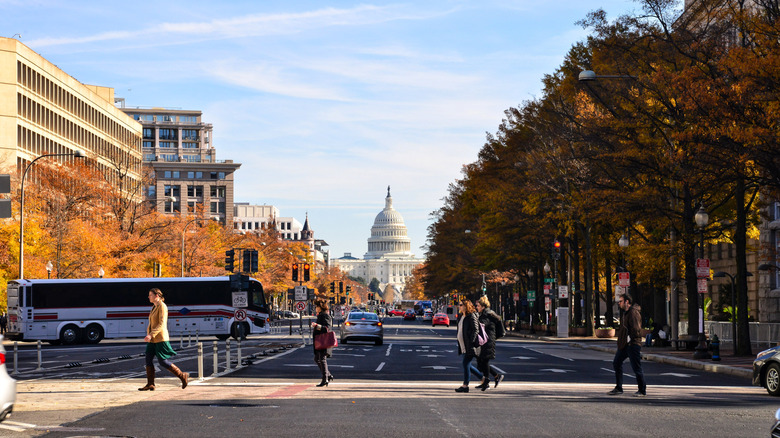
Planning a trip to the nation's capital? Comfortable shoes are a good idea. According to USA Today's list of most walkable cities for tourists, Washington, D.C., is definitely made for walking. The city's layout, designed by French-American engineer Pierre Charles L'Enfant in the late 18th century, is a patchwork of grand boulevards, public squares, and diagonal axes inspired by European city blueprints, resulting in a core where monuments, attractions, and even its airports are easily accessible without renting a car — something even Washington, D.C.'s tourism board discourages visitors from doing, an acknowledgement that driving "can be stressful with expensive, hectic parking and notorious rush hour traffic."
Washington, D.C., brims with parks, leafy lanes, green lawns, and marble monuments, providing a green and pleasant backdrop for walks. "Not having the car option forces us to walk, and most would agree, that exploring/discovery are absolutely optimum when we use our legs, especially in D.C.," shared Redditor u/Dknpaso. In addition to its walkable core, the city is bolstered by an effective metro, bus, and bike share system. Its average Walk Score as of this writing is 77.
Without the burden of a rental car, Washington, D.C.'s greatest hits — an intriguing mix of history, architecture, culture, and nature — are yours for the taking. Soak in the historical monuments on the National Mall; remember to pace yourself, because there's a lot to take in, including the unmissable Washington Monument, the U.S. Capitol Building, and the Lincoln Memorial. Mosey on to your pick of Smithsonian Institution museums, or stroll down Georgetown, a neighborhood with a bustling waterfront, a historic canal, and cool indie boutiques, before winding the day down discovering D.C.'s best speakeasies — which you absolutely can, because you won't have to drive yourself afterward.
Vancouver
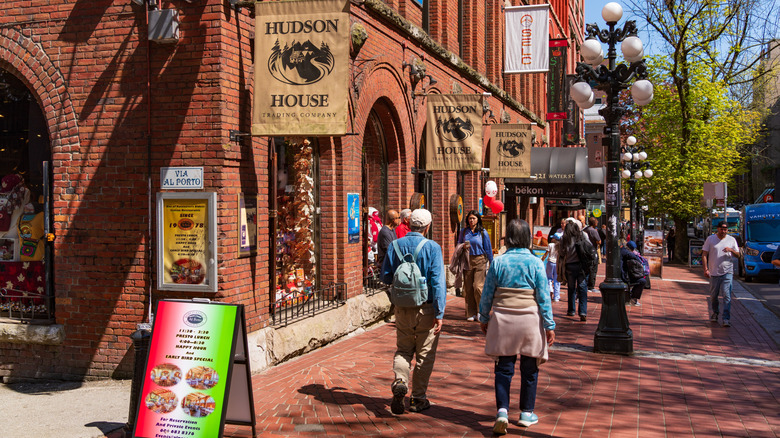
Solo-tripping in Vancouver, considered a vibrant and safe Canadian city, becomes even more alluring when you know that you needn't bother with renting a car: take Vancouver's word for it. "Whether it's a meandering walk through historic neighbourhoods, a scenic bike ride along the seawall, or a zippy ride on Vancouver public transit on a game day, our city has endless ways to get around," the city's official tourism board declares.
The SkyTrain's Canada Line connecting Vancouver International Airport (YVR) to downtown in under half an hour is a promising start to a car-free Vancouver vacation. First-time Vancouver visitor Joey Hadden regretted relying on ride-share apps instead of Vancouver's well-connected public transit. "If I'd taken the rails, buses, or ferries, I probably could have saved over $100 on transportation expenses," they told Business Insider.
In downtown Vancouver, urban trails that combine exercise and sightseeing abound. Architecture buffs will appreciate a tour of Gastown, where a concentration of late 19th and early 20th-century buildings line its streets, while strolls around the Coal Harbour seawall or the nearby Stanley Park can make you forget you're in a big city. Dive into the architecture and atmosphere of Chinatown, declared a Canadian National Historic Site for being one of Vancouver's oldest neighborhoods, and tuck in an order (or three) of dumplings while you're at it. Even the Vancouver environs are made accessible by public transportation. A Redditor suggested taking a bus to Whistler, a year-round mountain resort town, or ferrying your way across the water to Victoria, whose biggest draws are its rich heritage architecture and small-city atmosphere. Vancouver's current Walk Score is 80.
Methodology

This list was compiled by identifying North American cities with strong walkability scores, well-established public transportation systems, and reliable airport-to-city connections — factors that allow visitors to explore comfortably without renting a car. Cities that consistently appeared in traveler and local recommendations across Reddit discussions were shortlisted. New York City, Boston, Chicago, Washington, D.C., and Vancouver were then evaluated using information from travel blogs, official city tourism boards, and publications like Lonely Planet, Condé Nast Traveler, and Walk Score. Official transport channels — airport transit websites, public transportation platforms, and bike-share companies — were also consulted to ensure up-to-date information.