
A Pennsylvania Lawsuit Accuses The TSA Of Targeting And Stealing From Passengers Carrying This
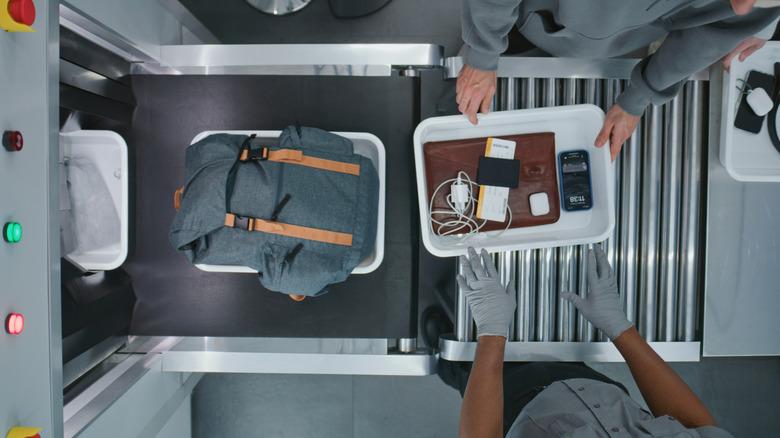
Surprisingly, passengers leave a staggering amount of cash behind at TSA (Transportation Security Administration) screening checkpoints; in 2024 alone, that number was a whopping $939,814.20. This is why tracking, collecting, and earmarking unclaimed money is one of the many jobs TSA does besides airport security. But it's one thing to lose the $4 in coins you had in your pocket and quite another to have your father's life savings seized. Unfortunately, this is exactly what happened to Rebecca Brown in August 2019.
Brown's father, a retired railroad engineer, had been hiding his savings at home in cash for decades. He'd accumulated over $82,000 when the family decided that Brown should open up a bank account for him. And that was her intent as she arrived at Pittsburgh International Airport for her flight to Boston. Instead, the TSA stopped and questioned her about the enormous sum she was carrying.
In what she described as a humiliating scene, the Drug Enforcement Agency (DEA) became involved and confiscated her father's money in front of hundreds of fellow travelers. While Brown eventually got the money back (over six months later), the harrowing experience led her to sue the TSA and DEA. Currently, there are three plaintiffs in what is now a class-action lawsuit: Brown, along with Stacy Jones-Nasr and Matthew Berger, both of whom experienced similar situations in 2020 and 2015, respectively. Arguments were heard for the suit on February 5, 2026, in a Pennsylvania federal court; a district court ruling will follow later. For now, the future remains uncertain, as the plaintiffs await the next steps.
What are the rules for flying with a large amount of cash?
If you do need to carry a large sum of money on a flight, this incident may have you feeling anxious and wondering what the law is surrounding travel with cash. While passengers on international flights are required to declare monetary instruments totaling more than $10,000, there's actually no limit on the amount that can be carried domestically. If there is a suspicion that the cash was obtained from a criminal activity, then the DEA or another law enforcement agency can be called in by the TSA to further investigate. However, money cannot legally be taken simply due to the fact that it is a sizable amount. This is exactly the issue here, as explained by the three plaintiffs' lawyer, Dan Alban. "We think there is no dispute of material facts that the TSA unlawfully and unconstitutionally stops and seizes travelers with cash at the airport, even though it admits it poses no threat to transportation security" (via CBS News).
Unfortunately, TSA rules are always annoyingly inconsistent and seemingly dependent on the airport you're in, the agent you're with, and their mood. But if you plan to travel with a large sum, there are a few things you can do to reduce the risks. First, always carry documentation showing the source of the funds, whether it be a sales receipt, bank withdrawal slip, or work pay stub. When questioned, stay calm and be truthful in your responses. If your money is confiscated, don't argue; contact legal representation immediately.
Airport seizures that apparently go beyond the bounds of the law (where assets are taken without probable cause) are something that the plaintiffs of the aforementioned suit aim to change. The hope is that the TSA and DEA will get rid of operational policies that appear to give agents a free rein to confiscate cash from passengers when there is no evidence of criminal activity.