
Why There's Simply No Need For A Money Belt Anymore
Travel is a fickle sport in which some of our most tried-and-true travel accessories become virtually obsolete overnight. One day we're rolling suitcases over ancient cobblestones, and the next day European cities are asking travelers to carry their wheeled suitcases. Gadgets like Bluetooth adapters and AirPods prematurely nailed shut the analog coffin of wired headphones on flights. Another travel gear casualty? The money belt, that longtime bastion of currency concealment that travel guru Rick Steves, on his blog Rick Steves' Europe, once hailed as: "More secure than a travel wallet, money belts are your key to peace of mind." In our current tech-heavy times, however, the value of using a money belt is certainly questionable. The evolution and ease of using tools like credit cards and money-transfer apps like Wise and Venmo, along with the world-wide availability of ATMs, appears to have sent the money belt packing.
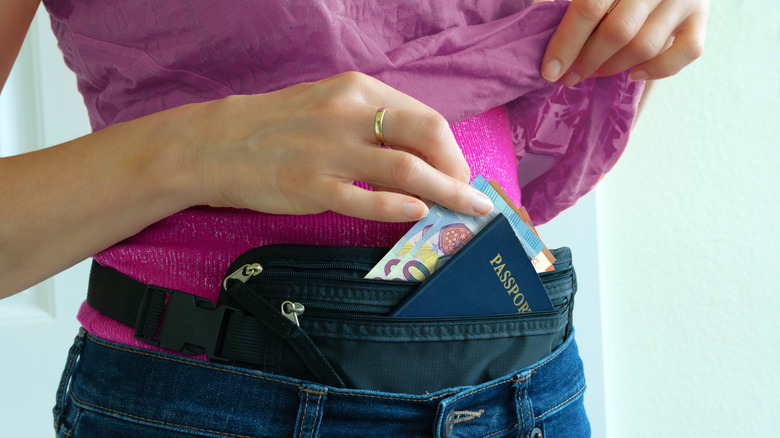
Once upon a time, when fees for international credit card usage and ATMs were sky high, and carrying traveller's cheques was de rigueur, money belts made a lot more sense. A flat, zippered pouch designed to sit under your clothing, a money belt could be fastened around your waist, or even around your neck. The prevailing wisdom during the money belt's heyday was that stuffing it with all your valuables transformed it into "your portable safe," according to Steves. But these days, who's really lugging around tons of cold, hard cash when innumerable, low-cost ways to access money are around every corner?
Money belts make you a target for theft, plus they're unfashionable and uncomfortable
There are a host of reasons why many travel professionals agree that money belts are one of the most unnecessary items you need to take out of your luggage. Not only has the way we handle currency kicked money belts closer to the curb, but the money belt's very design and existence poses challenges for the wearer. "The whole point of a money belt is to keep your valuables safe by being inconspicuous. The only problem is that money belts are the opposite of inconspicuous," points out a blog post on the travel-gear website, Tortuga.
It goes without saying that hiking up your shirt, then rifling around your bare midriff for cash, will draw more attention in a public place than simply reaching for your wallet inside of a bag. This exhibitionism is the reason why, Tortuga contends, "money belts make you a target for theft" — which obviously defeats their purpose. The travel blog Going Places agrees, and also posits that money-belt wearers actually make a criminal's job that much easier. "All the thieves and muggers know about these and will find them, so they don't actually protect you."
Comfort and aesthetics are another big money-belt issue. Once they're packed to the gills with all your valuables and ducats, wearing all that bulk can be pretty annoying. "Hiding special apparatuses under your clothes also requires you to wear enough clothes to disguise them," Lily Hay Newman writes on Slate. "In hot climates it can be difficult or uncomfortable to hide a money belt under, say, a light T-shirt and shorts."
Alternatives to money belts and advice from Rick Steves if you choose to wear one

Fortunately, an array of travel storage clothing now exists that makes it much easier and more fashionable to conceal your valuables than most money belts. Travel girlies know all about crossbody bags – many of which have durable, slash-proof fabrics, locking zippers, and hidden compartments. Or there's the "bra stash," a small pouch you can secret away in your up-top lingerie. The aptly named Clever Travel Company manufactures an impressive range of pickpocket-proof clothing, from underwear and tank tops, to scarves and even scrunchies. Travel pants and travel vests featuring discreet, zippered pockets are also great money-belt alternatives.
If you're not planning to part with your money belt anytime soon, Rick Steves has some tips to help ensure it doesn't make you a target. Steves encourages money-belt wearers to think of it as their "deep storage." In other words, don't treat it like a wallet. Keep larger amounts of money in your money belt, and don't use it to pull out cash for everyday travel purchases like food and sightseeing tickets. For these, Steves advises concealing a day's worth of spending money, an amount you're prepared to lose, in a zippered, Velcro, or buttoned pocket with a flap.
It might seem obvious, but the first rule of wearing a money belt is to make sure you're using it correctly. Not doing so can easily make you a victim of theft. Writes Steves: "I once met an American woman whose purse was stolen, and in her purse was her money belt."