
Why You Crave Tomato Juice On Airplanes
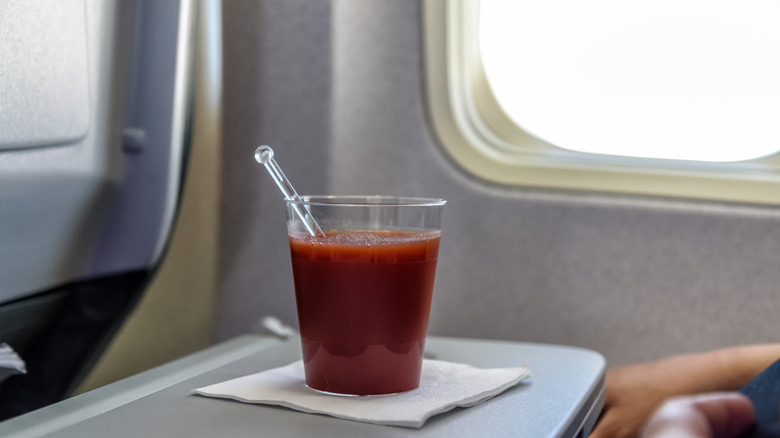
The idea that tomato juice improves in taste when enjoyed on a plane may seem like a phenomenon straddling fact and fiction. Yet, there is a scientific reason behind this mysterious craving. So much so that in 2010 it prompted German airline Lufthansa to launch a dedicated study to get to the bottom of why its customers drink 1.7 million liters (almost 450,000 gallons) of the stuff per year, according to Deutsche Welle. What the study found is that a mix of the altitude, cabin pressure, and even noise levels on the plane affects the way food smells and tastes.
Some flavor profiles – sweet and salty in particular — are negatively impacted by lower humidity and air pressure on board. Your sense of smell is stifled by the drier environment, and that, in turn, stifles your capability to decode flavors correctly. Simple so far. But, oddly, there is one key flavor that is amplified instead: umami. Tomato juice, with its blend of sour, sweet, earthy, and savory notes — the foundations of umami – has become the poster child to explain the phenomenon. But decreased air pressure and humidity levels are not the only ones doing the heavy lifting: according to a 2015 study at Cornell University, noise also impacts the way we perceive flavors. Scientists found that the high level of noise on a plane (around 85 decibels on average) dulls sweet flavors, but highlights umami instead.
On top of that, tomato juice is a versatile drink that passengers can spice up with salt and pepper, Tabasco, and even enjoy in a full-fledged bloody mary. Though bear in mind, you might get a few judging looks from flight attendants if ordering this boozy drink.
It's not just science, it's also human nature

While Lufthansa may have launched its study to explain the tomato juice phenomenon, this reflects a wider strategy from airlines to understand how food on planes works. The studies inform how in-flight meals can be fine-tuned as to taste more appetizing – for example, rebalancing the salt and seasoning ratio, or even picking naturally spicier dishes and ingredients from cuisines like Indian and Thai. If you've ever wondered where airplane food comes from, or how airlines choose which snacks to serve on board, this approach helps lift the veil of this fascinating behind-the-scenes.
But another important factor of your tomato juice craving has to do with human psychology. Since airlines first started serving the drink on board in the 1960s, it has become a de facto collective flight habit. As people started ordering it, it garnered fame for tasting better in the air, and the rest is history. The fact that it's packed with vitamins and electrolytes for combatting dehydration is a plus, and it's a healthier option than any cocktail on board.