
If You Know These 5 Under-The-Radar Destinations In Greece, You're A True Island Hopper
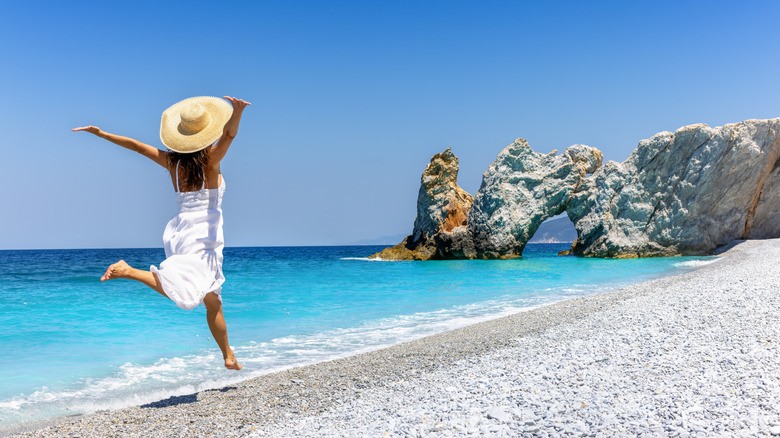
For first-timers to Greece, it's hard to ignore the call of Santorini, Mykonos, Crete, or Corfu — must-sees in their own right, no one's arguing with that. But these famous getaways only scratch the surface of what Greece has to offer. Look beyond what social media serves up and you'll find unique destinations hiding in plain sight, far removed from crowds and clichés.
With 227 inhabited islands out of more than 6,000, Greece is a playground for the true island hopper. Scattered around the Ionian, Mediterranean, and Aegean seas are destinations that are quietly living their best lives away from the tourist spotlight — each with its own history, culture, and daily cadences, and all just a ferry ride away.
These five islands are under-the-radar gems for those seeking an untapped version of Greece. Imagine a ferry dropping you on the shores of a Cyclades island studded with hundreds of places of worship, a Dodecanese port town where Mediterranean warmth meets Italian colonial architecture, or an isle known for its residents' longevity. Travel writers, beach lovers, and seasoned bloggers all agree: True island hoppers should have these little-known islands on their itineraries. (Find more information on our picks and methodology at the end of the article.)
Tinos (Cyclades)
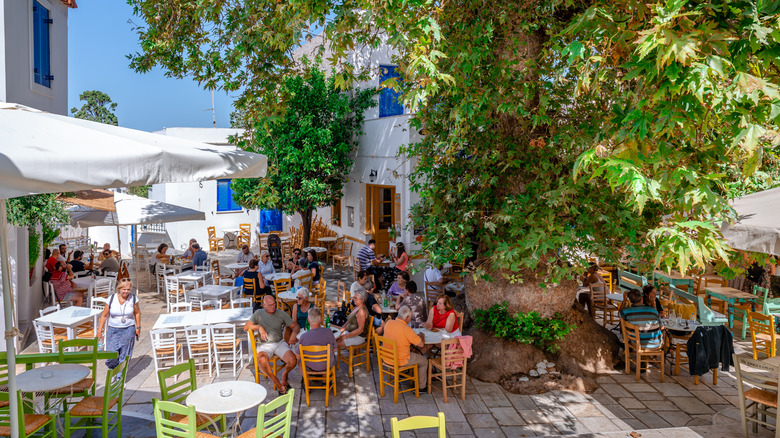
It's a mere half hour away from Mykonos by ferry, but the Greek island of Tinos is arguably prettier and more affordable than its popular neighbor. It's also managed to fly under the radar of most tourists, leaving it delightfully uncrowded and appealing to visitors looking to relax and decompress.
If there's one thing that Tinos has plenty of, it's places of worship. The island is dotted with 750 churches and chapels, both Catholic and Orthodox – a testament to its deep spiritual roots. Pilgrims flock to Tinos in mid-August to celebrate the Dormition of Virgin Mary, crawling on their hands and knees to show their devotion at the Evangelistria Church. Beyond religious sanctuaries, there are 40 or so villages to discover, each as charming as the next. Make a detour to Volax for its boulder-strewn landscape and poetry-inscribed walls; Pyrgos, the village whose marble craftsmanship earned Tinos UNESCO Intangible Heritage status; or Kardiani, the mountainside village that delivers the ultimate Greek postcard: whitewashed houses, paved alleys, narrow stairways, and generous views of the sea.
For architecture lovers, Tinos boasts hundreds of dovecotes. These centuries-old limestone, slate, or stone turrets originally functioned as pigeon shelters, though most have since been converted into homes, according to The World of Interiors. Water lovers aren't left wanting, either: Agios Sostis is blessedly sheltered from Tinos' relenting winds, as is Kalivia, which offers sun loungers and refreshments. Some 93 miles of hiking trails crisscross the island for those willing to explore on foot, ranging from easy to moderate. Tinos' authentic culinary and wine scene, where fresh seafood dominates the menus, rewards all that activity. As one Redditor put it, "The landscape is pretty unique, great local wine, quaint villages nice people and true authentic Greek taverns and restaurants."
Leros (Dodecanese)
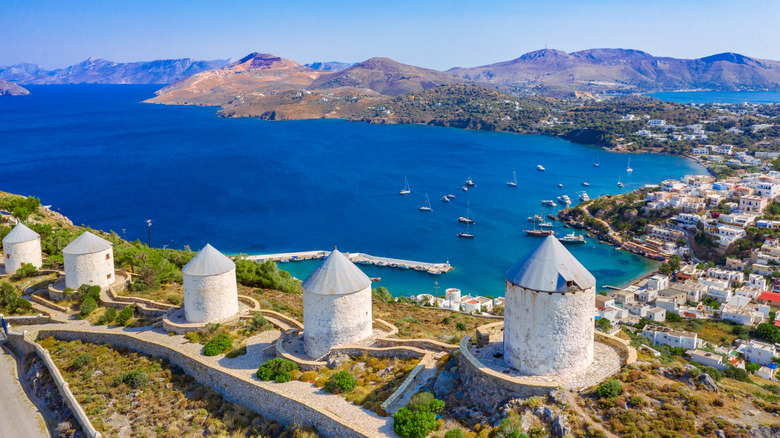
Here's why Leros deserves a spot on your island hopping list: It's connected to the rest of the Dodecanese archipelago by several ferry operators that dock on Leros' two ports, making it an accessible destination with Italian influences, hidden beaches, and serene Aegean charm. What makes it even more special is that this year-round destination stays discreetly under the tourist radar compared to neighboring islands Kos or Rhodes — even in the summer, when you can expect "just some Greek tourists and not many foreigners" during a June visit, as one Redditor noted.
The seafront town of Agia Marina is a good place to start your sojourn on Leros. Rows of traditional whitewashed buildings line the blue bay waters, hosting the tavernas, hotels, restaurants, and boutiques that make it the lively hub of the island. Overlooking the port from a 500-foot perch is the Byzantine-era Pandeli Castle, accessed by a winding climb through hairpin bends that pass by a photogenic row of restored windmills. Meanwhile, the town of Lakki is a striking departure from the expected Greek island aesthetic. The influences of its history as an Italian-occupied territory in the 1930s inform the clashing architectural styles — Rationalist, Moorish, and Art Deco — of Lakki's urban landscape.
The island is no slouch when it comes to beaches, either. The coasts of Pandeli, Alinda, and Dio Liskaria offer beachgoers sun lounges and refreshment stands, while Agia Kioura is better suited to those seeking something more rugged and remote. Diving in Leros doesn't just reveal reefs and caves, but World War II wreckage as well, from a Junkers 52 German aircraft to the remains of a German landing vessel on the seabed.
Ikaria (North Aegean)
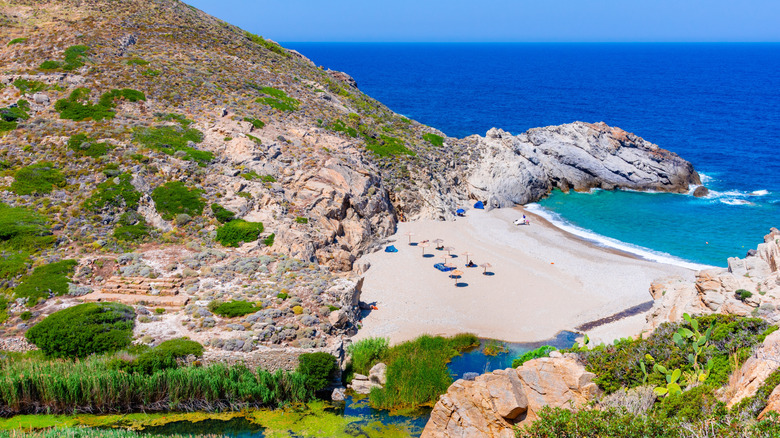
The North Aegean island of Ikaria has all the makings of an elusive Greek island paradise. "Ikaria felt like the most rugged, 'we dont cater to tourists' vibe," wrote one Redditor. It has beaches — stunning ones at that — stretched along its 99-mile coastline: the rock- and cliff-rimmed Seychelles Beach; the narrow sliver of Nas Beach, nestled between the Aegean from the Chalaris River; and Messakti Beach, a top spot for surfers. Thermal springs dot the coastline, too, among them Lefkada Spa and the purported healing properties of its iron-rich red sand, and the Ancient Thermal Springs, said to relieve ailments ranging from rheumatism to infertility. There are Byzantine-era homes camouflaged by stone-topped roofs, monasteries, museums, and churches to discover. Then there is the landscape itself: a patchwork of forests, gorges, coves, and mountain villages where the art of slow living has been perfected over centuries.
But what truly sets Ikaria apart from other Greek islands is another kind of natural wonder: the extraordinary longevity of its people, where one in three Ikarians lives past 90. Ikaria is an officially designated Blue Zone — a place where lifespans have been documented to be significantly longer than average. Chalk it up to the Mediterranean diet, afternoon naps, closeness to nature, and tight-knit family bonds that define Ikaria's rhythm.
Island hoppers can access Ikaria by ferry via two ports: Agios Kirykos on the south coast and Evdilos on the north. Neighboring islands are straightforward ferry connections: Patmos is approximately an hour away; Mykonos and Samos two hours; and Naxos, Syros, and Paros within three to 4.5 hours. And if traveling the seven-hour ferry from Athens to Ikaria isn't for you, opt for a direct 40-minute flight from Athens instead.
Spetses (Saronic)
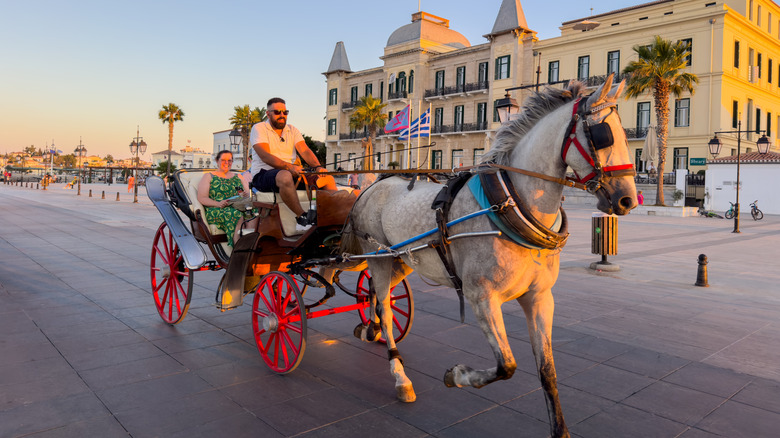
When a traveler as seasoned as Rick Steves singles out Spetses as one of his top beach hideaways — lauding it as a quiet Greek gem with local vibes and crystal waters — we're understandably all ears. For starters, it's practically car-free, save for the handful of taxis and scooters authorized to circulate around the island. Compared to tourist-saturated Athens, Spetses holidays spell quiet, understated exclusiveness. And have we mentioned it's only a two-hour ferry ride away from Athens?
Dapia port — the heart of the island's main village, Spetses Town — reveals a waterfront lined with a concentration of shops, restaurants, bars, and the iconic silhouette of the Poseidonion Grand Hotel. From here, it's a half-hour stroll to the Old Harbor (Baltiza), a site of boatyards that recall Spetses' 18th- and 19th-century seafaring culture. Hillside neoclassical mansions are nestled farther inland, the gated homes of old-moneyed families and notable celebrities that have lent the island its reputation as the "Monaco of Greece."
Beyond the port, explore the beach-laden coastline of the island. Hire a water taxi to the golden sandy shores of Agia Paraskevi, dropping by the quaint eponymous church a few steps from the shore while you're there. Farther north is the white-pebbled beach of Agioi Anargiri, a popular spot for snorkelers. Adventurers should make a detour to Bekiris Cave, accessed by a footpath through pine trees or by sea. After a weekend on Spetses, blogger In Love with the Med had this to say about the island: "It doesn't chase trends. It doesn't apologize for being quiet, slow, deeply elegant, or faintly peculiar. It's the kind of island that makes you feel like you just remembered something you forgot a long time ago."
Paxos (Ionian)
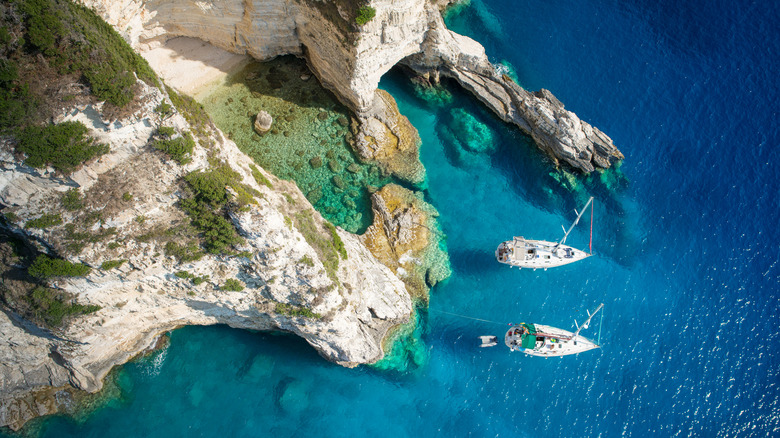
While most tourists have their eye on Corfu, Greece's greenest island that brims with dazzling beaches, the savvy traveler is ferrying south to neighboring Paxos (or Paxi). It's one of Greece's tinier islands at 9.7 square miles, but this hidden gem packs a punch with azure waters, olive groves, coves etched into the coastline, and charming villages — all worth the ferry ride to get there.
Gaios is your starting point: Ferries and hydrofoils to and from Corfu dock at this port town, where tavernas, shops, and bars extend along the waterfront's 18th-century Venetian-style buildings — handsome vestiges of Paxos' four centuries under Venetian rule. Gaios makes a convenient base for a Paxos sojourn, compact as it is to explore on foot, while bicycles, buses, and water taxis easily connect to the rest of the island. Head 5 miles north to Lakka to indulge in lazy days on the beaches of Harami, Kanoni, and Orkos. To the east, the fishing village of Loggos works its quiet charm through pastel-colored buildings, a laid-back atmosphere, and, as blogger The Londoner put it, "as many restaurants as there are residents."
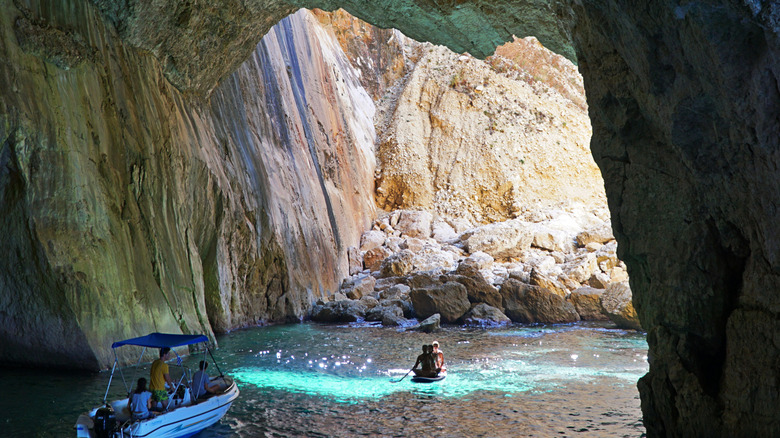
For the ardent island hopper, Paxos hits the jackpot. Sea taxis and private boats shuttle tourists to the string of caverns that make up the Blue Caves on the western coast, the naturally formed limestone Tripitos Arch, hidden beaches and coves, and the islet of Antipaxos, Paxos' sun-drenched, beach-laden little sister that sits to its south.
Methodology
These five islands were selected by researching the under-the-radar Greek island picks of seasoned bloggers, travel writers, and the wider Reddit travel community. To give this article geographic breadth, our research focused on one island from each of five different Greek island groups — the Cyclades, the Dodecanese, the North Aegean, the Saronic Gulf, and the Ionian islands. We bolstered our picks with information from reputable travel sources including UNESCO, Rick Steves, and Discover Greece. And to deliver on the island-hopping premise, we made sure that these destinations were reachable by ferry from neighboring islands.