
Why The Great Lakes Produce Ocean-Like Waves (And The Best Places To Surf Them)
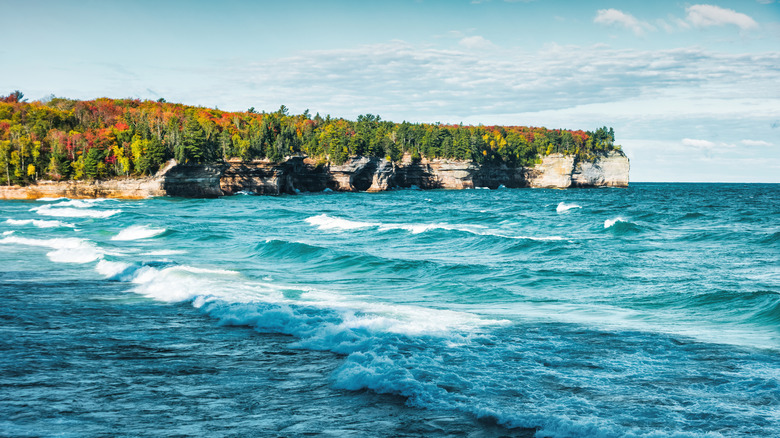
Straddling the border between the U.S. and Canada, the Great Lakes are an interconnected system of five bodies of water containing a staggering 20% of the world's surface freshwater by volume. Often considered inland seas because of their massive size, the Great Lakes are colloquially known as America's Third Coast, a designation that attracts water sports enthusiasts from across the country. While some head to the Great Lakes area for a swim in Lake Superior, the cleanest lake in the United States, others make the trip for a different reason: freshwater surfing.
The Great Lakes are big enough to regularly create waves 3 to 6 feet tall in the winter, as opposed to the tiny ripples seen in smaller bodies of freshwater. These larger waves are due to fetch, which is a measure of the distance wind travels uninterrupted over a body of water. A longer fetch results in larger, more powerful waves. The Great Lakes are large enough that winds traveling over them result in waves that can sometimes reach heights similar in size to those found in the ocean. The winds that produce these conditions on the Great Lakes are usually driven by localized storms that produce surf-worthy waves for anywhere from a few hours to a few days.
Among the Great Lakes, the largest waves are usually found on Lake Superior, although Lake Michigan has more spots along its shores to enjoy prime inland surfing. Freshwater surfing on the Great Lakes peaks during fall and winter, with optimal wave conditions occurring in a short window due to less predictable inland storms. Lake waves are also generally choppier and come in rapid succession compared to ocean waves.
The best surf spots on the Great Lakes
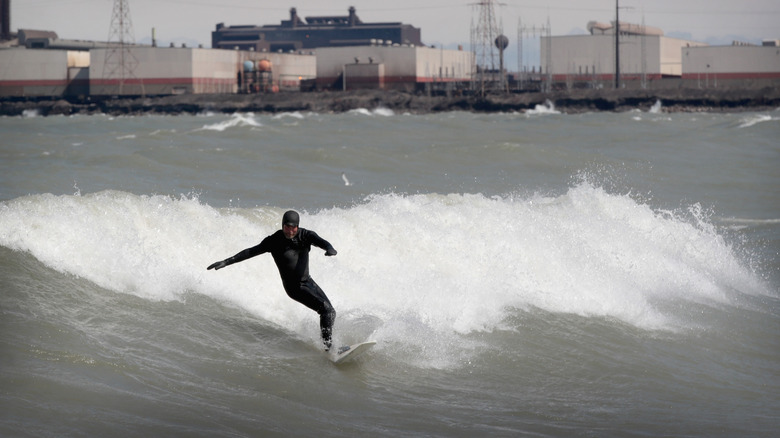
Frequent surfers have made a useful map of the best Great Lakes surf spots. On Lake Erie, the shallowest of the lakes, the best waves are found on the eastern coast — in Pennsylvania's Presque Isle State Park, Edgewater Park in Cleveland, and Buffalo's shores on the Canadian side. On Lake Huron, the best waves are found near Lexington and Burtchville in Michigan and Kincardine in Canada. Lake Ontario's western shores near Toronto are famous among surfers, although Americans can also catch waves near the mouth of the Niagara River.
Lake Michigan is prime surf territory thanks to strong winds that create large waves along the narrow lake. While some areas in the lake's northern shores have good waves, the stronger concentration of surf spots is in its southern half. One of the best Lake Michigan surfing spots is Wisconsin's Sheboygan, known as the "Malibu of the Midwest" because of its waves. On the eastern coast, Grand Haven, Michigan, has similar wave conditions to Sheboygan. Whiting, Indiana, is also a good spot to catch large waves on the lake's southern shore.
While Lake Superior doesn't have as many known surf spots as Lake Michigan, it does have the largest wave on record at 28.8 feet. Waves on Lake Superior have reportedly reached up to 26 feet during the annual storm season, making them the largest waves in the Great Lakes system. According to American Surf Magazine, the best places to catch waves on Lake Superior are Grand Marais and the sailing and waterfall hiking paradise of Marquette in Michigan. Stoney Point, near Duluth, Minnesota, is also known for its massive waves.
Things to keep in mind when surfing the Great Lakes

Across the Great Lakes, the best waves for surfing are found in winter, just before the lakes start icing over. This means the best surf conditions on the Great Lakes typically involve snow, icy winds, and frigid waters. So, before you dig out your surfboards and wetsuits, here are some freshwater surfing facts you should be aware of.
First: the right gear. Freshwater surfing requires thicker wetsuits to act as a buffer against the cold water. EOS Surf Shop in Sheboygan recommends 5/4 or 6/5 mm wetsuits with a hood, boots, and gloves for water temperatures below 47 degrees Fahrenheit. Your gloves should be at least 5 mm thick, paired with 6.5 to 7 mm boots. Even with the right gear, ice beards – icicles that form over exposed facial hair – are a common sight among Great Lakes surfers, so bring a canister or bucket filled with hot water from home so you can rinse off the ice before changing out of your wetsuit. If you don't have a lot of experience surfing, opt for a longer board for more stability.
You can use the National Oceanic and Atmospheric Administration's (NOAA) CoastWatch map or the Great Lakes Observing System (GLOS) Seagull platform to monitor water temperatures across the lakes in real time. Websites like Windfinder and Windy are also useful for monitoring wind conditions and finding out when the wind is most likely to create incredible, surf-worthy waves.