
National Parks Where You're Most Likely To See A Bald Eagle
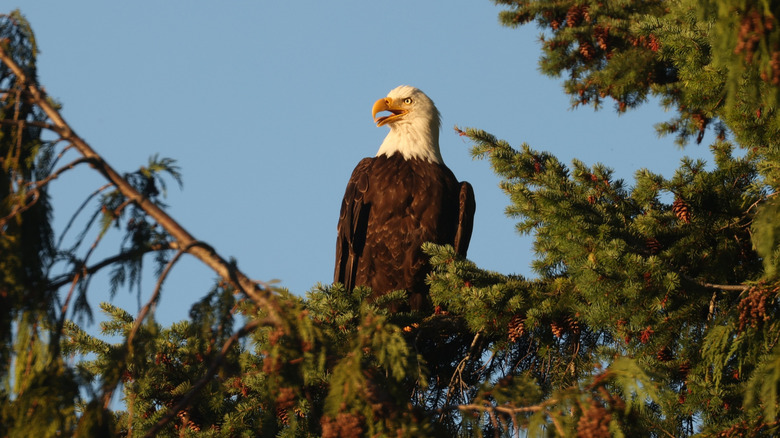
There's really no wildlife experience that matches seeing a bald eagle, not only because of its American symbolism, but also because these majestic birds were nearly extinct just 50 years ago. The bald eagle population has since rebounded quite extraordinarily, although you're still less likely to spot one than in George Washington's time. Today, national parks are the best place to spot rare wildlife, and this is especially true for the bald eagle as these areas provide essential distance from human activity, which eagles are highly sensitive to according to the National Parks Service (NPS).
A list made by the birding app Birda.org (reported by Fox Weather) used data from its users to rank the five national parks that have the most sightings of bald eagles. The top park is Maine's Acadia National Park, famed for its postcard-worthy scenery of forested peaks and the sea. In fact, one thing all of the five ranked parks have in common is being either close to the ocean or having water habitats within them — that's no surprise in light of the fact that, as the NPS states, these birds of prey feed primarily on fish. Another natural element that attracts these birds is mature forest for nesting, particularly coniferous or hardwood trees, and, as you'll see, the five most bald eagle-friendly national parks share this in common, too.
The top national parks for bald eagle sightings
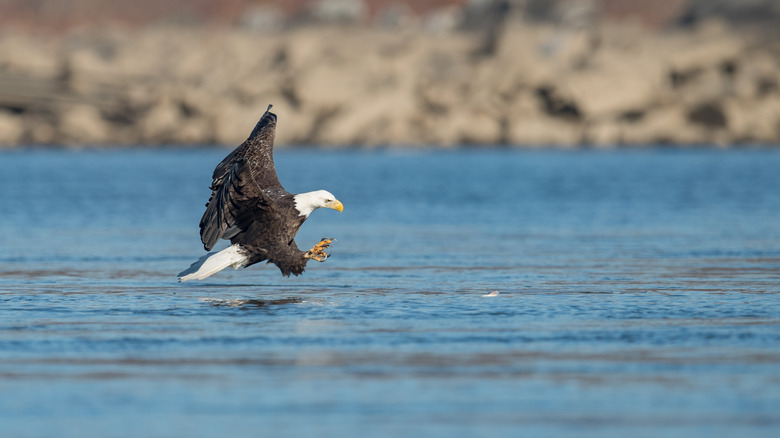
Ranked in first place for bald eagle sightings by Birda.org, Acadia National Park on the coast of Maine has the perfect balance of water habitats and coniferous forest that bald eagles love. According to the NPS page for Acadia, you're most likely to spot bald eagles near the coast, gliding over lakes, or perched up on mountain cliffs watching for prey. If you want a high-probability place to start your birdwatching adventure in Acadia, try the aptly named Eagle Lake, where some reviewers noted seeing bald eagles. It's the largest freshwater lake on Mount Desert Island, and there's a roughly 6-mile carriage road that encircles the lake, well-suited for hiking or cycling.
The park with the second-most sightings is Olympic National Park along the Pacific coastline of Washington state. Olympic National Park has some of the most pristine old-growth forest in the state, with trees up to 1,000 years old, and it has salmon-rich rivers — if you visit during certain months, you can see the iconic salmon jumping up waterfalls. Past visitors frequently cite the park's coastal areas as having good chances of a bald eagle sighting. My Olympic Park specifically recommends heading to Shi-Shi Beach, Second Beach, and Third Beach, all of which are located on the northwestern tip of the Olympic Peninsula.
The final three national parks ranked by Birda.org, in order, are Pinnacles National Park (California), Yellowstone National Park (Wyoming), and Fort McHenry National Monument and Historic Shrine (Maryland).
Tips for spotting bald eagles in national parks
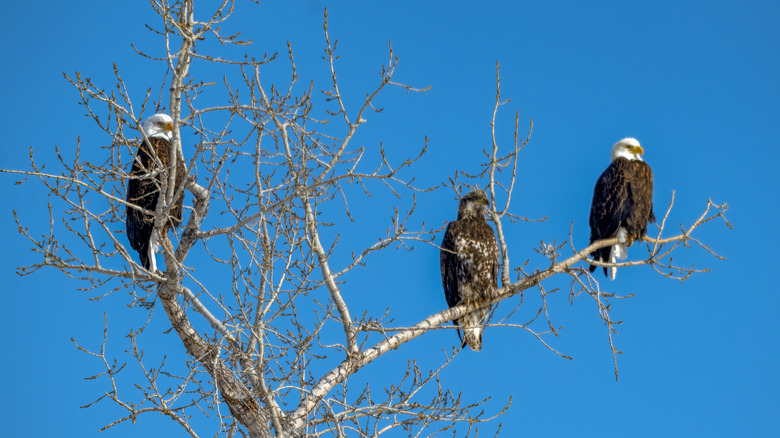
When you're planning a trip to a national park to see bald eagles, you can see the massive birds any time of year, but if you live in the contiguous U.S., your chances are highest in winter. According to the National Wildlife Federation, bald eagle numbers increase in winter because more migrate south from Canada and Alaska. During feeding time in the early morning, you might have better chances if you head to the waters, since bald eagles feed largely on fish. When they come to roost in the afternoon, look for tall trees (especially conifers), as bald eagles prefer these as nesting sites. In some places where there isn't much forest, the eagles can build their nests on high-up cliff faces. Their nests are huge, often extending up to 10 feet in diameter.
Another tip, which was shared by a Reddit user, is to use a birding app (like eBird) to see where sightings were most commonly reported. With an eBird account, for example, you can see pinpointed hotspots with a high number of recent sightings on a zoomable map.