
The Truth Behind Canada's Massive, Disastrous Quebec Airport Project
Sometimes, developers regret the things they build. California's "Bridge to Nowhere," Tennessee's Memphis Pyramid, and China's abandoned "ghost cities" are all examples of ambitious projects that never lived up to expectations. Stakeholders love the pitch, but the results leave a lot to be desired.
So it was for Montreal-Mirabel International Airport (YMX) in Quebec, an ill-fated travel hub located in Mirabel, a rural suburb about 35 miles northwest of Montreal, Canada's second-most populous city. During the planning stage, developers planned for YMX to become one of the world's largest airports, with 6 terminals and 6 separate runways, plus a total area of 97,000 acres. When construction began in 1969, proponents predicted that millions of passengers would pass through its gates each year. The airport's opening in 1975 anticipated Montreal's role as host of the 1976 Summer Olympics.
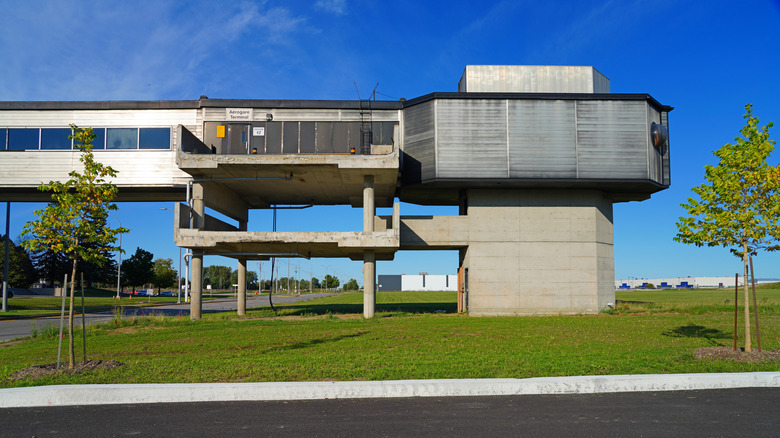
But only one of its six terminals was ever built. reducing the possible volume of flights. To its credit, YMX did provide passenger service for the next 28 years, but the number of travelers never met the developers' lofty expectations. Montreal already had an airport, Montreal Trudeau International (YUL), which is only 10 miles from the city center; in contrast, YMX is more than three times farther away, an unwelcome headache for weary travelers. A planned train line to make the commute to the city easier was never completed; a large hotel, Le Château de l'Aéroport Mirabel, felt isolated from Montreal's cultural scene, and its brutalist concrete exterior probably didn't earn it any curb appeal. While the airport in Mirabel was intended to replace the airport in Montreal, both airports continued services until 1997, when officials decided to close one airport, and Mirabel was placed on the chopping block. Like these 5 abandoned airports in the U.S., one airline after another stopped flying there. The airport ceased passenger service altogether in 2004.
The present and future of Mirabel International Airport
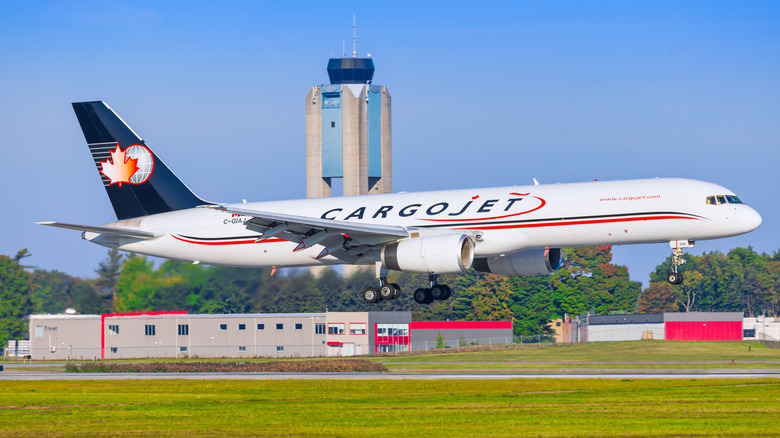
YMX is still an active airport, with at least 2,000 flight movements every month (takeoffs and landings). However, many of the flights are cargo planes, which can take advantage of the massive space and 12,000-foot runway. The grounds are also home to an aerospace testing facility and a hub for aircraft assembly. Despite the rundown appearance and empty hotel, YMX employs 8,000 people and has five all-cargo carriers onsite.
For many Quebec natives, this is small consolation. To build YMX, the Canadian government displaced 10,000 Mirabel residents: villages were leveled to make way for all that tarmac, and local households were forced to relocate elsewhere. It's one thing to evacuate residents after a natural disaster, like America's "burning ghost town" that was once a thriving mining destination in Pennsylvania, but it's another to transplant whole communities in order to build something that didn't even live up to expectations.
Just goes to show, even something as big and important as an airport is vulnerable to economic forces. YMX wasn't a total failure, but much of its potential was scrapped. All this aeronautic drama might make you wonder: What happens to retired airplanes?