
What In-Flight Meals Used To Look Like In The '60s
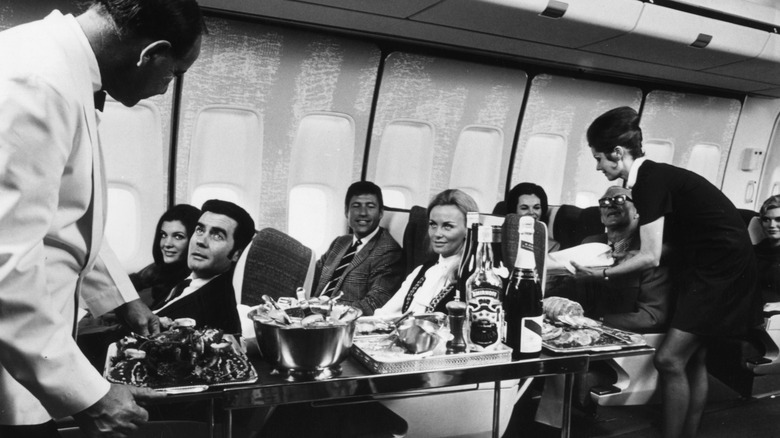
Would you like the broiled filet mignon with sauce Bercy or the scaloppini of veal saute au Marsala? That's a question you might have heard from the white-glove-donning flight attendant on a plane in the 1960s. Both options were real menu items from a United Airlines menu in 1969 that was published by The Points Guy. On today's flight menus, you might be lucky to get a decent sandwich — while some flights don't offer food or beverages at all — but the 1960s are frequently thought of as a golden age of airplane dining. You could easily feel like you're eating at a gourmet restaurant on a simple trip between states. Plus, unlike today, sumptuous meals were standard even for economy passengers.
Among some of the 1960s' airline foods you can't get anymore were whole roast beef, a selection of specialty cold cuts, and freshly scrambled eggs. Former Pan Am flight attendant Anne Sweeney, who served on planes from 1964 to 1975, shares some insight about the in-flight dining rituals with CNN: "Our five-week training program spent about 70% of the time on food and service training because we didn't just pull something pre-cooked out of a drawer." She recalls serving up everything from beef stroganoff to Cornish hen, noting that each dish "always had a sauce." In fact, images of a Scandinavian Airlines flight in 1969 show a full, bone-in leg of ham being freshly carved up by an attendant for some very satisfied passengers.
Why were in-flight meals so decadent in the 1960s?
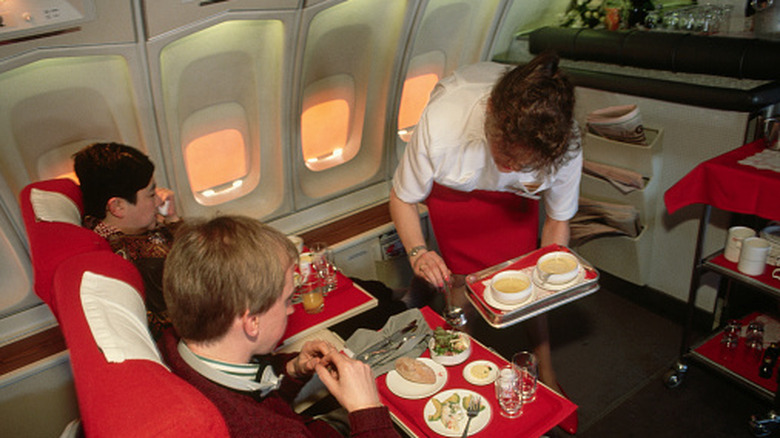
The opulence of 1960s airline meals wasn't a given at the start of commercial flying, nor did it last very long. When planes first became a viable travel option in the early 20th century, meals were sparse and limited by aircraft weight limits, as the Metropolitan Washington Airports Authority (MWAA) reports. Menus looked similar to how an economy menu might today, dominated by modest, pre-made sandwiches. Over the next several decades, plane engineering became more advanced, and by the 1960s, they had whole in-flight kitchens, which allowed for more elaborate meals to be prepared.
On top of that, flying was much more of a luxury in itself than it is today. Long-haul flights were up to five times more expensive, according to Skyscanner. That also meant there were fewer travelers (and fewer mouths to feed). A study from Our World in Data shows that between 1970 and 2023, the annual number of worldwide passengers went from 310 million to over 4 billion.
Needless to say, flights became more accessible in the decades after the 1960s, and, in turn, meals became less exclusive. The U.S. passed the Airline Deregulation Act in 1978, which meant that airfare was no longer controlled by the government, and airlines could jockey in a new marketplace of price competition. Scaling back on beef stroganoff and caviar was, naturally, a way to reduce expenses and lower fares for passengers. So, while you might not be able to dine so decadently on your next flight, you can at least appreciate that the plane ticket wasn't a total drain on your wallet. Plus, there are some economy-class freebies you can ask for to help quell your hunger a little more.