
What Happens To Airlines' Leftover Meals (And When Do They Expire?)
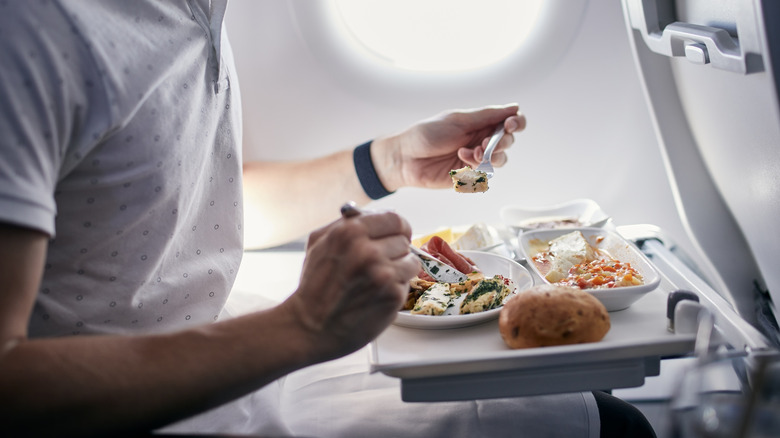
Unless you're flying in the right class aboard the right airline — hopefully one with the best in-flight dining in the world — airplane food rarely makes a good impression. Some in-flight meals are questionable enough to make you wonder where your airplane food came from. And if you pass on your in-flight meal, where exactly does the excess airplane food go? Turns out, excess airline food from international flights doesn't just get tossed in the garbage when a plane lands — it's subject to a country's International Catering Waste (ICW) legislation, established to eliminate any potential disease risks to plants and animals at your destination.
According to the International Air Transport Association's (IATA) risk assessment report on ICW, airline food waste entering the European Union, Canada, Australia, the United Kingdom, and the U.S. from abroad is either incinerated, pressure-sterilized in autoclaves, or buried and disposed of in authorized landfills. In addition to these methods, the U.S. allows waste-grinding into approved sewage systems. And while the U.K. regards a plastic cup that's held any trace of milk outside the EU as a waste product, it does allow the recycling of confectionery, chips, nuts, and drinks without milk — so long as they've been duly separated from other catering waste. Canada maintains the strictest stance among the others, as all materials from international flights arriving in the country must be disposed of, even if they're from the neighboring U.S.
All that airline waste amounted to almost 4 million tons in 2023 and is expected to double by 2040, per the IATA report. Fortunately, food waste from domestic routes has more recycling possibilities. Australian food rescue organization OzHarvest, for example, redistributes uneaten food to local charities from canceled or changed flights from Brisbane Airport. Meanwhile, Cathay Pacific's catering arm, Cathay Dining, is turning food waste into clean energy via an anaerobic digestion process.
When does airplane food expire?
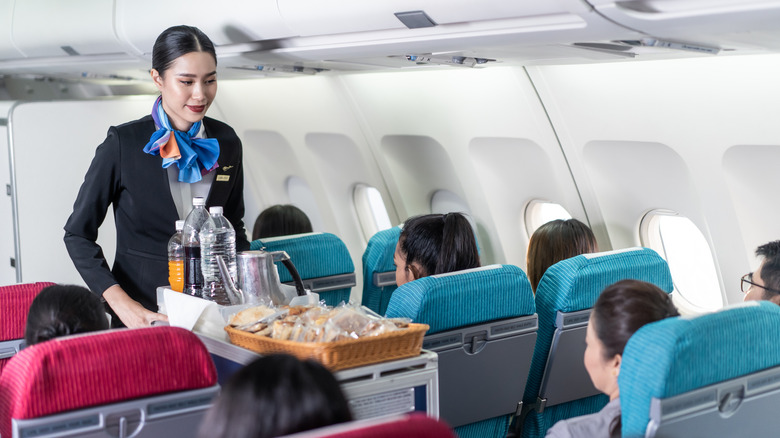
It's no secret that airlines serve packaged and frozen food on flights. Food served on board follows the guidelines set by the airline industry's own adaptation of the Hazard Analysis and Critical Control Point, which was initially developed by NASA and adapted for aviation by the International Flight Services Association (via Airline Routes and Ground Services).
However, don't panic if you happen to catch a glimpse of your airline food's manufacturing date going back a year (or even more). After reaching out to different airline representatives regarding their frozen meals' shelf life, The Points Guy uncovered some surprising details: American Airlines could serve frozen meals up to a maximum of 18 months following its manufacturing date; Delta Airlines quoted a 12-month window from the date of packaging; while United Airlines holds frozen meals for up to 180 days.
But how safe are these frozen food windows? The USDA Food Safety and Inspection Service mentions that as long as frozen food is stored at a constant 0 degrees Fahrenheit, it is safe (although the quality will suffer). This is echoed by Randy Worobo, a Cornell University professor of food safety and microbiology, who shared with The Points Guy that as long as the moisture barriers of the food packaging are intact, "It doesn't represent a safety issue." But if you're feeling iffy about it, maybe pack your own food and snacks — one of the tips flight attendants suggest for surviving ultra-long-haul flights.